#HipsterStudies

PJ Rey just posted a terrific reflection on hipsters and low-tech on this blog, and I just want to briefly respond, prod and disagree a little. This is a topic of great interest to me: I’ve written about low-tech “striving for authenticity” in my essay on The Faux-Vintage Photo, reflected on Instagrammed war photos, the presence of old-timey cameras at Occupy Wall Street, and the IRL Fetish that has people obsessing over “the real” in order to demonstrate just how special and unique they are.

While I appreciate PJ bringing in terrific new theorists to this discussion, linking authenticity and agency with hipsters and technology, I think he focuses too much on the technologies themselves and not enough on the processes of identity; too much on the signified and not where the real action is in our post-modern, consumer society: the signs and signifiers. more...


Since Sarah posted on Kony yesterday, I though I would throw in my two cents on the matter. I would like to discuss claims that the Kony 2012 is a hipster movement.

Why are people claiming the movement against Kony is a hipster movement? I think it is because of three main reasons. 1) people are using social media to spread it; 2) Invisible children plays into the whole Toms shoes, suburban college student social justice movement; and 3) individuals are claiming allegiances to this social justice movement as a form of social distinction. more...

Kurt Anderson, writer, critic, and public intellectual

Kurt Anderson’s recent article in Vanity Fair titled “You Say You Want a Devolution.” contends that the past 20 years have seen a total stagnation in the production of new cultural aesthetics. In other words, the end of the 50s looked nothing like the end of the 70s, but 1989 looks remarkably similar to 2009. Anderson concludes:

We seem to have trapped ourselves in a vicious cycle-economic progress and innovation stagnated, except in information technology; which leads us to embrace the past and turn the present into a pleasantly eclectic for-profit museum; which deprives the cultures of innovation of the fuel they need to conjure genuinely new ideas and forms; which deters radical change, reinforcing the economic (and political) stagnation.

This is concerning, since that means the entirety of our blog is nothing more than the fungal growth sitting upon the neutral technological substrate that we impregnate with decaying cultures of past decades. Tattoos, Facebook, Burning Man, the iPhone, Twitter, sex dolls, wifi, internet memes, reality TV, geek culture, hipsters, video gamesfaux-vintage photographs, and dubstep are all popular topics on our blog, and (along with blogging itself) are products of the last 20 years. Anderson assumes that cultural objects are made possible through technology, but refuses to admit that technologies can also be cultural objects in and of themselves. more...

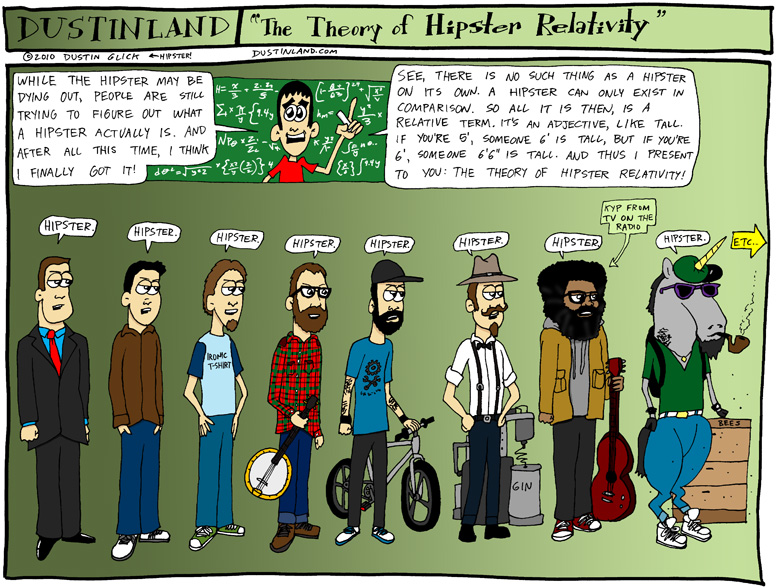
A few of us here at Cyborgology have a running joke going about #HipsterStudies, so I thought I would compile a couple comics that likewise intellectualize this subcultural movement. The first, sent in by reader Letta Wren Page, is a comic by Dustin Glick:

Dustin Glick's "Theory of Hipster Relativity"

This image does a great job illustrating the inherent relativity of the hipster label. That is, as a largely pejorative label, one can only be deemed a hipster by comparison. Much like Thornton (1996) discovered in her study of UK youth raves, where club kids used pejorative labels to denote the bounds of group membership, the hipster as label serves to undermine attempts to mimic subcultural forms (and hence, it serves as a way to deny these actors any semblance of subcultural capital). more...