environment

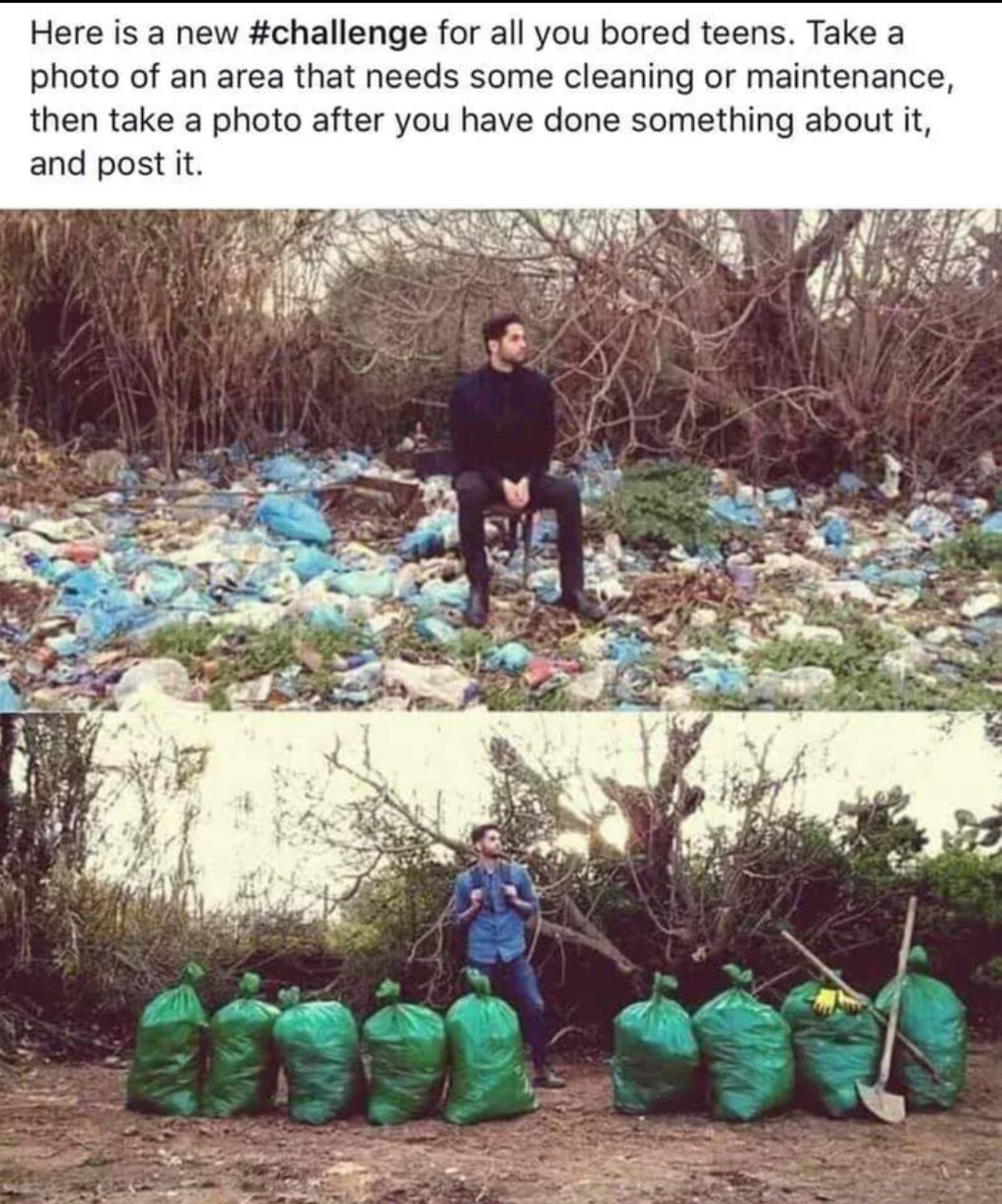
Less than a week ago Byron Román made the above Facebook post challenging “bored teens” to pick up trash and post before and after photos on social media. Reddit user Baxxo24 (Baxxo24 looks to be Swedish while Byron lives in Arizona) took a screenshot and posted it to r/wholesomememes where it went viral. Now #trashtag (“hashtag trashtag?”) is the subject of a dozen or so feel-good human interest stories. It is unclear who the guy in the photo is (It looks like it came from a Guatemalan Travel Agency), but CNN, Washington Post, and CBS News have reported that “trashtag” is a long-dormant social media campaign for UCO Gear, a Seattle-based camping equipment company.

When I started seeing Byron Román’s #trashtag trending on my usual platforms I did what any well-adjusted person would do: I assumed it was as scam and Facebook stalked him until I was convinced otherwise. According to his Facebook profile, Román works in the non-profit home loan industry, mostly in marketing. His latest job helps veterans apply for and receive cheap mortgages. Nothing too dubious there, but it got me thinking about the long and dismal history of littering campaigns’ role in playing cover for corporate interests. more...

14221637039_7d81bd26b4_z

In the 60s there was a movement in engineering and the physical sciences towards building what the British economist E.F. Schumacher called “appropriate technology.” Appropriate technology is sort of what it sounds like: build things that are appropriate to the context in which they are meant to be deployed. If that sounds like common sense to you, then you are benefitting from a minor scientific revolution that occurred in the midst of incredible professional hubris. For quite a while (and still today, as I can personally attest to during my time at a polytechnic institute) scientists and engineers thought that what works in an American lab will work anywhere in the world. Physics is physics no matter where you are and so the underlying mechanical properties of any given technology should work wherever it is situated. Appropriate technology pushed back against that concept, encouraging practitioners to think long and hard about social, economic, political, environmental, and any other context an artifact might find itself in. more...

source
source

I have a secret to tell all of you: I kind of don’t care about teaching evolution in science classes. Put another way, I’m less than convinced that most people, having learned the story of species differentiation and adaptation, go on to live fuller and more meaningful lives. In fact, the way we teach evolution ­­––with a ferocious attention toward competition and struggle in adverse circumstances–– might be detrimental to the encouragement of healthy and happy communities. I also see little reason to trust the medical community writ-large, and I cringe when a well-meaning environmentalist describes their reaction to impending climate change by listing all of the light bulbs and battery-powered cars they bought. I suppose –given my cynical outlook– that the cover story of this month’s National Geographic is speaking to me when it asks “Why Do Many Reasonable People Doubt Science?” Good question: what the hell is wrong with me? more...

Image credit
Image credit

Late Monday night it was discovered that one of the EPA’s Twitter accounts was a C-list celebrity on the popular iPhone game Kim Kardashian: Hollywood. The Tweet was one of those automatically generated ones meant to announce progress in a game or the unlocking of an achievement. Its easy to imagine the scenario: an over-worked or deeply bored social media manager didn’t realize they were signed into their work account instead of their personal one and let the tweet go. Or maybe a family member borrowed their work phone. Who knows? What we do know is that the tweet immediately garnered thousands of retweets and countless more screenshots were shared on other platforms. Why is this even remotely funny? What sorts of publicly held believes does it reveal? more...

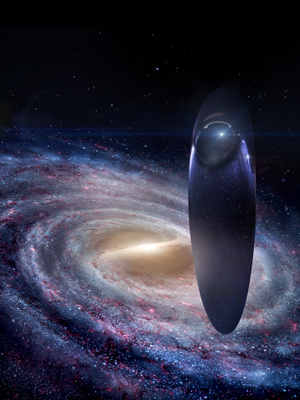
Ship of the Imagination from Fox's rebooted Cosmos with Neil Degrasse Tyson
Ship of the Imagination from Fox’s rebooted Cosmos with Neil Degrasse Tyson

While I was, and still remain, a Beakman’s World partisan, I have fond memories of watching Bill Nye The Science Guy throughout the 90s. It is unfortunate that the just-so-happy-to-be-doing-science character of my childhood has turned into another angry white dude occupying a rectangle on a cable news show. Undoubtable he has a lot to be upset about: not enough Americans agree that the future will be marked by resource scarcity and vastly altered climates and even fewer are convinced that the way we live our lives can’t be sustained. Understandably, many of us (and cable news producers especially) turn to Science Guys like Bill Nye or Neil Degrasse Tyson for answers to society’s most important questions: What is the future going to look like? How can we make it better? Why are so many of us not agreeing on what needs to be done? This impulse is dead wrong.

more...

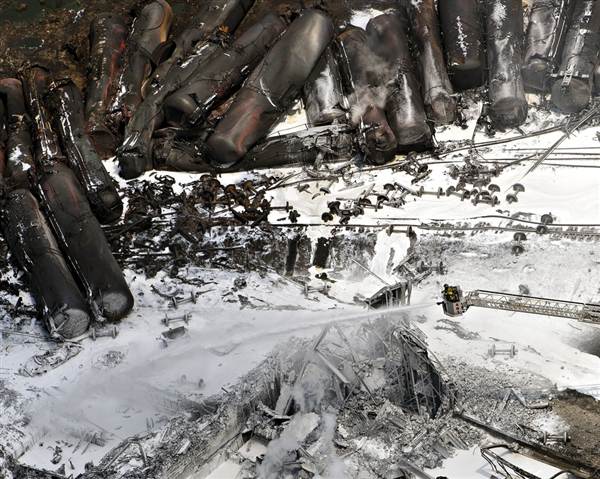
An entire train full of crude oil slides and tumbles 11 miles down hill. Image from NBCNews

One morning, in the seventh grade, my math class was told to prepare for a surprise standardized writing test. A writing test with no warning in math class wasn’t the weirdest thing we had been asked to do. Jeb Bush was our governor and Florida was a proving ground for what would later be called “No Child Left Behind.” Tests were common and testing different kinds of tests were even more common. You never knew if the test you were taking would change your life or never be seen again. This one was a little bit of both. The prompt was really strange, although I don’t remember what it was. As a life-long test taker (my first standardized test was in the 4th grade) you become a sort of connoisseur of writing prompts. This one didn’t seem to test my expository or creative writing skills. It just felt like a demand to write and so we did. We wrote for about half an hour. more...

Photo by: The Fayj

The concept of “risk” comes up a lot in the classes I TA. Usually, it comes up as part of a conversation about acceptable levels of risk for consumer products: How safe should a car be? How much money should we spend on fire safety in homes? If you’re utilizing a cost-benefit analysis that also means calculating the price of a human life. How much is your life worth? These questions are familiar to safety regulators, inspectors, CEOs, and government officials but as private citizens and consumers, we like to think that such questions are sufficiently settled. Cars are as safe as we can make them because human life is incalculably valuable. We won’t be able to know when something bad happens, so it’s better to get sp30 car insurance to avoid disturbing future costs. After all, these sorts of questions sound macabre when we invert the function: How many cars should explode every year? How many jars of peanut butter should have salmonella in them? These questions are largely considered necessary evils in today’s risk-based society, but what kind of society does that create? more...

For the sake of argument, let’s assume that what the scientists are saying about global warming – that we are headed for all manner of catastrophic changes in the environment unless fossil fuel emissions are drastically reduced, immediately – is accurate.

Also for the sake of argument, let’s assume that the world’s political leaders and the citizens they represent are sane, and that, therefore, they would like to avoid those catastrophic changes in the environment.

Assuming both propositions to be true, it would seem reasonable to ask ourselves whether it’s possible to take the necessary actions that would forestall those changes. In order to answer yes to that question we will need to overcome a series of challenges that can collectively be described as technological autonomy.

Technological autonomy is a shorthand way of expressing the idea that our technologies and technological systems have become so ubiquitous, so intertwined, and so powerful that they are no longer in our control. This autonomy is due to the accumulated force of the technologies themselves and also to our utter dependence on them. more...

This is the first of a two-part series dedicated to answering the question “Do we need a new World’s Fair?” It is an honest question that I do not have an answer to. What I aim to do here is share my thoughts on the subject and present historical data on what these sorts of events have done in the past. In the first part, I explore what previous World Fairs have accomplished and what we must certainly avoid. The second part will investigate what a new 21st century fair might look like, and how it would help our economy. Part 2 is here.

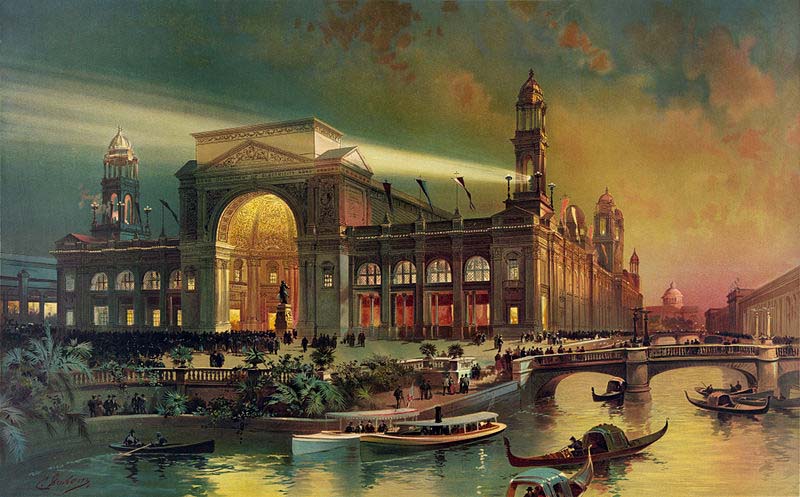
electrical building
By Charles S. Graham (1852–1911). Printed by Winters Art Litho. Co. (Public domain c/o Wikipedia.)

A “World Fair” is first and foremost, a grand gesture. They are typically months if not a few years long. Think of them as temporary theme parks, or the the olympics of technological innovation. They are extravagant, optimistic, and brash. But let’s be clear here. All of the World Fairs held in Paris, Chicago, New York, and Seattle had sections that are deeply troubling. The 19th century fairs had human zoos and “freak shows.” The 20th century fairs were, in many ways, launchpads for the corporate take-over of the public realm and the plundering of the very cities that hosted them (more on that later). But that does not mean the form is totally useless or inherently bad. In fact, a new American World Fair might be just what we need. more...