by
whitneyerinboesel,
Apr 16, 2013, at 07:00 am
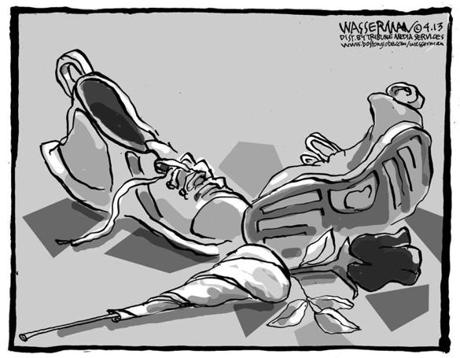
As I write this, it’s 5:00 PM on April 15th, 2013. From my window over Massachusetts Avenue (we call it “Mass Ave”) in Cambridge—which I have open to let in one of the first nice spring days of the year—I can hear waves of sirens from the emergency vehicles that are still moving in response to the two explosions at the Boston Marathon finish line that went off just before 3:00 PM. The Mass Ave bridge between Boston and Cambridge is reportedly closed; large shuttle buses are trying, awkwardly and uncertainly, to make the turn off of Mass Ave onto one of my cross streets. The flags at both Cambridge City Hall and the Cambridge Post Office are still flying high, but I imagine they’ll be at half mast by the time you read this tomorrow. Even tomorrow, this intentional tragedy will still be very recent, very fresh, and very raw.
I’m sad in ways I can’t fully identify or explain, grateful that (so far as I know) everyone I care for here is okay, and—as I said on Twitter—longing for that time in the recent past when all the bombs (“bombs”) in Boston were actually stupid light-up LED pictures of cartoon characters. Somewhere in my disorganized thoughts, I’m also struck by the many ways that both people and institutions are using digital social technologies in response to this attack, and I’m going to try to get a few of those thoughts down here. In particular, I want to focus on the “vine” (short looping video) of one of the explosions that spread throughout my Twitter feed within an hour of the carnage at the finish line. (more…)
by
nathanjurgenson,
Jan 28, 2013, at 09:58 am
Is there a Dunbar’s Number for our documentary consciousness?
Dunbar argued that we can only keep up with about 150 people at a time, at which point we reach a cognitive saturation. Can this similar sort of saturation occur with the proliferation of ways we can document ourselves and others on social media? The ways someone holding a working smartphone can document experience grows not just with the number of sites one can post to, but also the number of available mediums of documentation: audio, video, photo, and their recombinations into things like GIFs and Vines whatever else I’m forgetting or will come next. Each new app carries with it a different audience with different expectations, adding to the documentary chaos.
Or: Given the proliferation of options, how should I document this cat? (more…)
by
whitneyerinboesel,
Aug 6, 2012, at 09:00 am
This is the complete version of a three-part essay that I posted in May, June, and July of this year:
Part I: Distributed Agency and the Myth of Autonomy
Part II: Disclosure (Damned If You Do, Damned If You Don’t)
Part III: Documentary Consciousness

Privacy is not dead, but it does need to change.
Part I: Distributed Agency and the Myth of Autonomy
Last spring at TtW2012, a panel titled “Logging off and Disconnection” considered how and why some people choose to restrict (or even terminate) their participation in digital social life—and in doing so raised the question, is it truly possible to log off? Taken together, the four talks by Jenny Davis (@Jup83), Jessica Roberts (@jessyrob), Laura Portwood-Stacer (@lportwoodstacer), and Jessica Vitak (@jvitak) suggested that, while most people express some degree of ambivalence about social media and other digital social technologies, the majority of digital social technology users find the burdens and anxieties of participating in digital social life to be vastly preferable to the burdens and anxieties that accompany not participating. The implied answer is therefore NO: though whether to use social media and digital social technologies remains a choice (in theory), the choice not to use these technologies is no longer a practicable option for number of people.
In this essay, I first extend the “logging off” argument by considering that it may be technically impossible for anyone, even social media rejecters and abstainers, to disconnect completely from social media and other digital social technologies (to which I will refer throughout simply as ‘digital social technologies’). Consequently, decisions about our presence and participation in digital social life are made not only by us, but also by an expanding network of others. I then examine two prevailing privacy discourses—one championed by journalists and bloggers, the other championed by digital technology companies—to show that, although our connections to digital social technology are out of our hands, we still conceptualize privacy as a matter of individual choice and control. Clinging to the myth of individual autonomy, however, leads us to think about privacy in ways that mask both structural inequality and larger issues of power. Finally, I argue that the reality of inescapable connection and the impossible demands of prevailing privacy discourses have together resulted in what I term documentary consciousness, or the abstracted and internalized reproduction of others’ documentary vision. Documentary consciousness demands impossible disciplinary projects, and as such brings with it a gnawing disquietude; it is not uniformly distributed, but rests most heavily on those for whom (in the words of Foucault) “visibility is a trap.” I close by calling for new ways of thinking about both privacy and autonomy that more accurately reflect the ways power and identity intersect in augmented societies. (more…)
by
whitneyerinboesel,
Jul 19, 2012, at 08:00 am

Documentary consciousness entails the ever-present sense of a looming future failure.
In Part I this essay, I considered the fact that we are always connected to digital social technologies, whether we are connecting through them or not. Because many companies collect what I call second-hand data (data about people other than those from whom the data is collected), whether we leave digital traces is not a decision we can make autonomously. The end result is that we cannot escape being connected to digital social technologies anymore than we can escape society itself.
In Part II, I examined two prevailing privacy discourses to show that, although our connections to digital social technology are out of our hands, we still conceptualize privacy as a matter of individual choice and control. Clinging to the myth of individual autonomy, however, leads us to think about privacy in ways that mask both structural inequalities and larger issues of power.
In this third and final installment, I consider one of the many impacts that follow from being inescapably connected in a society that still masks issues of power and inequality through conceptualizations of ‘privacy’ as an individual choice. I argue that the reality of inescapable connection and the impossible demands of prevailing privacy discourses have together resulted in what I term documentary consciousness, or the abstracted and internalized reproduction of others’ documentary vision. Documentary consciousness demands impossible disciplinary projects, and as such brings with it a gnawing disquietude; it is not uniformly distributed, but rests most heavily on those for whom (in the words of Foucault) “visibility is a trap.” I close by calling for new ways of thinking about both privacy and autonomy that more accurately reflect the ways power and identity intersect in augmented societies. (more…)
by
genemorrow,
Dec 9, 2011, at 06:00 am
This is a video from a talk given by James Bridle, one of the main forces behind the New Aesthetic Blog, about the ways in which he is seeing the collision between machine and human happen, and the transformations which are being brought to by it society.
I have to say that it is pretty phenomenal, and touches on some of the aspects already talked about on this blog. For example Bridle touches briefly on the phenomena of documentary vision, which has been discussed extensively on this site, just after the 30 minute mark of the talk.
While some aspect of a digital dualism is still present in the language of the talk, the references to real as dichotomous with digital (which may be inevitable in trying to talk about these things), I still think that Bridle covers an amazing breadth of ways in which the digital and physical are bleeding into each other and collapsing any reasonable difference between the two. He really highlights, and shows, how humans are developing ways of seeing which are dependent on our technology, on the ways which are machines see. As well as how the machines are developing ways of seeing which are dependent on our own naturalized concepts of vision and perception, they are learning to see like us.
I think this is an important aspect of the entire cyborgology exercise. That we are developing characteristics which are influenced by our machines and technology (and that we always have), and that our technology also develops characteristics which are like us. I think it further breaks down the divide between ‘real’ and ‘virtual’, and shows how person and machine merge into a social space made up of equal parts of both.
All in all it is a really excellent talk, and well worth watching. I felt as though it absolutely needed to be shared here.
by
nathanjurgenson,
Nov 28, 2011, at 11:06 am
I wanted the photo above to be an example of the new so-called “living pictures” that have garnered much recent attention. However, Lytro has not provided proper embedding code so I can only post this screenshot of a living photo. I highly recommend clicking on the photo or clicking here before reading along.
Update: the code now works, so before reading on, click the photo above. Click around various parts of the image and watch the focus change.
Okay, by now you have experienced a living photo. You see it, but you can also make it come alive; touch it, change the focus, reorient what is seen and focused on. Some might even argue that you get to decide the meaning of the story the image tells. This post asks: what would it mean if we start posting living pictures across social media? Might it change how we take photos? How might we differently interact with social media photography when we can manipulate the faces of our friends and engage with the images in a new way?
It has been my contention that photography can teach us quite a bit about social media. Not just because there are so many photos online but because photography serves as a familiar and grounding reference point to the newness of social media. Photography situates the novel and sometimes disorienting ways we are documenting ourselves online with a technology that did the same offline more than a century ago.
I have written about Susan Sontag’s description of photographers being always at once poets and scribes when taking photos to describe how we create our social media profiles in a similar way. I have used the concept of the “camera eye” photographers develop to discuss how social media has imbued us with a similar “documentary vision.” I also described how the explosion of faux-vintage photos taken with Hipstamatic and Instagram serve as a powerful example of how social media has trained us to be nostalgic for the present in a grasp at authenticity.
Here, I want to discuss what many are calling “revolutionary” and the next “big thing” in photography: the so-called living pictures linked to above developed by the Lytro company that have just entered the consumer market with cameras shipping early next year.
Lytro “Living Picture” Technology
This is not an essay so much about the technology but instead the implications of (more…)
by
Nathan Jurgenson &
PJ Rey,
Nov 21, 2011, at 10:16 am

We begin with the assumption that social media expands the opportunity to capture/document/record ourselves and others and therefore has developed in us a sort-of “documentary vision” whereby we increasingly experience the world as a potential social media document. How might my current experience look as a photograph, tweet, or status update? Here, we would like to expand by thinking about what objective reality produces this type of subjective experience. Indeed, we are increasingly breathing an atmosphere of ambient documentation that is more and more likely to capture our thoughts and behaviors.
As this blog often points out, we are increasingly living our lives at the intersection of atoms and bits. Identities, friendships, conversations and a whole range of experience form an augmented reality where each is simultaneously shaped by physical presence and digital information. Information traveling on the backs of bits moves quickly and easily; anchor it to atoms and it is relatively slow and costly. In an augmented reality, information flows back and forth across physicality and digitality, deftly evading spatial and temporal obstacles that otherwise accompany physical presence.
When Egyptians dramatically occupied the physical space of Tahrir Square this past January (more…)
by
PJ Rey,
Nov 17, 2011, at 06:00 am

For nearly two centuries, the term “production” has conjured an image of a worker physically laboring in the factory. Arguably, this image has been supplanted, in recent decades, by office worker typing away on a keyboard; however, both images share certain commonalities. Office work and factory work are both conspicuous—i.e., the worker sees what she is making, be it a physical object or a document. Office work and factory work are also active—i.e., they require the workers’ energy and attention and come at the expense of other possible activities.
The nature of production has undergone a radical change in a ballooning sector of the economy. The paradigmatic images of active workers producing conspicuous objects in the factory and the office have been replaced by the image of Facebook users, leisurely interacting with one another. But before we delve into this new form of productivity we must take a moment to define production itself.
Following Marx, we can say that any activity that results in the creation of value is production of one sort or another. Labor is a form of production specific to humans because human are capable of imagination and intentionality. (more…)
by
PJ Rey,
Nov 14, 2011, at 01:03 pm

A recent Salon.com piece by Bonnie Stewart (a previous Cyborgology contributor) offers an interesting analysis of Klout, the increasingly popular tool for measuring personal value and influence. The Klout site explains:
Our friendships and professional connections have moved online, making influence measurable for the first time in history. When you recommend, share, and create content you impact others. Your Klout Score measures that influence on a scale of 1 to 100.
and
The Klout Score measures influence based on your ability to drive action. Every time you create content or engage you influence others. The Klout Score uses data from social networks in order to measure:
- True Reach: How many people you influence
- Amplification: How much you influence them
- Network Impact: The influence of your network
Stewart criticizes the idea of rationalizing our online interaction (i.e., submitting them to greater efficiency, calculability, predictability, and control). She also notes that Klout is limited in that it fails to measure how our online actions influence (i.e., augment) activity in the offline world. Finally, she discusses how knowledge that Klout exists influences the way people behave online, making them more inclined to act in such a way as to improve their score. Cyborgology editor Nathan Jurgenson recently described this tendency to view our present actions from the perspective of the documents they will eventually produce as “documentary vision.” (more…)
by
Nathan Jurgenson &
PJ Rey,
Nov 1, 2011, at 08:03 am
(Or: How we’ve come to be micro-celebrities online)

Facebook’s recent introduction of “frictionless sharing” is the newest development in a growing trend: data is being increasingly produced passively as individuals conduct their day-to-day activities. This is a trend that has grown both on and offline. We will focus on the former here; especially “frictionless” sharing that involves syncing Facebook with other sites or apps. Once synced, much of what a user listens to, reads or otherwise accesses are automatically and immediately published on Facebook without any further action or approval. Users may not even need to “opt into” frictionless sharing because many services are changing their default setting to automatically push content to Facebook. In short, we can say that users play a passive role in this process.
Contrast this to more active sharing: when we “like” or “+1” something (by clicking the eponymous buttons that have spread throughout the Web) it requires the user to make a conscious and affirmative action to share something with others in their network. Nathan Jurgenson (one of this post’s co-authors) previously described these two models as types of “documentary vision:” We actively document ourselves and our world around us as if we have a camera in our hand (“liking”, status updates, photos, etc.), or we can passively allow ourselves to be documented, curating our behaviors along the way (e.g., reading a magazine article so that you can present yourself as the type of person who “likes” that sort of magazine) much like a celebrity facing a crowd of paparazzi photographers.
Let’s make another layer of complexity to this documentary model (more…)