disability

(Photo: Brendan Smialowski/AFP/Getty Images)

This past weekend I attended Crafting the Long Tomorrow, a conference ostensibly about climate change, though approached through the varied perspectives of scholars working in both the sciences and the humanities. The setting was Biosphere 2, the site of two 1990s experiments to recreate the Earth’s biosphere in a completely sealed environment, under the assumption that humanity would need to evacuate our current planet some time in the future. Throughout the densely packed three days of panels and keynotes, we heard about efforts to measure, curb, combat, and educate on the anthropocentric nature of our impending planetary disaster.

From the outset, there was a relatively awkward divide in the room, though not the disciplinary sort that I would have predicted. Rather, there seemed to be two parallel conferences going on in the same room at the same time: one was being attended and contributed to by individuals who wanted to center identity politics and socio-economic considerations and another by those who did not (or, to be fair, perhaps did not even consider it a possibility). What I found the most striking, however, was that when the former would call out the latter, the critique would be met with an absurd defensiveness. When a respondent to a talk about the first Biosphere 2 experiment pointed out that there was a complete lack of diversity in the all-White participants (the “Biospherians”), another audience member took it upon himself to explain that the experiment was not about diversity among humans, but diversity among plants within the structure. The next morning, when two presenters spoke out about the dearth of people of color within the room, one of the organizers declared that she was made sad by the call-out and didn’t find it fair.

This is not to say that the conference was, in itself, not fruitful. Those talks that did engage with questions of diversity and marginalized communities did so eloquently and with an openness that resulted in compelling discourse. Still, even throughout those talks, not one speaker engaged with questions of physical access, disability studies, or disability rights.

That climate change will affect the most marginalized first and with the most force has been well argued. It is important to recognize the at-risk nature of those for whom the deterioration of our natural world and the systems of infrastructure within means life-or-death situations on an order of magnitude greater than for an abled body. In 2017, for PS Mag, David M. Perry described four different types of ways that disabled individuals might be at-risk during a climate crisis:

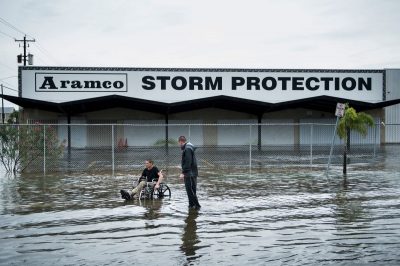
health maintenance (medicine, electricity, medical care), ability to move in and through physical areas, effective communication access, and what the experts call “program access.” Some of these needs are obvious: People who depend on dialysis or oxygen need power. Diabetics need insulin. Chemotherapy patients need hospitals that work, and so forth. A wheelchair user might well not be able to cross flooded areas, climb stairs to escape rising water, or access a shelter. Shelter space might also be inaccessible because messages about locations aren’t communicated in sign language or Braille. Such spaces might be too loud or chaotic for people with sensory integration needs

Perry’s piece provides an excellent overview of the problem and I suggest you read it.

But I also suggest/implore scholars, artists, researchers, and scientists to start centering disability studies within their work on climate change. You might approach it from an infrastructural perspective, extending work of scholars like Cassandra Hartblay, who has argued that “When accessible design elements are installed to meet minimum standards, they are “just for the check mark” and often do not “work.”” This might relate well to research on, for instance, ADA standards and how well they would hold up to the various climate disaster scenarios. Or you might take a more theoretical approach and build on Rosemarie Garland-Thomson’s work on fitting versus misfitting—something we’ve talk about a lot at Theorizing the Web. What happens when the environment shifts so drastically that the fits become the misfits—what do the misfits become?

There is a rich trove of research to be done here and it’s not being addressed on the necessary scale. Let’s do better.

Gabi Schaffzin is a PhD candidate in Art History, Theory, and Criticism, with a concentration in Art Practice, at UC San Diego. The headline of this piece is a shout-out to Annie Elainey’s awesome t-shirt project.
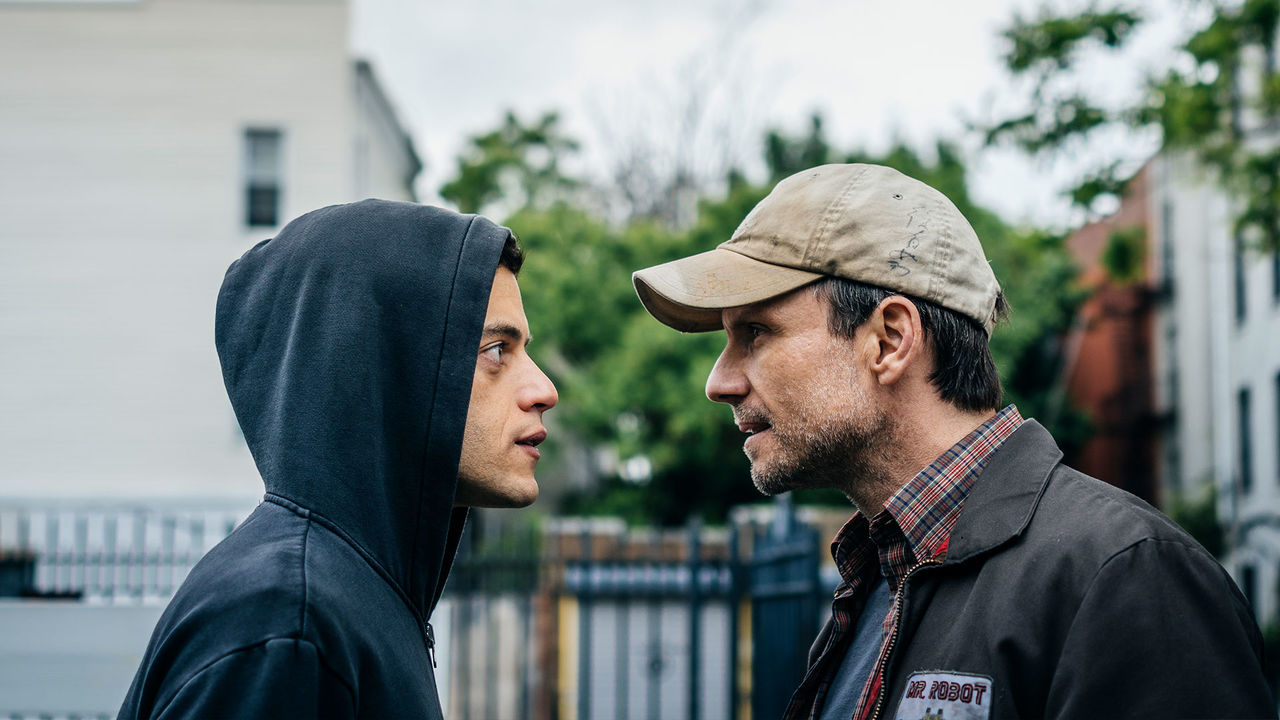
 

robot_s2ep3_elliotrobot

Warning: Major spoilers for Mr. Robot (through s02e06) follow.

********************************************************************************************************* more...

AccessibleIconVector-1
Pic via: The Accessible Icon Project

Let me start by saying, accessibility is a human rights issue, not an afterthought. Frankly, it’s an insult to people with disabilities that access is even a subject of debate. And yet…

The Technology, Equality, and Accessibility in College and Higher Education Act (i.e., the TEACH Act) is currently under debate in congress. The legislation requires that technologies used in college classrooms be accessible to all students, including students with disabilities. It is entirely possible that you have not heard of the TEACH Act, but for those who it most affects—students with bodies that deviate from the norm—the stakes are quite high. The bill has some strong support, but also strong opposition, from surprising sources.   more...

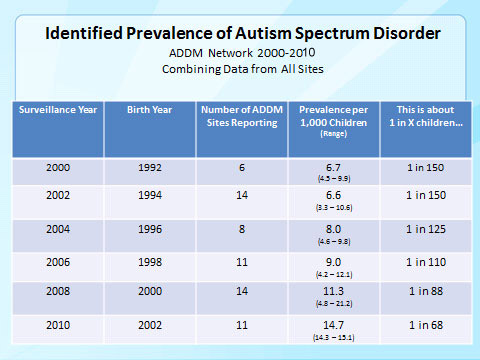
Several months ago, the CDC released a report on Autism Spectrum Disorders (ASD). They found that as of 2010, 1 in every 68 U.S. children are on the ASD spectrum. This is up from 1 in every 150 children just ten years prior. This means that rates have more than doubled. The reasons for the large increase are fodder for some wonderfully interesting conversations and heated debates about biology vs. environment vs. culture vs. the Medical Industrial Complex. Putting these debates aside for another day, however, I instead want to talk about how new technologies can serve this ever growing population. As a quick caveat, I should say that I am a person who dabbles in disability studies research. My hope is that those who know more than I—through personal experience and/or professional expertise—will add nuance to the ideas I present below and help guide the discussion into all of the complex places I know it can go, but don’t quite know how to take it.

autism_data_graphic2012-copy more...

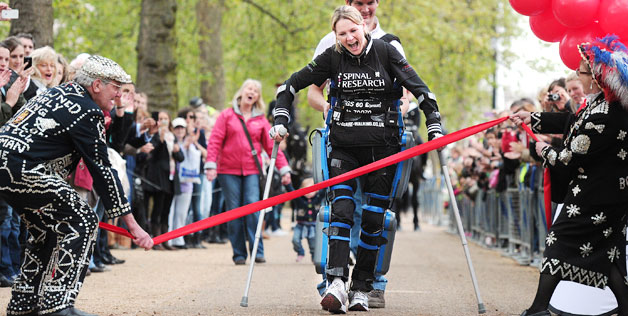
Claire Lomas, promoted by the media as the “Bionic Woman” just made history and sparked inspiration by completing the London Marathon in 16 days.  Averaging about two miles per day, this woman with below-chest paralysis walked her 26.2 miles to finish proudly in 36,000th place. She did so with the help of a ReWalk suit, a supportive family, and the goal of raising money for spinal cord injury research.

The ReWalk suit resembles closely the Ekso suit that I wrote about previously and raises similar questions. They both enable people with spinal cord injuries to stand and walk. They are heralded by the companies as tools to enhance rehabilitation, mobility, and dignity. They also both leave me with the same uncomfortable uncertainty: is this progress or ableism? (See link above for a full delineation of this uncertainty and a lengthy discussion in the comments section). more...


Eksobionics, a company dedicated to the augmentation of the human body, recently developed Ekso—a “bionic exoskeleton that allows wheelchair users to stand and walk.” In this post, I pose a question to which I honestly do not have a definitive answer: Does this development represent human progress or does it further perpetuate the subordination of physically impaired bodies?

I begin with a brief background on the company and a description of the product. I then present arguments for both progress and ableism. Finally, I question —but ultimately defend—the validity of this dichotomy. more...

Photo by Howard Schatz

My post today comes from a class on ableism and disabled bodies that I taught earlier this past semester in my Social Problems course. Its inception came from the point at which I wanted to introduce my students to Donna Haraway’s concept of cyborgs, because I saw some useful connections between one and the other.

My angle was to begin with the idea of able-bodied society’s instinctive, gut-level sense of discomfort and fear regarding disabled bodies, which is outlined in disability studies scholar Fiona Kumari Campbell’s book Contours of Ableism. Briefly, Campbell distinguishes between disableism, which are the set of discriminatory ideas and practices that construct the world in such a way that it favors the able-bodied and marginalizes the disabled, and ableism, which is the set of constructed meanings that set disabled bodies themselves apart as objects of distaste and discomfort. In this sense, disabled bodies are imbued with a kind of queerness – they are Other in the most physical sense, outside and beyond accepted norms, unknown and unknowable, uncontrollable, disturbing in how difficult they are to pin down. Campbell identifies this quality of unknowability and uncontainability as especially, viscerally horrifying.

more...

Crossposted at Sociological Images

I am a huge fan of the television series “It’s Always Sunny in Philadelphia,” but I want to problematize some of the humor we often take for granted in the show. In a recent interview with Conan O’Brien, Charlie Day discusses some of the changes introduced into the current season of the show. Specifically, about 1:30 in, they discuss the weight gain that Rob McElhenney (“Fat Mac”) accomplished in pursuit of a “funnier” character. Notice how Charlie Day and Conan laugh—freely and unapologetically—at the prospect of Mac contracting diabetes (especially Conan’s mocking “Go America!” response to the image of “Fat Mac”): more...

Can an identity have a homepage?

Many have long argued that identity is the result of both  (1) performative work on the part of the individual as well as (2) the influence of society with all of its history, structures, institutions, norms and so on. We do not produce our identities in a vacuum, they are influenced by society. And we do not blindly consume our identities from the options given to us; humans are complex beings who creatively tweak, mix and remix to achieve something always unique. Not just producers or consumers,  it is best to think of ourselves as identity prosumers. Here, we will show how this process is made most explicit when identities are prosumed through social media technologies. more...