I want all of your mind
People turn the TV on, it looks just like a window…
Digital witnesses
What’s the point of even sleeping?
— St. Vincent, “Digital Witness” (2014)
Each day seemingly brings new revelations as to the extent of our Faustian bargain with the purveyors of the digital world in which we find ourselves. Our movements, moods, and monies are tracked with relentless precision, yielding the ability to not only predict future behaviors but to actively direct them. Permissions are sometimes given with pro forma consent, while other times they’re simply baked into the baseline of the shiniest and newest hardware and software alike. Back doors, data breaches, cookies and trackers, smart everything, always-on devices, and so much more — to compare Big Tech to Big Brother is trite by now, even as we might soon look back on the latter as a quaint form of social control.
While data breaches and privacy incursions are very serious and have tangible consequences, debates over user rights and platform regulation barely scratch the surface. Deeper questions about power, autonomy, and what it means to be human still loom, largely uncovered. And when these concerns are even voiced at all they can often seem retrogressive, as if they represent mere longings for a bygone (pre-internet) time when children played outside, politics was honorable, and everyone was a great conversationalist. Despite ostensible consternation when something goes egregiously wrong (like influencing an election, let’s say), the public and political conversation around mass data collection and its commercialization never goes far enough: why do so many seemingly reasonable and critical people accept a surveillance-for-profit economy (with all of us as the primary commodity) as tolerable at all? more...
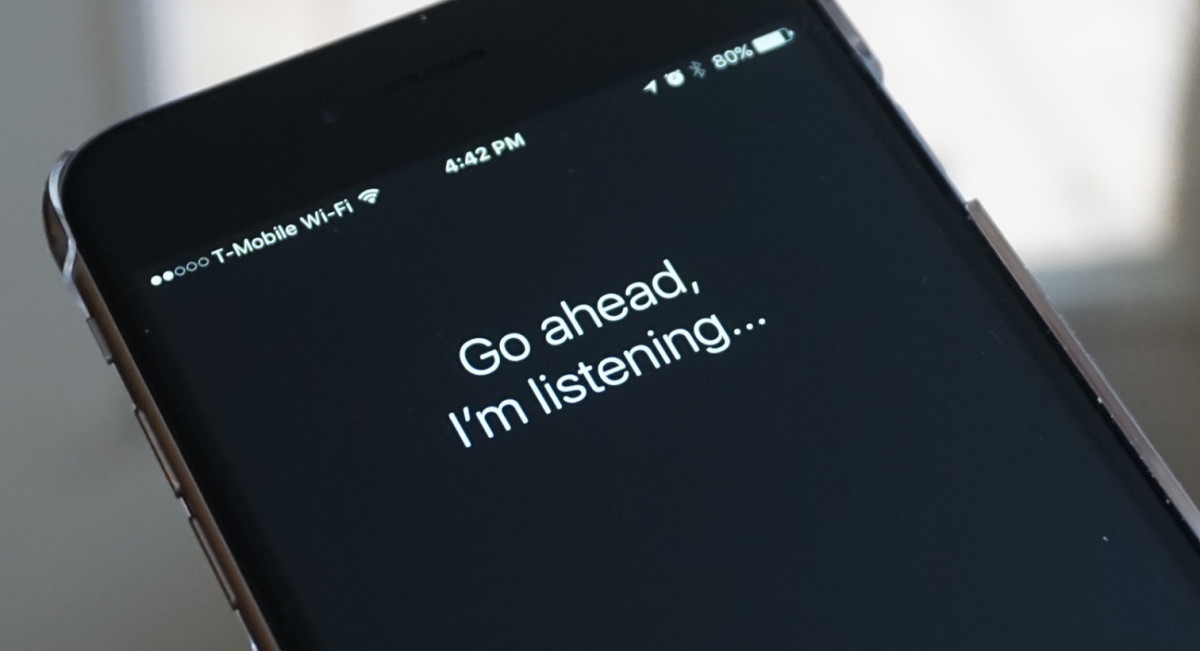
I recently updated my mac’s operating system. The new OS, named Sierra, has a few new features that I was excited to try but the biggest one was the ability to use Siri to search my files and launch applications. Sierra was bringing me one step closer to the human-computer interaction fantasy that was set up for me at an early age when I watched Picard, La Forge, and Data solve a complicated problem with the ship’s computer. In those scenes they’d ask fairly complicated questions, ask follow-up questions with pronouns and prepositions that referenced the first question, and finish their 24th century Googling session with some plain language query like “anything else?” Judging by the demo I had seen on the Apple website it seemed like I could have just that conversation. I clicked the waveform icon, saw the window pop up indicating that my very own ship’s computer was listening and… nothing.
The problem wasn’t with Siri, it was with me. I had frozen. It was as if a rainbow spinning beach ball was stuck in my mouth. I was unable to complete a simple sentence. I closed the window and tried again:
Show me files that I created on… Damnit
Sorry I did not get that.
Show me files from… That I made on Friday.
Here are some of the files you created on Friday.
In all honesty, I should have seen this coming. I frequently use Siri to set reminders or to put things in my calendar but I always use my digital assistant in secret: the moment between getting in the car and starting the engine, alone at my desk, or (sorry) while I am using the bathroom. It works almost every time but when something goes wrong, it is my commands not Siri’s execution, that is left wanting. I pause because I forget the name of the place I need directions to or I stumble when it comes to saying exactly what reminder I want to set. There are several Siri-dictated reminders sitting in my phone right now that don’t want me to forget to “bring it back with you before you go” or “to write email in the morning.” I clam up when I know my devices are listening.
It gets worse when other humans are listening to my awkward commands. The thought of talking to an algorithm in the presence of fellow humans is about as enticing to me as reciting a poem I wrote in high school or explaining a joke that just fell flat. Here I was thinking it was the technology that had to catch up to my cyborg dreams but now it seems that the flesh is the half not willing. more...
It feels good / To know that you really care
It feels good / To know that I can relax when I’m with you
It feels good / To know that I can be by your side
– “Feels Good” – TONY! TONI! TONE!
Some time ago, absentmindedly tweeting about the woeful state of higher education, I received a notification that one of my tweets was liked. This being somewhat rare, I excitedly went to check out who it was from, only to find that it was one of the institutions I was directly critiquing. If they had actually read the tweets I’m sure they wouldn’t have actually ‘liked’ them, so what gives?
This isn’t the first time something like this has happened to me. Periodically, as I’m sure many of us do, I get likes, follows, and retweets that seem incongruous with the content of my posts. Some are a result of Twitter users actively seeking to aggregate info, gain followers, and increase their social media presence. Others are fully automated Twitter bots.
Twitter bots, for the uninitiated, are pieces of software that use automated scripts to crawl the Twitterverse in search of particular words or phrases, to follow, like, or retweet others. In 2014 Twitter revealed that as many as 8.5% of its active accounts were likely bots. Beyond mere annoyance at the lack of a human interlocutor behind a ‘like’ or ‘follow,’ however, why care about the presence of Twitter bots or the use of algorithms to harness the power of social media?
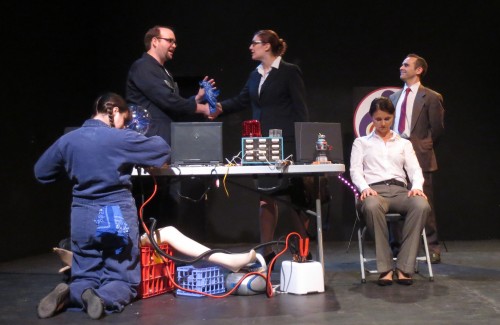
R.U.X. (Rockwell Universal Sexbots), written by Maurice Martin and directed by Sun King Davis, was first written and performed as a charity effort to raise money for HIPS (Helping Individual Prostitutes Survive); it ran as a five-part serial in Arlington’s October 2011 Hope Operas. It was rewritten as a full play for DC’s 2012 Fringe Festival, where it took the award for best comedy. The show just finished up a brief encore at Fall Fringe. While this comedy has already been widely and positively reviewed by DC theater critics, it deserves a piece that engages its rather weighty themes.
The story takes place in near-future America (similar in setting to the spate of early twenty aughts robot films such as Bicentennial Man, A.I., and I, Robot), where anthropomorphic robots have become a common consumer product. Louis Rockwell Jr. (John Tweel) has just been made acting CEO of the Rockwell Universal Carebots company, after his father (Frank Mancino) fell into a coma. Louis Jr. has a new vision that would transition the company away from producing robots designed for childcare and, instead, move it into designing robots for—you guessed it—sex. After rebranding the company “Rockwell Universal Sexbots,” he hires Dr. Callie Veru (Aubri O’Connor), a young and romantically inexperienced software expert to program the robots with the capacity to fulfill human desire. To program robots to respond to human desire, however, the characters must first understand it, and this interrogation of human desire becomes the axis on which the entire plot rotates. more...
What do people want? As it turns out, it depends on how the question is asked. At SXSW this year, NetBase.com presented a social media analysis of expressed desire. Specifically, they analyzed 365 days of 27 million status updates that begin with the words “I want.” Recently, they followed up with a Harris survey in which they asked 2,000 participants (1,000 men and 1,000 women) “What is the one thing you want right now? Be as specific as possible.” Unsurprisingly, the results varied dramatically. First, check out the infographic, then keep reading for my analysis. more...
This is part of a series of posts highlighting the Theorizing the Web conference, April 14th, 2012 at the University of Maryland (inside the D.C. beltway). See the conference website for information as well as event registration.
At this year’s Theorizing the Web, we are pleased to announce a lunch time short-film screening of the techno-queer-romantic-comedy “Over&Out” (2012). The film runs less than 30 minutes. Register here for free lunch & a movie.
We will also have the film’s writer, Kelsey Brannan, available all day for questions, comments, and/or chit-chat after the screening. Brannan, who wrote the film while getting her bachelor’s from UC Santa Barbara, is currently getting her master’s in Culture, Communications, and Technology from Georgetown University. In her own words more...
About Cyborgology
We live in a cyborg society. Technology has infiltrated the most fundamental aspects of our lives: social organization, the body, even our self-concepts. This blog chronicles our new, augmented reality.