death

harambe

On May 28th, 2016 a three-year-old black boy fell into the gorilla enclosure at the Cincinnati Zoo.  As a result a 17-year-old gorilla inside the pen, Harambe, was shot, as the zoo argued, for the boy’s protection. Nearly three months later, on August 22nd the director of the zoo, Thane Maynard, issued a plea for an end to the ‘memeification’ of Harambe, stating, “We are not amused by the memes, petitions and signs about Harambe…Our zoo family is still healing, and the constant mention of Harambe makes moving forward more difficult for us.” By the end of October, however, despite turgid proclamations to the contrary, the use of Harambe seems to be waning.

The six-month interim marked a significant transition in the media presence of Harambe, from symbol of public uproar and cross-species sympathy to widely memed Internet joke. The death and affective trajectory of Harambe, therefore, represents a unique vector in analyzing intersections of animality, race, and the phenomenon of virality. Harambe, like Cecil the Lion before him, became a widely appropriated Internet cause, one with fraught ethical implications.


more...

antigone-july2013There’s a song from the musical Avenue Q that famously proclaims, “The Internet is For Porn”—but really, anyone who’s been paying attention to the post-“Web 2.0” era knows that isn’t true.

These days, the Internet is for cats.

Furthermore, I propose this corollary: Smartphones are for documenting cats. Whether through T. gondii or through their unrivaled documentability, cats actually rule the world. Cat people know this, and anyone who’s ever spent time with cats knows that cats know this. Rewrite the song: The Internet is For Cats.

My cat, however, is not a fan of the Internet. more...

Ticker1

The Quantified Self is defined—in the tagline of the movement’s website—as self -knowledge through numbers.  With the example of the Tikker “Happiness Watch” (also known as the Death Watch) I argue for the primacy of self-knowledge within the movement, and the subservient role of numbers. more...

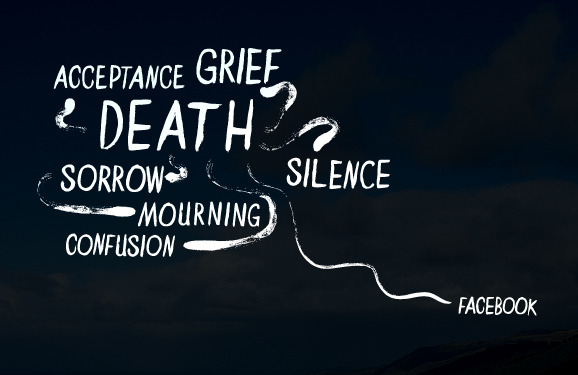
death-and-facebook

Hello, Cyborgology…it’s been a while. I’ve missed you, but I haven’t quite known what to say. Which is weird, right? Strangely enough, I’ve got half a dozen half-finished posts on my computer—twenty-thousand someodd words of awkward silence waiting to be wrapped up and brought into the world.

Writer’s block happens to the best of us, or so I’m told. What’s been strange for me is looking back and realizing that the last thing I posted was my piece from the beginning of #ir14, the 14th Annual Conference of the Association of Internet Researchers. I say “strange” because I had an amazing experience at #ir14, and left it feeling so excited about my field and my work and what I imagine to be possible. And yet, in the two months since, something’s been off. I’ve managed to submit to a couple of important abstracts, and I continued sitting in on a really cool seminar, and I’ve plunged into the work of helping to organize this year’s Theorizing the Web (a conference about which I’m passionate, to say the least). But my words went somewhere, have been gone.

I realized recently, however, that it’s not about some kind of post-#ir14 crash. It’s actually about what happened after.

more...

Image credit:
Image credit: ~Ninetailsgal on deviantART

Russian Internet giant Yandex posted a press statement on July 25th about the death of their co-founder Ilya Segalovich. Segalovich, 48 years old and a father of four, was a billionaire and a philanthropist, loved by many for his kindness and hard work to better the Russian Internet and software development field. He reportedly had stomach cancer and had been ill for some time.

News of his death quickly went viral – it was shared on Twitter, Facebook, and many news websites. But hours later, Yandex retracted the press-release to say Segalovich was not actually dead, but was in a coma & on life support, with no signs of brain activity.

Flabbergasted, RuNet users exploded in a new wave of discussion: was Segalovich dead or not?

All this has me thinking about how modern medicine, science, technology and media are changing the conventions of reporting on the deaths of public figures: when is someone really dead? more...

In each of the past two Theorizing the Web conferences, I have been present to see an audience member—concerned about the fleeting popularity of online platforms and rapid technological development— question the pervasive use of Facebook as a study site. This is an important question, and one to which panelists (including myself) have not adequately responded.  Absent the pressure of probing eyes and a ticking clock, I work here to craft the kind of response that the question deserves.

more...

Taken from my News Feed

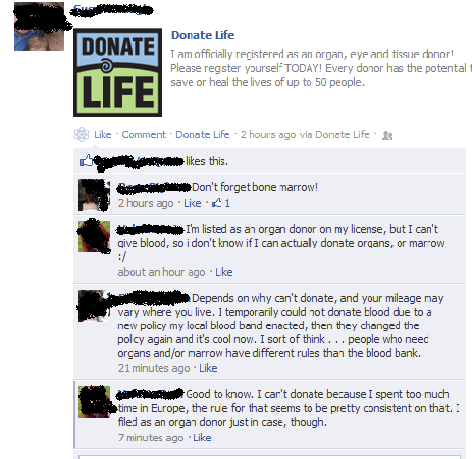
It was the first year of the new millennium, and at 16 years old, I bared my metal-clad teeth in a proud smile for what would be an appropriately hideous driver’s license photograph. On this momentous day in my young life, I volunteered to be an organ donor.  My status as an organ donor is not something that I often talk about—mostly because it is not something I often think about. In fact, I often forget that I am an organ donor until someone makes a verbal note about it while looking at my (updated but still appropriately hideous) driver’s license picture, at which point I silently congratulate myself, and seamlessly forget until the next time. In theoretical terms, my organ donor status is not a salient part of my identity and it is rarely an attribute through which others interact with me. This is about to change. more...

Last week, Cyborgology editors Nathan Jurgenson and PJ Rey were on WYPR (Baltimore’s NPR affiliate) talking about death and dying on Facebook. This is part of the conversation, the rest will be aired in the near future.

Click here to listen to the audio.

Society today exists within a level of technology greater than the human race has ever experienced. If the idea that “we live in public” with digital media remains true, it is then equally true that we even die in the public sphere. This assertion thus substantially modifies the relationship between the living and the dead; specifically regarding the mechanisms of mourning. In other words, as danah boyd states, “we are all authors of our digital biographies”; we are supposed to be also authors of our own tombstones.

The digital space provides an advancement in the modern dichotomy theorized by Baudrillard regarding the separation of the city as a place of the living and the cemetery as a place of the dead. He argues that what is typical in the Western Hemisphere is that the city and the cemetery must necessarily remain separated and distant to legitimize a taboo of death. The cemetery is demonstrated to be a place of segregation; a ghetto. more...

YouTube Preview Image

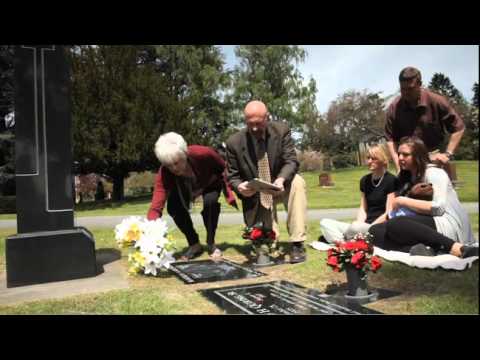
A company called Quiring Monuments has recently begun marketing augmented tombstones that are designed to assist smartphone-carrying visitors in accessing digital information about the deceased.  On these tombstones, qr codes are given the kind of prominence once exclusively reserved for a person’s name, dates, and epitaph.  The qr codes link users to individualized sites that contain information about the person being memorialized.  This means that part of the memorializing process now includes constructing an enduring Web presence for the deceased.

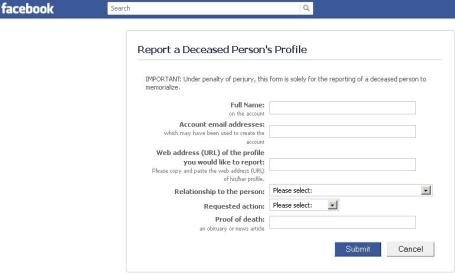
This raises a few questions.  How important to the memorializing process is being in the physical presence of a the body?  Will crystallized bits of memory in cyberspace deepen, or even eclipse, the memorial experience found in physical graveyards?  Facebook has already adopted a policy for memorializing accounts (also discussed in the official blog).  Are graveyards becoming redundant?

For more, see Bellamy Pailthorp’s NPR story, “Technology Brings Digital Memories To Grave Sites.”