
cultural criticism

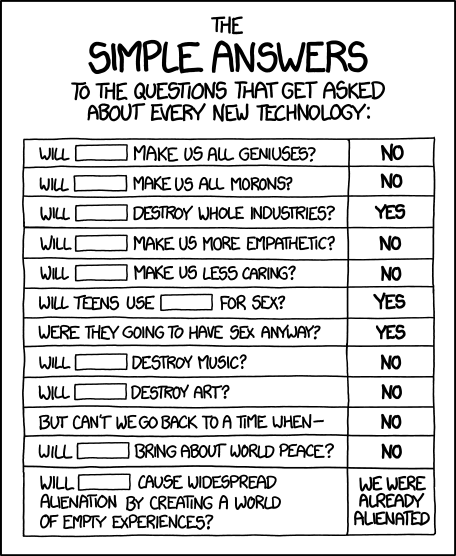
After seeing today’s XKCD (above) I sort of wish I had written all of my digital dualism posts as an easy-to-read table.  I generally agree with everything on there (more on that later), but I’m also pretty confused as to how Randall Munroe got to those conclusions given some of his past comics. I can’t square the message of this table with the rest of Monroe’s work that has maligned the social sciences as having no access to The Way Things Are. The table is funny specifically because the social scientists he pokes fun of, did a lot of work to make those answers plainly (painfully?) obvious. How does someone with an obvious resentment for the social sciences, also make a joke about how we were always already alienated?  more...
Below is Part 3 of a three part essay (Part 1 is available here; Part 2 is available here) I will be presenting at the 2012 Southwest Texas Popular Culture Association meetings in Albuquerque, New Mexico on February 9th. I will be presenting alongside several other scholars for a series of panels titled “The Apocalypse in Popular Culture.” A (much) earlier version of this paper can be found on the Sociological Images sister blog. Part 3 discusses the “Zombie Renaissance” after 9/11 and concludes briefly on the importance of the zombie as a cultural artefact.
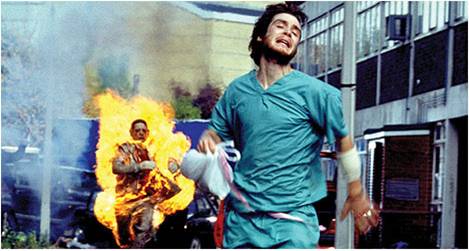
Jim being pursued by a feral "rage"-infected zombie in Boyle's now classic film 28 Days Later (2002).
Scholars have called the post-9/11 era the “Zombie Renaissance” due to the torrent of zombie films produced at this time and the paradigmatic changes introduced to the zombie as movie monster (Bishop 2010). The first blockbuster film of this era, Danny Boyle’s 28 Days Later (2002) is often credited to raising the stakes in zombie films. This film became a powerful drama oriented around the zombie apocalypse, something that has since been mimicked in recent films and especially in AMC’s recent television series The Walking Dead. more...