Conservative

Thiel - Girard

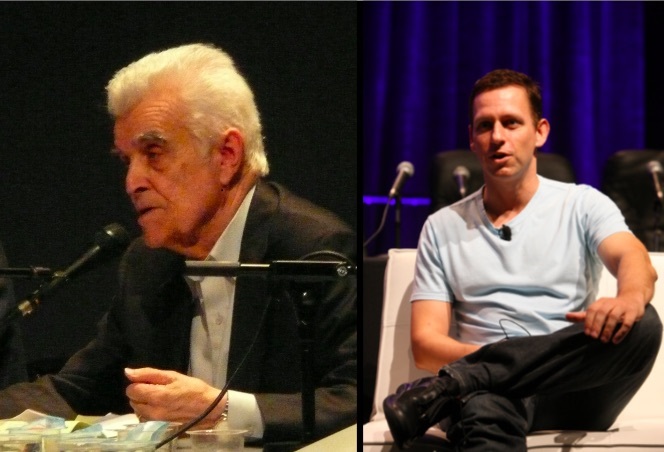
During the week of July 12, 2004, a group of scholars gathered at Stanford University, as one participant reported, “to discuss current affairs in a leisurely way with [Stanford emeritus professor] René Girard.” The proceedings were later published as the book Politics and Apocalypse. At first glance, the symposium resembled many others held at American universities in the early 2000s: the talks proceeded from the premise that “the events of Sept. 11, 2001 demand a reexamination of the foundations of modern politics.” The speakers enlisted various theoretical perspectives to facilitate that reexamination, with a focus on how the religious concept of apocalypse might illuminate the secular crisis of the post-9/11 world.

As one examines the list of participants, one name stands out: Peter Thiel, not, like the rest, a university professor, but (at the time) the President of Clarium Capital. In 2011, the New Yorker called Thiel “the world’s most successful technology investor”; he has also been described, admiringly, as a “philosopher-CEO.” More recently, Thiel has been at the center of a media firestorm for his role in bankrolling Hulk Hogan’s lawsuit against Gawker, which outed Thiel as gay in 2007 and whose journalists he has described as “terrorists.” He has also garnered some headlines for standing as a delegate for Donald Trump, whose strongman populism seems an odd fit for Thiel’s highbrow libertarianism; he recently reinforced his support for Trump with a speech at the Republican National Convention. Both episodes reflect Thiel’s longstanding conviction that Silicon Valley entrepreneurs should use their wealth to exercise power and reshape society. But to what ends? Thiel’s participation in the 2004 Stanford symposium offers some clues.    more...

16024515689_3cc1be05a2_z

Sherry Turkle has been very successful lately. She is still touring the country giving high-profile talks and her best-selling books are assigned in college classrooms all across the country. The quotes on her books’ dustjackets are from respected authors and thinkers. She is a senior faculty member at an elite east coast university. She is by all accounts someone with an ostensibly left-of-center perspective that is popular while still pushing audiences to consider the ramifications of their actions. Turkle, through her critical analysis of social media and portable digital devices, wants people to think twice about the unintended consequences of their actions; how individual choices often aggregate into undesirable interpersonal dynamics. This is important work worthy of public debate but, precisely because it is so important, it is worth asking who benefits from Turkle’s particular brand of mindfulness.

Critiques of Turkle are too few, but the ones that exist are spot on. Focusing on individuals’ technology use, according to Nathan Jurgenson, not only turns the subjects of Turkle’s analysis into broken subhumans, it also gives the reader the opportunity to feel superior simply by fretting over when and how a device comes out of their pocket. Her work also misses, according to Zeynep Tufeci and Alexandra Samuel all the ways social media is a way of reclaiming some form of sociality in a world dominated by televisions, the suburbs, long work hours, and life circumstances that geographically separate us. Taken together we might understand the shortcomings of Turkle’s work as primarily one of digital dualism, i.e. that she considers non-mediated, in-person interaction as inherently more real or authentic compared to anything done through digital networks. What has been left unsaid, and what I want to focus on here, is how Turkle contradicts herself and, in so doing, reveals a bias toward authority and socially conservative political institutions. Turkle selectively deploys her analysis in such a way that traditional sources of authority are left unchallenged. more...

Image credit
Image credit

Late Monday night it was discovered that one of the EPA’s Twitter accounts was a C-list celebrity on the popular iPhone game Kim Kardashian: Hollywood. The Tweet was one of those automatically generated ones meant to announce progress in a game or the unlocking of an achievement. Its easy to imagine the scenario: an over-worked or deeply bored social media manager didn’t realize they were signed into their work account instead of their personal one and let the tweet go. Or maybe a family member borrowed their work phone. Who knows? What we do know is that the tweet immediately garnered thousands of retweets and countless more screenshots were shared on other platforms. Why is this even remotely funny? What sorts of publicly held believes does it reveal? more...

A digital heap.
A digital heap.

In a previous post for Cyborgology, I attempted to take what has been called “digital dualism” and repackage it into a slightly new shape—one that would bring into focus what I considered to be the concept’s most significant features. Specifically, I posited that digital dualism should be understood to include—and be limited to—any instance where a speaker establishes a normatively-charged hierarchy of ontological categories, at least one of which is technological. Thus, were a speaker to carve up the world into the “digital” and the “physical” while suggesting the former is somehow ontologically inferior to the latter (or vice versa), she would be instantiating digital dualism, as I defined it.

I next sought to situate digital dualism within a broader set of views that I characterized as “conservative.” Conservatism, I argued, is a cluster of ideologies unified by an effort to justify and further social hierarchy. I argued that ontological hierarchy of the sort that characterizes digital dualism often plays an instrumental role in the conservative project, as it serves to legitimate perceived differences in status. (For more exposition of this point, see my previous Cyborgology post). Indeed, I contend that digital dualism is very often deployed for conservative ends by those who seek to elevate themselves above technophillic masses.

If one accepts these premises, it becomes possible to formulate generalized strategies for critique, beginning with contestations of (conservative) digital dualism and then abstracting to arguments that might be directed against other conservative ideologies that rest upon hierarchical ontologies.

more...

original

It is pretty easy to mistake most technologies as politically neutral. For example, there is nothing inherently radical or conservative about a hammer. Washing machines don’t necessarily impose capitalism on whoever uses one, and televisions have nothing to do with communism. You might hear about communism through television, and there is certainly no shortage of politically motivated programming out there, but you’d be hard-pressed to find someone that says the technology itself has a certain kind of politics. This sort of thinking (combined with other everyday non-actions) is what philosopher of technology Langdon Winner (@langdonw) calls technological somnambulism: the tendency of most people to, “willingly sleepwalk through the process of reconstituting the conditions of human existence.” It is difficult to see the politics in technology because those politics are so pervasive. The fact that technological artifacts have politics is kind of like Call Me Maybe, once you’re exposed, it is hard to get it out of your head. more...

The result of a Google Image search for “High Tech” What the hell could this possibly mean? Image c/o Small Business Trends

If you live in the United States and have been adjacent to something with the news on it, you have probably heard of the “Fiscal Cliff.” The fiscal cliff refers to several major tax breaks and earned benefit compensation programs that were set to expire at the end of 2012 unless Congress raised the debt ceiling. One of the few good things to come out of this manufactured crisis was some excellent reporting on the power of metaphor in politics. The ability to spur action and drive public opinion while offering next-to-no information demonstrates the awesome power of metaphors. Most people did not know why we were falling off the cliff, what the cliff was made of, or what the consequences for falling would be. Slate’s Lexicon Valley covered this phenomenon in an episode last month titled  “Good is Up.” Co-hosts Mike Vuolo and Bob Garfield dissected the cliff metaphor using the classic book, Metaphors We Live By (1980) by George Lakoff and Mark Johnson. Vuolo and Garfield note, “‘Success is rising’ and ‘failing is falling.’ Lakoff believes these primal, spatial metaphors form what he calls a ‘neural cascade’ that he says is ‘so tightly integrated and so natural that we barely notice them, if we notice them at all.'” In short, we might not understand what goes into creating or averting the fiscal cliff, but we know it should be avoided. Going down is bad, and staying up is good. The episode got me thinking about similar spatial metaphors and the work they do in our augmented society. One of the more ubiquitous metaphors is “high tech.” Is high tech “good” technology? Or is it high in the same way the Anglican Church uses the word; steeped in conservative traditions and formal code?  more...

Many have linked political conservatism with “the authoritarian personality,” which, in part, involves the willingness to view power structures as legitimate, less reluctance to submit to those in authority over you, and an increased tendency to exercise authority over the less powerful. Social media is often seen as counter-authoritarian, however, we also have good evidence that the Web in general, and social media in particular, also replicates existing power structures.

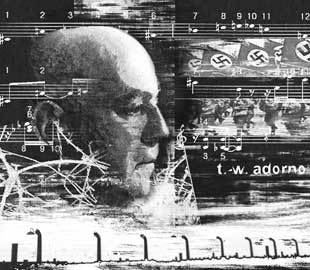
With these different concerns in mind, we might wonder if those with different political orientations use social media for politics in different ways. More specifically, are those on the right, even in a social media environment that permits more expression, voice, and creativity, more likely to submit and follow? Theodore Adorno, pictured above and pioneered work in this line of thought, I think, would predict that Republicans would be more passive, more likely to listen and restate, whereas those on the left would be a bit more likely to create new content.

I post these very brief thoughts (certainly much more would be needed to substantiate the sweeping claims I just made above; this is only a short blog post!) because The Pew Internet in American Life Project just today released some new findings on Social Media and Political Engagement [pdf]. Here are most of the findings:  more...

Fry on Fry Love

Chick-fil-A has delicious waffle fries. So delicious. But before getting in to the content of this post, I should locate myself by stating that I have not purchased anything from this company in over a year, and I will never consume those warm checkered squares of potato-y goodness again.  The reason for this (in case anyone has been living under a rock/in a dissertation shaped bubble) is that the company explicitly opposes same-sex marriage. I am explicitly anti-bigotry, and so I do not purchase food from Chick-fil-A

Okay, now I can theorize. more...

"For Trayvon Martin" mural by "Israel" in Third Ward Houston. Photo taken by Jenni Mueller.


On February 26, 2012 Trayvon Martin, a Black, 17 a year old, unarmed, high school student, was shot and killed by George Zimmerman, a White Hispanic man acting in the self-appointed position of neighborhood watch captain (click here for more details).

The case has become a symbolic battle ground for two important issues: gun laws and racism. Although both of these issues are inextricably entwined, for purposes of simplicity, I will focus here only on the issue of race.

As Jessie Daniels importantly points out on Racism Review, battles over racism have shifted into the realm of social media, where digital and physical race relations persist in an augmented relationship. We see this in both the progressive anti-racist discourses, and the racial smear campaigns surrounding the Martin/Zimmerman case.

Although it is important to expose the overtly racist tactics utilized by some of Zimmerman’s defenders—of which there are plenty—I want to talk here about a more subtle, and so perhaps more problematic form of racial discourse. Specifically, I will talk about how a prominent strategy of protest—coming out of the liberal left—may inadvertently perpetuate, rather than challenge, racial hierarchies in their most dehumanizing form. more...