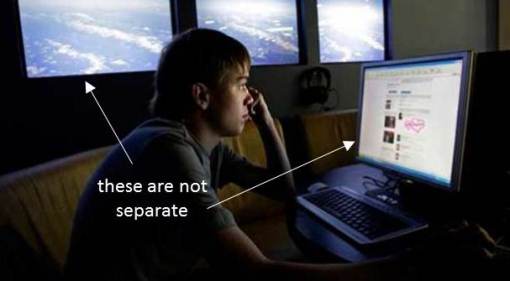
connection

Image credit
Image credit

What does it mean to have access to the internet? It’s an apparently simple question that gets complicated when we consider the wide variety of ways people access the web and products from the web. Indeed, the question is wrapped up in recent debates about zero rating, net neutrality, “the next billion” and numerous initiatives designed to bring people from the developing world online.

At Theorizing the Web this year, I presented research that combined my fieldwork and personal observations in developing world internet contexts like rural northern Uganda, urban China and rural Philippines with emergent research and journalism on the use of sneakernets–the physical transfer of data using devices like USB sticks or Bluetooth-enabled mobile phones–in places like Mali, North Korea and Cuba. These latter formed the basis for my talk and a recent paper in The New Inquiry, in which I draw from Jan Chipchase’s writing on binary thinking about connectivity and how this ultimately overlooks the vast diversity of ways that people do access the web and its products. more...

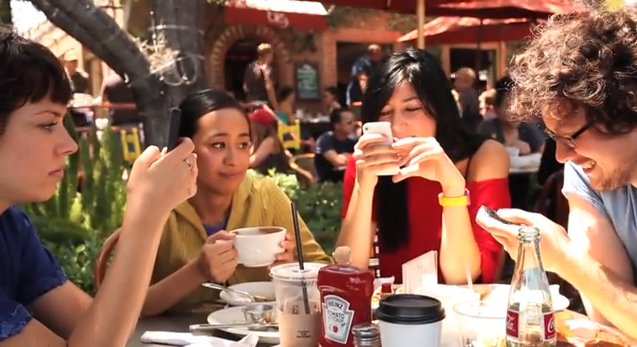
This was a lead image in a story from the New York Times titled, “Your Phone Versus Your Heart“. Let’s break this image down, shall we?

Becoming a parent has inflected how I see everything in the world, including the practice of “being online.” I apologize for using scare quotes so soon into this essay, but it feels necessary. “Online” contains several types of possible connection, as Jenny Davis and others at Cyborgology have argued. And the “being” part is what needs to be at stake: how does the way in which we exist change when that existence is networked and distributed? The anthropology of “being online” therefore includes a consideration of the ontological effects on people as much as empirically measurable effects of using iPads and Facebook.

A common narrative, and one Cyborgology has consistently disputed, is that “technology” or “social media” or “the digital” have impinged on an authentic mode of life that previously existed and which we retroactively call “offline.” This narrative relies on constructing images that can quickly code as “authentic,” as in this video that Nathan Jurgenson has dissected. The graphic above, from a New York Times essay, crystallizes this narrative as it makes us of family and child-rearing as an icon of authentic offline living. Devices and the information they present come between a parent and the child. They blot out the child’s pleading face. Tellingly, the phone is represented as blank–the viewer is not asked to make a judgment about the value of what the person is doing with the phone (checking Twitter? responding to an email? calling 911?), they are asked to condemn its vacuity. more...

or just get new friends
…or just get new friends?

The easiest, laziest, most click-baitiest op-ed, trend video, or thing to scream at a bar right now is how, with today’s technologies, we are more connected but also more alone. Ooh. Zuckerberg has 500 million friends but it was never really a spoiler to say that Sorkin’s The Social Network ends with him sitting alone at a computer. Ooh. The Turkle-esque irony is just too good for it not to zeitgeist all over the place.

That argument should not be altogether dismissed but I am quite skeptical of where it’s so often coming from and how it’s articulated. This trend might be largely disingenuous, and by that I do not mean intentionally insincere but instead a sort of cultural positioning: we-are-connected-but-alone not only drips with that delicious ironic juxtaposition, it simultaneously props the person making the case as being somehow deeper, more human, more in touch with others and experience. more...

This is the complete version of a three-part essay that I posted in May, June, and July of this year:
Part I: Distributed Agency and the Myth of Autonomy
Part II: Disclosure (Damned If You Do, Damned If You Don’t)
Part III: Documentary Consciousness

Privacy is not dead, but it does need to change.

Part I: Distributed Agency and the Myth of Autonomy

Last spring at TtW2012, a panel titled “Logging off and Disconnection” considered how and why some people choose to restrict (or even terminate) their participation in digital social life—and in doing so raised the question, is it truly possible to log off? Taken together, the four talks by Jenny Davis (@Jup83), Jessica Roberts (@jessyrob), Laura Portwood-Stacer (@lportwoodstacer), and Jessica Vitak (@jvitak) suggested that, while most people express some degree of ambivalence about social media and other digital social technologies, the majority of digital social technology users find the burdens and anxieties of participating in digital social life to be vastly preferable to the burdens and anxieties that accompany not participating. The implied answer is therefore NO: though whether to use social media and digital social technologies remains a choice (in theory), the choice not to use these technologies is no longer a practicable option for number of people.

In this essay, I first extend the “logging off” argument by considering that it may be technically impossible for anyone, even social media rejecters and abstainers, to disconnect completely from social media and other digital social technologies (to which I will refer throughout simply as ‘digital social technologies’). Consequently, decisions about our presence and participation in digital social life are made not only by us, but also by an expanding network of others. I then examine two prevailing privacy discourses—one championed by journalists and bloggers, the other championed by digital technology companies—to show that, although our connections to digital social technology are out of our hands, we still conceptualize privacy as a matter of individual choice and control. Clinging to the myth of individual autonomy, however, leads us to think about privacy in ways that mask both structural inequality and larger issues of power. Finally, I argue that the reality of inescapable connection and the impossible demands of prevailing privacy discourses have together resulted in what I term documentary consciousness, or the abstracted and internalized reproduction of others’ documentary vision. Documentary consciousness demands impossible disciplinary projects, and as such brings with it a gnawing disquietude; it is not uniformly distributed, but rests most heavily on those for whom (in the words of Foucault) “visibility is a trap.” I close by calling for new ways of thinking about both privacy and autonomy that more accurately reflect the ways power and identity intersect in augmented societies. more...

We're always connected, whether we're connecting or not.

Last month at TtW2012, a panel titled “Logging off and Disconnection” considered how and why some people choose to restrict (or even terminate) their participation in digital social life—and in doing so raised the question, is it truly possible to log off? Taken together, the four talks by Jenny Davis (@Jup83), Jessica Roberts, Laura Portwood-Stacer (@lportwoodstacer), and Jessica Vitak (@jvitak) suggested that, while most people express some degree of ambivalence about social media and other digital social technologies, the majority of digital social technology users find the burdens and anxieties of participating in digital social life to be vastly preferable to the burdens and anxieties that accompany not participating. The implied answer is therefore NO: though whether to use social media and digital social technologies remains a choice (in theory), the choice not to use these technologies is no longer a practicable option for number of people.

In the three-part essay to follow, I first extend this argument by considering that it may be technically impossible for anyone, even social media rejecters and abstainers, to disconnect completely from social media and other digital social technologies (to which I will refer throughout simply as ‘digital social technologies’). Even if we choose not to connect directly to digital social technologies, we remain connected to them through our ‘conventional’ or ‘analogue’ social networks. Consequently, decisions about our presence and participation in digital social life are made not only by us, but also by an expanding network of others. In the second section, I examine two prevailing discourses of privacy, and explore the ways in which each fails to account for the contingencies of life in augmented realities. Though these discourses are in some ways diametrically opposed, each serves to reinforce not only radical individualist framings of privacy, but also existing inequalities and norms of visibility. In the final section, I argue that current notions of both “privacy” and “choice” need to be reconceptualized in ways that adequately take into account the increasing digital augmentation of everyday life. We need to see privacy both as a collective condition and as a collective responsibility, something that must be honored and respected as much as guarded and protected. more...

–Listen to the show here–

The Diane Rehm Show took to the air, ending 45 minutes ago, to debate how Facebook is making us lonely and disconnected and ruining just about everything. This is my quick first-reaction. On one side was Sherry Turkle, that avatar of “digital dualism” (more on this below) who recently wrote “The Flight From Conversation” in the New York Times and Stephen Marche who wrote “Is Facebook making us Lonely?” in The Atlantic. On the other side was Zeynep Tufekci, a researcher who communicates as well as these journalists*, responding to Turkle (also in the Atlantic). While Turkle and Marche’s headlines are intentionally catchy and dramatic, they are also sensationalist and misleading. The reality is not as captivating and Tufekci’s headline in response is far more accurate: “Social Media’s Small, Positive Role in Human Relationships.”

This is one of the many lessons provided by this hour of NPR: catchy arguments tend to trump data, even on nerdtacular public radio. Tufekci, outnumbered, did well given the dearth of air time provided relative to the more sensationalist ideas on the show. Further, the show (@drshow) seemed completely unaware of the fast-moving and engaging Twitter backchannel discussing the topics in much more nuance and detail than much of what was said on-air. [You’ve already enjoyed the irony of this as opposed to Turkle’s argument, right? Obviously.]

The next lesson more...

The PEW Research Center just released new findings based on a representative sample of Americans on “Social networking sites and our lives.” Let’s focus on a conclusion that speaks directly to the foundation of this blog: that our social media networks are dominated by physical-world connections and our face-to-face socialization is increasingly influenced by what happens on social media.

Movies like The Social Network, books like Turkle’s Alone Together and television shows like South Park (especially this episode) just love the supposed irony of social media being at once about accumulating lots of “friends” while at the same time creating a loss of “real”, deep, human connection. They, and so many others, suffer from the fallacy I like to call “digital dualism.” There are too many posts on this blog combating the digital dualism propagated by these people who don’t use/understand social media to even link to all of them all here.

from the full report: http://pewinternet.org/~/media//Files/Reports/2011/PIP%20-%20Social%20networking%20sites%20and%20our%20lives.pdf


Further, more...