
broadcast media

http://usagymnastics.zenfolio.com/p336439808/e7473ea2d

Every 2 years, Olympic trials provide the rare opportunity to watch people’s huge and impossible dreams coming true. I love the Olympic trials. All of them. I love them so much. If shoe-tying were an Olympic sport, I would be entirely rapt with the selection process.  However, I am especially enamored by women’s gymnastics (in trials and in The Games)—I trace this back to my own budding gymnastics career cut short at the fragile age of 8 when, upon receiving an invitation to join my gym’s competition team, my mom said Hell-No-Competitive-Gymnastics-Is-Too-Intense and signed me up for basketball.

So imagine my delight when I discovered and immediately dove gleefully into the podcasts, blogs, and Twitter feeds that make up the gymternet—a network of gymnastics enthusiasts who nerd out about the sport and its athletes.  I had (and still have) so much to learn.  Jessica O’Beirne’s  GymCastic podcast is like the mother of the gymternet. The podcast goes in depth with gymnasts, coaches, and experts, and is a must-do for many of the big names in the sport (see: McKayla Maroney’s interview after deciding to retire).  In the blogosphere, Lauren Hopkins’ Gymternet blog has shot into popularity, and includes gymnastics history lessons, commentary, FAQs and funny memes. Linking around through the contributors at both GymCastic and Gymternet leads to an array of additional fantastic content. more...
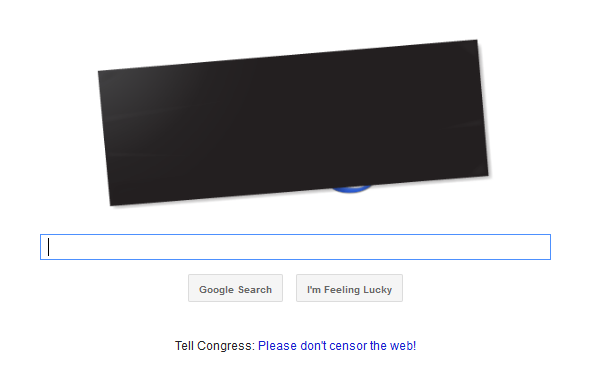

Google

While tech geeks and Silicone Valley execs have been decrying the the Stop Online Piracy Act (SOPA) and its sister bill, the Protect Intellectual Property Act (PIPA), today, January 18, 2012, marks an unprecedented day of action across the Web. The protest is remarkable because it fully utilizes the Internet’s unprecedented ability blend top-down and bottom-up organization. Specifically, the action achieves maximum effect because major sites like Wikipedia, Google, and reddit have blacked-out part or all of their pages while individuals users also black-out their own profile images and posts. As a result, it is near impossible to surf the Web without encountering a deluge of such images and, thereby, being encouraged to do at least a little investigating into why these bills provoke such ire.

Interestingly, the debate of intellectual property law pits new, social media against old, broadcast media. For this reason, the anti-SOPA movement may be the clearest demonstration to date of social media’s superior capacity for organizing and mobilizing social or political movements (vis-à-vis broadcast media). New media is clearly winning the messaging war. A recent Zogby poll finds that 60% of likely voters are aware of the SOPA legislation and 68% of them oppose it; the same number also believe it infringes on First Amendment Rights.

The following is as scrapbook-style archive of anti-SOPA images from across the Web. more...

Last week, Nathan Jurgenson linked to an interview with Noam Chomsky, where Chomsky argued that social media is superficial:

Jeff Jetton: Do you think people are becoming more comfortable communicating through a device rather than face to face or verbally?

Noam Chomsky: My grandchildren, that’s all they do. I mean, of course they talk to people, but an awful lot of their communication is extremely rapid, very shallow communication. Text messaging, Twitter, that sort of thing.

Jeff Jetton: What do you think are the implication for human behavior?

Noam Chomsky: It think it erodes normal human relations. It makes them more superficial, shallow, evanescent. One other effect is there’s much less reading. I can see it even with my students, but also with my children and grandchildren, they just don’t read much.

Jeff Jetton: Because there’re so many distractions, or…?

Noam Chomsky: Well you know it’s tempting…there’s a kind of stimulus hunger that’s cultivated by the rapidity and the graphic character and, for the boys at least, the violence, of this imaginary universe they’re involved in. Video games for example. I have a daughter who lives near here. She comes over Sunday evening often for dinner. She brings her son, a high school student. And of course he hasn’t done any homework all weekend, naturally, so he has to do all his homework Sunday night. What he calls doing homework is going into the living room while we’re eating, sitting with his computer and with his headphones blaring something, talking to about ten friends on whatever you do it on on your computer, and occasionally doing some homework.

Jeff Jetton: How do you know what he’s doing?

Noam Chomsky: I watch him.

Jurgenson offered an epistemological critique of Chomsky, arguing that Chomsky’s dismissal of social media as superficial fits a long-standing pattern of affluent white academics maintaining their privileged position in society by rejecting media that is accessible to non-experts.  Jurgenson pointedly asks “who benefits when what you call “normal” human relationships get to be considered more “deep” and meaningful?”  Chomsky is seemingly ignorant to the use of Twitter and other networks in shaping the Arab Spring and the #Occupy movement; or the fact that young people are voraciously sharing and consuming important news stories through these same networks; or that Blacks and Hispanics were early adopters of smartphones; or that gay men have been pioneers in geo-locative communication. In many cases, historically-disadvantaged groups have used social media technology to find opportunities previously foreclosed to them.  For these folks, social media is hardly trivial. more...