by
davidbanks,
Dec 4, 2012, at 11:52 am
Don’t tell the Israel Defense Force (IDF) that sharing videos from your Twitter account is ineffectual. They will point to their two-hundred thousand twitter followers that have generated 35 million views on their official Youtube account. They will extoll the virtues of a ruthlessly efficient and effective ad campaign that invites participation without the young Israeli even knowing they are engaged in two wars: a war of flesh as well as a war of mind. Granted, the IDF is no Justin Beiber, but it is hard to deny the impact of the IDF’s 30-person social networking team. The IDF’s social media savvy has not gone unnoticed. Technology and business publications have been more than happy to publish uncritical, lengthy interviews of top officials. This meta-propaganda usually begins by noting that Pillar of Defense was first announced through Twitter. The conversation will then turn to their complete arsenal: (Tumblr, Flickr, Facebook, Pintrest, and even Google+) before commenting on their brief tweet confrontations with Hamas. All of this happens almost apolitically. Every news pieces calls it propaganda, and yet it still has a powerful aesthetic and rhetorical effect. Social media is the Abrams tank of propaganda. Messages must navigate the harsh terrains of corporate and government-owned mass media and arrive safely in the minds of citizens. Unedited, unfiltered, pure. Social media can trample news cycles, navigate the minefields of editorial desks, and maintain total media superiority in the vacuum of Western under-reporting. (more…)
by
jennydavis,
Oct 8, 2012, at 09:45 pm

c/o Facebook.com/Help “Where do my promoted posts show up on Facebook? What do they look like?”
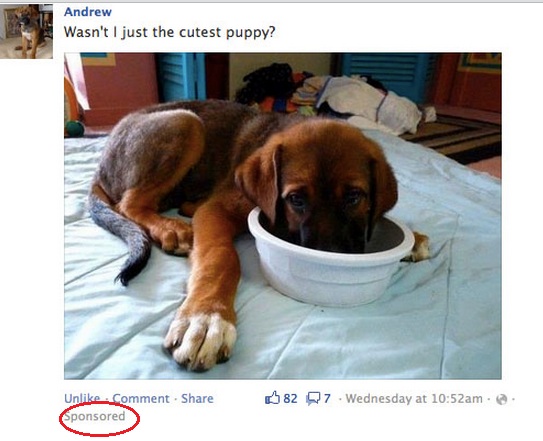
Social media blurs private and public, production and consumption, play and work, physical and digital. There. I just saved myself about 500 words worth of work.
Now with this blurring framework in mind, let us take a look at Facebook’s newest feature: Pay-to-Promote posts. (more…)
by
nathanjurgenson,
Sep 27, 2012, at 12:26 pm

PJ Rey just posted a terrific reflection on hipsters and low-tech on this blog, and I just want to briefly respond, prod and disagree a little. This is a topic of great interest to me: I’ve written about low-tech “striving for authenticity” in my essay on The Faux-Vintage Photo, reflected on Instagrammed war photos, the presence of old-timey cameras at Occupy Wall Street, and the IRL Fetish that has people obsessing over “the real” in order to demonstrate just how special and unique they are.
While I appreciate PJ bringing in terrific new theorists to this discussion, linking authenticity and agency with hipsters and technology, I think he focuses too much on the technologies themselves and not enough on the processes of identity; too much on the signified and not where the real action is in our post-modern, consumer society: the signs and signifiers. (more…)
by
Sarah Wanenchak,
May 16, 2012, at 10:11 am
This is the complete version of a previously posted two-part essay. Part one is here; part two is here.

Photo by Matthew Christopher
Objects have lives. They are witness to things. –This American Life, “The House on Loon Lake”
Atlantic Cities’ feature on the psychology of “ruin porn” is worth a look–in part because it’s interesting in itself, in part because it features some wonderful images, and in part because it has a great deal to do with both a piece I posted previously on Michael Chrisman’s photograph of a year and with the essay that piece referenced, Nathan Jurgenson’s take on the phenomenon of faux-vintage photography.
All of these pieces are, to a greater or lesser extent, oriented around a singular idea: atemporality – that the intermeshing and interweaving of the physical and digital causes us not only to experience both of those categories differently, but to perceive time itself differently; that for most of us, time is no longer a linear experience (assuming it ever was). Technology changes our remembrance of the past, our experience of the present, and our imagination of the future by blurring the lines between the three categories, and introducing different forms of understanding and meaning-making to all three – We remember the future, imagine the present, and experience the past. The phenomenon of “ruin porn” is uniquely suited to call attention to our increasingly atemporal existence, and to outline some of the specific ways in which it manifests itself.
(more…)
by
jennydavis,
Apr 30, 2012, at 01:17 pm

I have mentioned previously on this blog that I am engaged in an ongoing, qualitative, Facebook-based project looking at the experiences of social media users. None of the work from this most recent project is yet published, though I did use the data for my TtW2012 presentation. As I move into manuscript preparation, there are several theoretical and empirical trends that I need to flesh out. I hope that readers will indulge me today as I work through one such trend. I especially hope that readers will offer critiques and literature suggestions, as the end product will inevitably be strengthened through collaborative input from this academic community.
Specifically, I hope to flesh out the notion of reality curation. Much of the work on social network sites focuses on self-presentation, or the ways in which people curate images of themselves. These strategies of image-curation include friending practices, selective photographic and textual displays, and careful utilization of privacy settings—among other practices. Users are careful about their self-images, diligent in their upkeep, and protective against identity threats. Undeniably, I see these laborious practices of protection, maintenance, and care in the participants of my study. I also, however, see a second kind of labor; I see a diligent upkeep not only of outgoing data, but also incoming data. In particular, participants report careful curation of their Facebook News Feeds and (when applicable) Twitter networks.
This second type of curation—the curation of data coming in—is empirically and theoretically interesting. Work that focus on self-presentation (data going out) understands social network sites as both window and mirror—spaces for both voyeurism and self-reflection. This implicitly neglects, however, the idea that windows work two ways: they offer a view from outside in, but also a view from inside out. Social network sites, as opposed to non-social websites, are spaces of simultaneous projection, reflection, and, as I argue here, observation by the prosumer of the Profile.
(more…)
by
Sarah Wanenchak,
Mar 24, 2012, at 12:45 pm

Irony? A porn addiction helpsite (via ABCnews.com)
“The internet is for porn.” Given that, pornography addiction and internet addiction frequently show up together in the same discussion. The two have some important features in common being medicalized descriptions of certain sets of behaviors: the problematization of pornography addiction rests in part on the idea that unhealthy levels of consumptions of porn precludes healthy, fulfilling relationships with “real people”. Jenny Davis’s post earlier this week on the “problem with internet addiction” highlights the same issue: the idea that digital interaction is somehow a zero-sum game, wherein more of the “virtual” means less of the “real”, instead of merely a part of the whole of augmented social interaction:
If we understand the internet as a means of sociality, a venue for business communications, an outlet for creativity, a source of news gathering and a space of recreation, then indeed, an addiction to internet technologies would be an addiction everyday life.
(more…)
by
Dave Paul Strohecker,
Mar 23, 2012, at 11:34 am
We are currently facing a cultural crisis of authenticity. Since the early 2000s, we have seen the concept “authenticity” slowly move from margins to mainstream (Reynolds, 2011), encapsulated by feverish celebrity gossip surrounding breakout stars like Lana Del Rey, personified through the rise of the urban hipster as folk devil (those self-professed taste arbiters of cool who ride “fixies” through the urban landscape, collect obscure records, and wear vintage clothes), and exemplified in Web 2.0 and the rise of social media (especially curatorial media like LastFM and more recently, Pintrest), where we are all now encouraged to share, like, and make public pronouncements of our personal tastes. In the contemporary zeitgeist, it seems that we are all “grasping for authenticity” in an attempt to make our lives seem more important, substantial, and relevant (Jurgenson, 2011).
In this environment, identity is constructed both on and offline, but our online identities are increasingly coming to define our public identities. As such, the “online commons” (Lih, 2009) becomes an important space of identity construction and conflict. (more…)
by
Sarah Wanenchak,
Jan 12, 2012, at 11:43 am
This is the first part of a two-part essay; the full version of the essay — both parts — can be found here.

Photo by Matthew Christopher
Atlantic Cities’ feature on the psychology of “ruin porn” is worth a look–in part because it’s interesting in itself, in part because it features some wonderful images, and in part because it has a great deal to do with both a piece I posted last week on Michael Chrisman’s photograph of a year and with the essay that piece referenced, Nathan Jurgenson’s take on the phenomenon of faux-vintage photography.
All of these pieces are, to a greater or lesser extent, oriented around a singular idea: atemporality – that the intermeshing and interweaving of the physical and digital causes us not only to experience both of those categories differently, but to perceive time itself differently; that for most of us, time is no longer a linear experience (assuming it ever was). Technology changes our remembrance of the past, our experience of the present, and our imagination of the future by blurring the lines between the three categories, and introducing different forms of understanding and meaning-making to all three – We remember the future, imagine the present, and experience the past. The phenomenon of “ruin porn” is uniquely suited to call attention to our increasingly atemporal existence, and to outline some of the specific ways in which it manifests itself.
(more…)
by Dave Paul Strohecker and Ibalu Dwan,
Jan 6, 2012, at 12:39 pm
Part 2
From Screamo to Brostep: The Case of Skrillex


The popularization of dubstep is further epitomized in the wildly popular, albeit polarizing example of Sonny Moore, former lead singer/frontman of the 2000s screamo band From First to Last. He left the band in 2004 to pursue his solo career only to return in 2008 as the dubstep DJ Skrillex, when dubstep was beginning to “blow up” in American popular music. He quickly became an internet phenomena, an early harbinger of the recent “brostep” wave of popularization which would later be bolstered by user-generated dubstep videos using footage from the Transformers movies. And at the 2011 MTV Music Awards, he walked away with the award for Best New EDM Artist as a result of his popularity under the stage name Skrillex.
Upon hearing of this award, many in the EDM community were outraged. Why? Because many members of this subculture viewed him as an outsider who solidified dubstep as pop music played on radio and television stations, making the subculture open and accessible to most everyone. Most in the EDM community have never seen him as an organic member of the underground dubstep or EDM subculture. Skrillex is simply the product of mainstream capitalism taking notice of dubstep as a viable market commodity. His popularity and success coincides directly with the most recent wave of popularization occurring in the late 2000s, his five recent Grammy nominations notwithstanding. (more…)