atemporality

This is the complete version of a previously posted two-part essay. Part one is here; part two is here.

Photo by Matthew Christopher

Objects have lives. They are witness to things. –This American Life, “The House on Loon Lake”

Atlantic Cities’ feature on the psychology of “ruin porn” is worth a look–in part because it’s interesting in itself, in part because it features some wonderful images, and in part because it has a great deal to do with both a piece I posted previously on Michael Chrisman’s photograph of a year and with the essay that piece referenced, Nathan Jurgenson’s take on the phenomenon of faux-vintage photography.

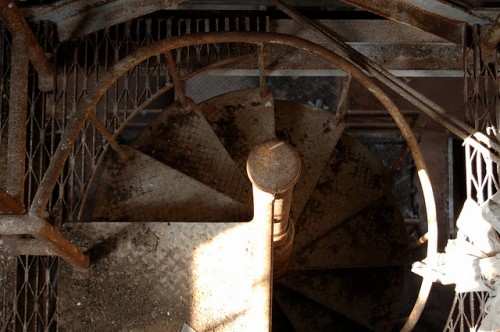
All of these pieces are, to a greater or lesser extent, oriented around a singular idea: atemporality – that the intermeshing and interweaving of the physical and digital causes us not only to experience both of those categories differently, but to perceive time itself differently; that for most of us, time is no longer a linear experience (assuming it ever was). Technology changes our remembrance of the past, our experience of the present, and our imagination of the future by blurring the lines between the three categories, and introducing different forms of understanding and meaning-making to all three – We remember the future, imagine the present, and experience the past. The phenomenon of “ruin porn” is uniquely suited to call attention to our increasingly atemporal existence, and to outline some of the specific ways in which it manifests itself.
more...

This is the second part of a two-part essay; the full version of the essay — both parts — can be found here.

Photo by Jim Potter/Blind Owl Underground

In part one of this essay, I focused on the atemporality of the physical spaces from which “ruin porn” images are made. This may have seemed like a bit of an aside from a take that purports to be technology-focused, but I want to emphasize the importance of physicality here–one of the crucial – if not the most crucial – ideas behind atemporality in the sense in which I use the word is the profound connection between our perception and understanding of time and our relationship with the enmeshed physical/digital world that our technology is increasingly helping to create. In short, we cannot discuss the digital in this case without first establishing why and how the physical matters.

But now I want to focus on that move from physical to digital, the point of entanglement where one shades into another and the relationship between the two becomes truly complex. I want to talk about the image itself, both in terms of its production and its consumption.

more...

This is the first part of a two-part essay; the full version of the essay — both parts — can be found here.

Photo by Matthew Christopher

Atlantic Cities’ feature on the psychology of “ruin porn” is worth a look–in part because it’s interesting in itself, in part because  it features some wonderful images, and in part because it has a great deal to do with both a piece I posted last week on Michael Chrisman’s photograph of a year and with the essay that piece referenced, Nathan Jurgenson’s take on the phenomenon of faux-vintage photography.

All of these pieces are, to a greater or lesser extent, oriented around a singular idea: atemporality – that the intermeshing and interweaving of the physical and digital causes us not only to experience both of those categories differently, but to perceive time itself differently; that for most of us, time is no longer a linear experience (assuming it ever was). Technology changes our remembrance of the past, our experience of the present, and our imagination of the future by blurring the lines between the three categories, and introducing different forms of understanding and meaning-making to all three – We remember the future, imagine the present, and experience the past. The phenomenon of “ruin porn” is uniquely suited to call attention to our increasingly atemporal existence, and to outline some of the specific ways in which it  manifests itself.

more...

Photo by Michael Chrisman

One of the most heavily trafficked posts on this blog in 2011 was Nathan Jurgenson’s excellent essay on “faux-vintage” photography and the construction of meaning in documentation; given the discussion around this phenomenon, it’s interesting to consider photographer Michael Chrisman’s year-long photo project, especially in the details of how it was processed and how you and I are able to view it above.

more...

Photo by David Shankbone, September 30th, NYC

Two days ago, Nathan Jurgenson wrote on what has become one of the central questions around Occupy Wall Street: Now that the encampments are closing up and the winter is coming on, can Occupy survive? The crucial point that Nathan makes is that we need to think about Occupy not just in terms of space but in terms of time – that permanence has been a part of what’s given the movement so much symbolic and discursive power. Nathan brings up an additional point, to which I want to respond here: that the role of physical permanence that the encampments represented was powerful because it resulted in a form of cognitive permanence in the minds of everyone who saw them (and heard them; the auditory side of Occupy is also vital to pay close attention to).

While I clearly agree with Nathan that the physical permanence that tents represent has been what’s given Occupy a lot of its power, I think we can glean enough evidence from how things have proceeded so far to at least make an educated guess at an answer to his question. For me, the answer is yes: I expect that Occupy will survive the winter and emerge in spring, albeit – like a bear emerging from hibernation – perhaps in somewhat of a different shape. There are several reasons why I come down on this side of things.

more...

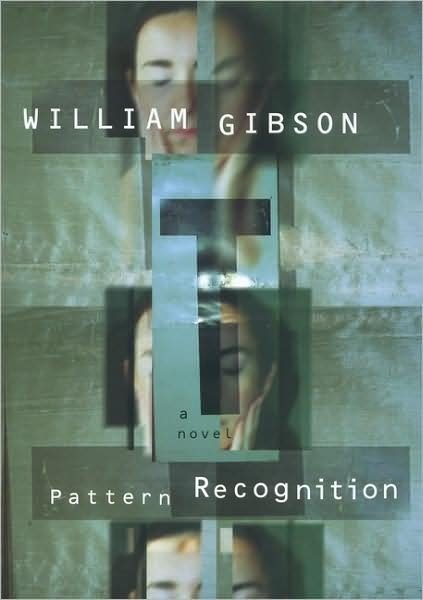
“The future is there,” Cayce hears herself say, “looking back at us. Trying to make sense of the fiction we will have become. And from where they are, the past behind us will look nothing at all like the past we imagine behind us now.”
–William Gibson, Pattern Recognition

“This is a kind of writing which simply makes you feel very strange; the way that living in the late twentieth century makes you feel, if you are a person of a certain sensibility.”
–Bruce Sterling, “Slipstream”, SF Eye #5, July 1989

I first read William Gibson’s Pattern Recognition almost a year ago, after a long hiatus from his work. I’ve long loved his books, but went through the kind of distance that time and life just sometimes put between a reader and an author. Pattern Recognition was the return, and I went into it cold, knowing nothing about it except for the author–an experience that I always find somewhat refreshingly like exploring a dark, richly appointed room with a small flashlight.

And then something rather interesting happened. The book contains a description of the memories that the protagonist retains of the events of September 11, 2001, and as I read, I experienced a curious kind of vertigo–something that I have since come to understand as the mirror-hallway perception of reading a fictionalized account of a real event in my own memory, remembered as past in a near-future context. In that moment, what I experienced as vertigo was the collapsing of a number of categories–past, present, and future, fiction and non-fiction, myself and other.

Vertigo, a really common illness seen in many of us may be a sort of dizziness that makes balance disorder. Vertigo gives one a sense of swaying while the body is stationary with reference to the world or its surroundings. Vertigo is commonest when an individual goes up some height. it’s going to produce to a false sensation of movement. Vertigo often results in nausea and vomiting.

Vertigo is said to the internal ear balance mechanism that relates to the brain or the nerves connecting the ear and therefore the brain. The disease creates a loss in equilibrium and wooziness. However, vertigo and dizziness aren’t synonymous. While dizziness is one symptom of Vertigo, not all dizziness are often termed as Vertigo. Vertigo is commonest in elderly people, but can affect both sexes at any age.

Vertigo is a treatable disease and handled through medicines, but only if treated from well qualified doctors like vertigo la. As vertigo is more a symbol of other diseases, it are often treated by treating the particular disease that causes this. If Vertigo has been caused by a tympanic cavity infection, then it requires antibiotic treatment. Home remedy is additionally an option for vertigo.

more...