
Africa

Image credit
Image credit

What does it mean to have access to the internet? It’s an apparently simple question that gets complicated when we consider the wide variety of ways people access the web and products from the web. Indeed, the question is wrapped up in recent debates about zero rating, net neutrality, “the next billion” and numerous initiatives designed to bring people from the developing world online.

At Theorizing the Web this year, I presented research that combined my fieldwork and personal observations in developing world internet contexts like rural northern Uganda, urban China and rural Philippines with emergent research and journalism on the use of sneakernets–the physical transfer of data using devices like USB sticks or Bluetooth-enabled mobile phones–in places like Mali, North Korea and Cuba. These latter formed the basis for my talk and a recent paper in The New Inquiry, in which I draw from Jan Chipchase’s writing on binary thinking about connectivity and how this ultimately overlooks the vast diversity of ways that people do access the web and its products. more...
This post combines part 1 and part 2 of “Technocultures”. These posts are observations made during recent field work in the Ashanti region of Ghana, mostly in the city of Kumasi.

Part 1: Technology as Achievement and Corruption

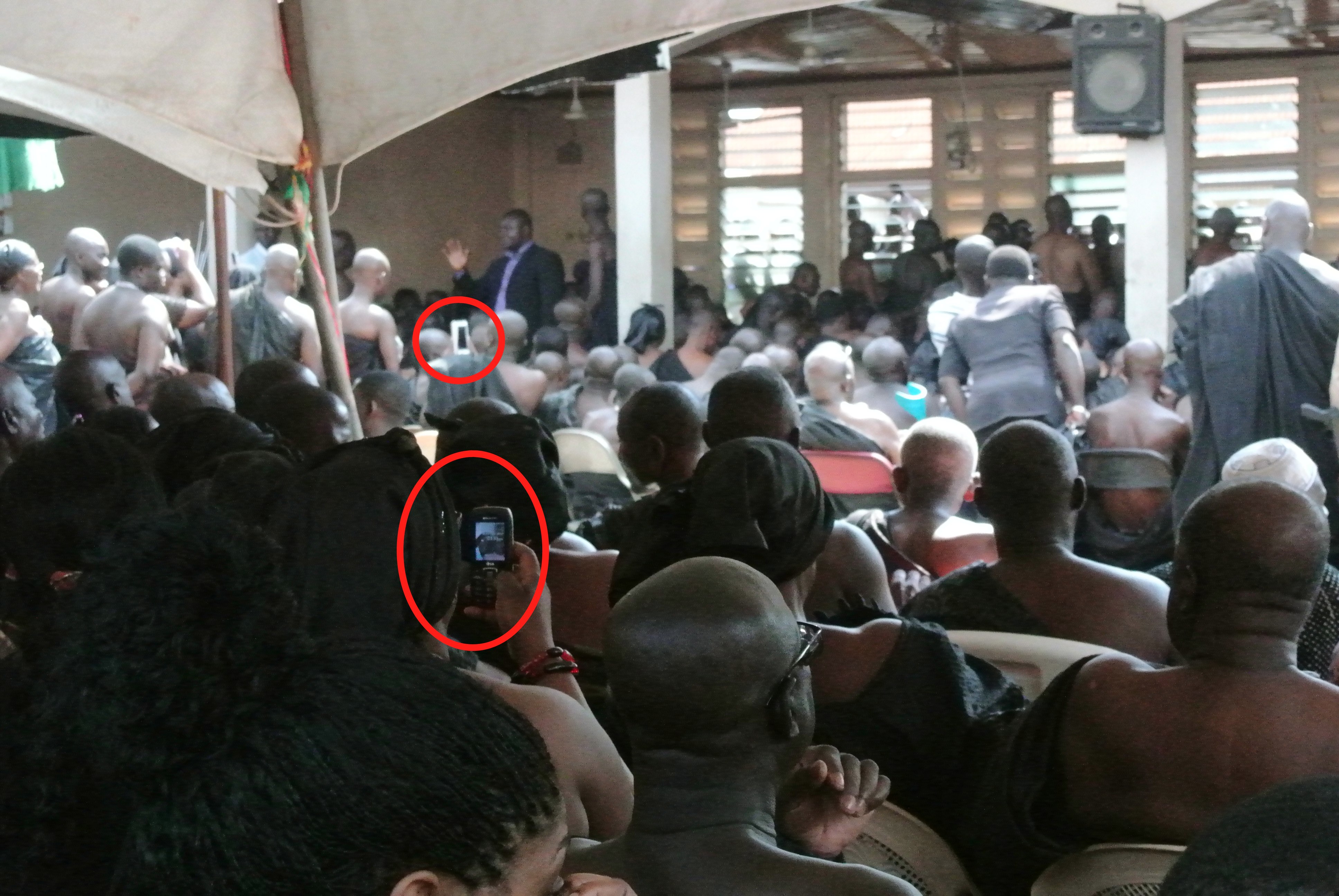
An Ashanti enstooling ceremony, recorded (and presumably shared) through cell phone cameras (marked).

The “digital divide” is a surprisingly durable concept. It has evolved through the years to describe a myriad of economic, social, and technical disparities at various scales across different socioeconomic demographics. Originally it described how people of lower socioeconomic status were unable to access digital networks as readily or easily as more privileged groups. This may have been true a decade ago, but that gap has gotten much smaller. Now authors are cooking up a “new digital divide” based on usage patterns. Forming and maintaining social networks and informal ties, an essential practices for those of limited means, is described as nothing more than shallow entertainment and a waste of time. The third kind of digital divide operates at a global scale; industrialized or “developed” nations have all the cool gadgets and the global south is devoid of all digital infrastructures (both social and technological). The artifacts of digital technology are not only absent, (so the myth goes) but the expertise necessary for fully utilizing these technologies is also nonexistent. Attempts at solving all three kinds of digital divides (especially the third one) usually take a deficit model approach.The deficit model assumes that there are “haves” and “have nots” of technology and expertise. The solution lies in directing more resources to the have nots, thereby remediating the digital disparity. While this is partially grounded in fact, and most attempts are very well-intended, the deficit model is largely wrong. Mobile phones (which are becoming more and more like mobile computers) have put the internet in the hands of millions of people who do not have access to a “full sized” computer. More importantly, computer science, new media literacy, and even the new aesthetic can be found throughout the world in contexts and arrangements that transcend or predate their western counterparts. Ghana is an excellent case study for challenging the common assumptions of technology’s relationship to culture (part 1) and problematizing the historical origins of computer science and the digital aesthetic (part 2). more...


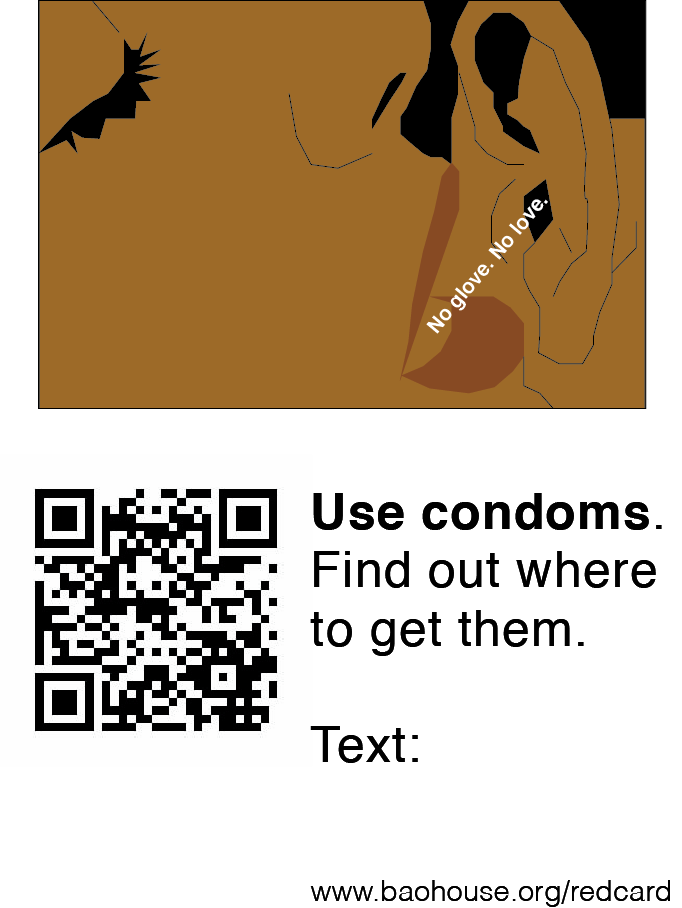
The card being used to advertise the service
The SMS service will be advertised using an ad campaign that is based on field work from the previous year by Dr. Audrey Bennett of RPI's Language Literature and Communication Department..

Next month I’ll be in Kumasi, Ghana doing field research and I thought I’d share what I hope to accomplish over there, since my work is informed by much of what I write about on this blog. (I will be blogging over here.) We hope to set up an information system by which Ghanaians can find condom sellers nearby. The primary interface will be text messaging using a fantastic open-source project called FrontLineSMS. By texting a certain number, the user will be asked to send their district and a list of nearby landmarks. The database will send back a list of condom sellers within a reasonable walking distance. We also hope to have several other front-end access points that are already becoming popular places to socialize. Our aim is to increase access to condoms in order to reduce the infection rate of HIV/AIDS. As of 2009, according to UNICEF, 230,000 people (about 2% of the population) live with HIV in Ghana. I should also note that cell phones are not a luxury item in Ghana. Adoption has exploded over the past several years, and it is estimated that about 67% of Ghanians own a cell phone.

more...