The new Google maps probably won’t destroy public space.
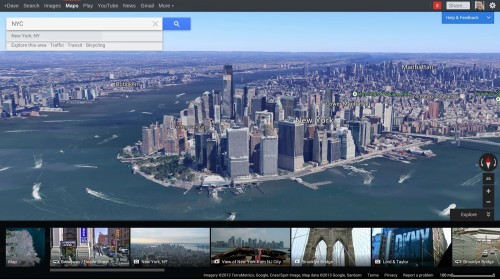
Maps are always political. Most maps show us something that we already believe, so its difficult to see what is being reinforced and what is systematically ignored. Even the most mundane AAA maps of highways and state borders are doing political work by recognizing the sovereignty of individual states and the obduracy of highways and roads. The near-infinite number of things, qualities, measurements, and people that have spatial characteristics (seriously, just think of all of it: temperatures, ancestral lands, endemic species, isobars, places to buy smoothies, locations of hidden treasure, and so on, and so on…_) mean that map makers must always select what is relevant and what is not. This selection process—a human endeavor—is inherently social and deeply political. Google, a company that has taken upon itself to reject that selection process and “organize all the world’s information,” wants to provide a single map and, instead of deciding what is relevant in any given map, will personalize it based on information it has about you and your friends. Evgeny Morozov, writing in Slate,[1] is rightfully concerned that Google doesn’t quite know what they’re dealing with when they say they want to organize public spaces in their databases right next to email and photos of cats. He is concerned that–unlike books or weather forecasts—Google doesn’t “acknowledge the vital role that disorder, chaos, and novelty play in shaping the urban experience.” I completely agree that unpredictability is necessary for good urban space, but the biggest threat Google poses to public space isn’t that its maps are “profoundly utilitarian, even selfish in character.” Rather, Google hasn’t done enough to personalize maps in such a way that they become part of everyday social (and Social) life. (more…)
If you haven’t yet noticed (you’ve probably noticed), Facebook likes to appropriate features from competing apps and platforms. You can credit the demise of the old “[Name] is…” status update prompt, for instance, to the rise of Twitter. You may also recognize the “share” feature on your friends’ status updates from Tumblr; the place check-ins from Foursquare; the friend “lists” from Google+; the photo albums from Flickr (or any other photo sharing site); the photo filters from Instagram (back before Facebook bought Instagram outright); the vanishing images of Poke (that’s a newer Facebook app, not the older Facebook feature) from Snapchat; the “Music” app from Myspace (new or old); or even the “Work and Education” profile field from LinkedIn. Yes, that’s right: voracious media amoeba that it is, Facebook has even engulfed some of LinkedIn. Icky.
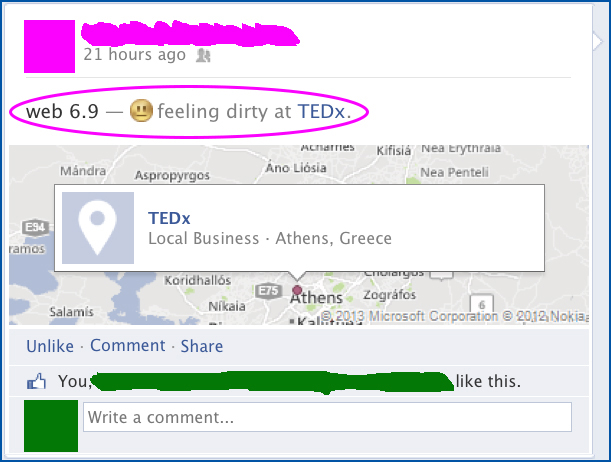
Yet in its seeming quest to digest and regurgitate elements from every digital social technology ever, Facebook most recently appropriated features not from a competing platform or app, but from the pre-Web-2.0 ‘sharing’ stalwart LiveJournal[i]. Remember the “Current Mood” field, and the various “Mood Theme” icons you could use to answer when you weren’t feeling up to free response? If you don’t already, you’ll soon have something similar in a new field on your Facebook status update prompt. Go into that new field and select “feeling,” and you’ll get to answer “How are you feeling?” with one of roughly 200 preset emoji/emotion combinations like it’s 2001 all over again. Your profile will then show something like the image above.
There are some significant differences between LiveJournal’s “Current Mood” field and Facebook’s new “feeling” icons, however, and these differences get at the heart of why—potentially cute/annoying emoji notwithstanding—talking about your emotions with the new Facebook feature is very different from talking about your emotions on LiveJournal. (more…)
This recent ad for Norton Antivirus software reinforces the concept of lifestyle consumption as articulated by Mike Featherstone (1991) two decades ago. When I saw this commercial, it made me wonder how the trends of lifestyle consumption are fast changing as a result of the increasing digitization of consumer goods. At a time when our very identities seem to be wrapped up in the information we circulate (via Facebook, email, and the various other affordances our digital technology allows), this ad seems to push the concept of lifestyle consumption to a new extreme. And it epitomizes postmodern advertising in that it “educates and flatters at the same time” (Featherstone 1987).
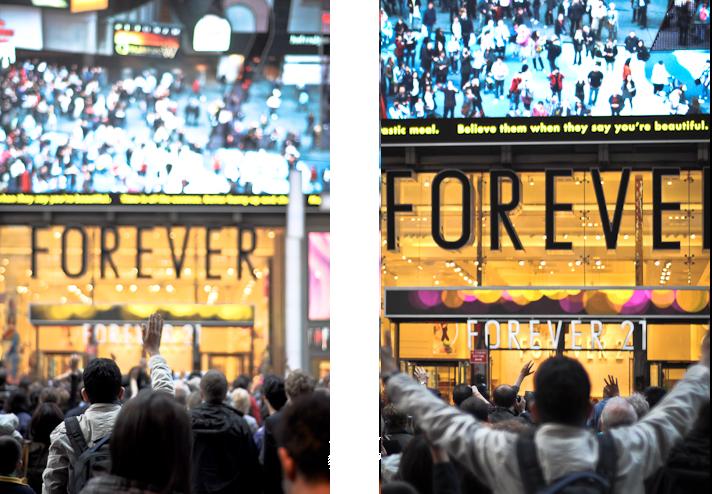
Crowds in Times Square waving at themselves on the big screen. Photos in this post by nathan jurgenson.
Something interesting has been happening in Times Square this summer. As has been occurring for a century, the crowds gather with necks perched upward looking at all the famously illuminated billboards. But now there is a new type of buzz in the crowd: they stand together facing the same direction, cameras held high and their hands waving even higher. They are not just watching celebrities or models in this the most expensive ad-space in the world; today, they are watching themselves on the big screen.
This is all part of a new billboard for the company Forever 21 currently in use in Times Square in the heart of New York City. It struck me that this billboard is nothing short of a consumer-capitalism-happening, and started snapping photos and thinking about what this all might mean. (more…)
[Edit 09/07/11 @ 5:03PM EST] It has been mentioned in the comments, and elsewhere, that while the Postal Service is facing a solvency problem, that problem is the direct result of Republican-led legislation that burdens them with excessive overhead. I completely agree with this sentiment. The 109th Congress, passed the “The Postal Accountability and Enhancement Act” in 2006, which you can read in full here. The law requires that the USPS pre-fund 75 years-worth of pensions, and prohibits them from selling goods that are not directly used for sending letters and packages. I suggest you read more about this legislation here and here. I encourage all of you do to your own research and post what you find in the comments.]
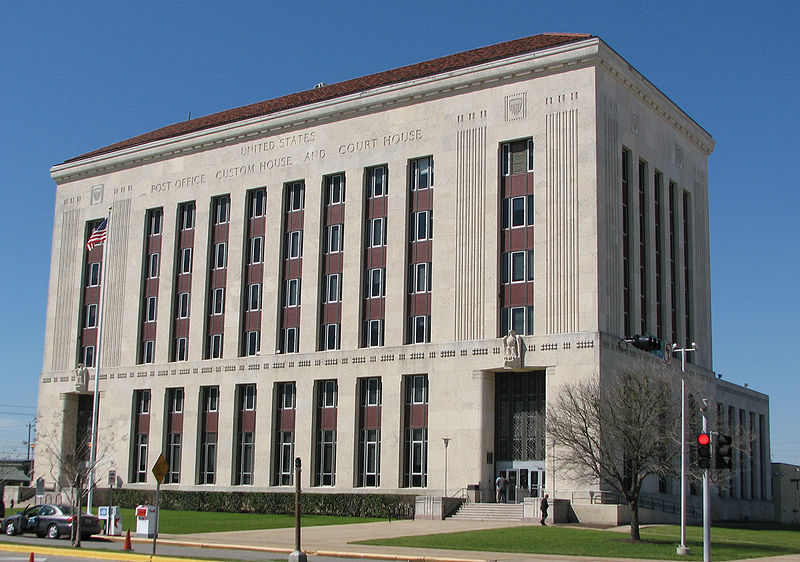
Photo Credit: Wikipedia – The Galveston Federal Building, built in 1937, is a multi-purpose building with many different government agencies. Don’t bleed the Post Office dry, make it a 21st Century Civic Center
Reading the news lately, makes it seem as though the Post Office is giving its final economic death rattle. Post Master General Patrick Donahoe spoke at a Senate hearing yesterday, and according to the Christian Science Monitor:
Donahoe reiterated a list of cost-cutting measures he has been proposing in recent months to erase the agency’s deficit, which could reach up to $10 billion this fiscal year. They include eliminating Saturday mail delivery, closing as many as 3,700 postal locations, and laying off 120,000 workers – nearly one-fifth of the agency’s work force. (This doesn’t include another 100,000 jobs lost to attrition that the agency does not plan to replace, for a total of 220,000 lost positions.)
These are disgraceful solutions to what could be considered an exciting opportunity to innovate. The Internet is being blamed for many of the Post Office’s problems, and it is safe to say that email has put a significant dent in their revenues. But revenues are only half the story. Expenditures are equally important. Duany, Plater-Zyberk, and Speck in their book Suburban Nation relay a conversation with a former (unnamed) Postmaster General who explained that most of our postage goes to the gas for the trucks and vans that carry mail to the suburban fringes of municipalities. Indeed, the USPS has the largest civilian truck fleet in the world. In an era of austerity, we need to look for ways to reduce spending while maintaining affordable services. I just think we need to spend less money on machines, and more on people. The internet can help us do this.
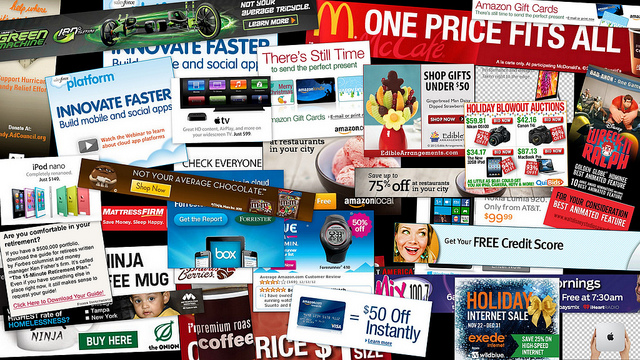
Advertising on social media is more than those segregated paid-for-spaces that display ads paid for by companies (e.g., on the far-right of your Facebook screen). This sort of paid-advertising has been shown to be so highly ineffective that some have predicted it will be the downfall of the social web. However, these predictions do not understand that the fundamental point of the social web (2.0) is that users are prosumers; they are simultaneously both consumers and producers of content. And advertising is no different. Advertisements that we simply consume worked in a consumer medium, like television. However, social media is a prosumer medium, and today we are the ones doing the advertising work of integrating corporate logos and branding into our profiles and news feeds.
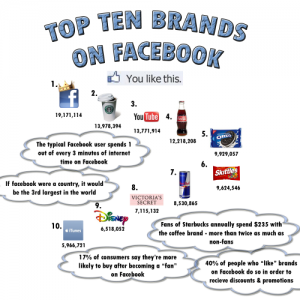
Facebook’s ubiquitous “like” button reflects our modern task of self-presentation (and distinction) based on our taste in just about anything and everything, documented and compared to the various “likes” of any other visitor to your profile (and remember: what someone “likes” may not be what they actually like but what they want others to see that they like). In modern consumer culture, this collection of displayed “likes” will include corporate brands that one identifies with. This might mean clicking “like” on the Starbucks or Victoria’s Secret pages, which then becomes a part of your profile. (more…)
We live in a cyborg society. Technology has infiltrated the most fundamental aspects of our lives: social organization, the body, even our self-concepts. This blog chronicles our new, augmented reality.