
academic publishing

Photo by Michael Newman

I’m in the midsts of one of those unavoidable grad student extended crises this month so I I thought writing something this week was going to be out of the question. But last Monday I had an interaction with a PDF that I really need to tell someone about. Trust me, its more interesting than it sounds.

Lately, I’ve been taking advantage of my institution’s (appropriately ancient-sounding) ILLiad Inter-Library Loan System. Usually, if I can’t find journal article I need, I just ask a fellow grad student friend over GChat or Facebook to get me the article from their library. If I can’t find anyone (or I’ve asked them too many times) I resort to ILLiad. Getting a book from ILLiad means waiting about 24 hours for an undergrad on work study to copy and paste a DOI and send me the article under another institution’s journal subscription. It is the ultimate exercise in artificial scarcity: A teenager in a library basement, fueled on Moe’s burritos and motivated by the threat of crushing student debt, orchestrates the transfer of a few ones and zeroes in such a way that my desire for the article can be monetized to the benefit of a publishing company’s CEO and a couple of computer system designers. The physical scarcity of a paper journal is transmuted into a new kind of scarcity: the scarcity of student labor and my own dedication to reading this article that I saw in someone else’s bibliography. more...
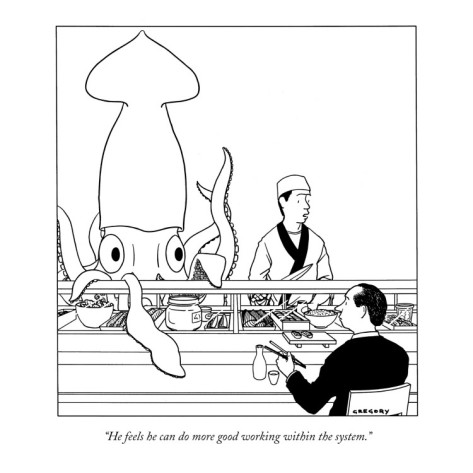
Cartoon by Alex Gregory. Published in The New Yorker, a Condè Nast Publication.

At the beginning of the year, rumors were going around that the popular but relatively small citation software company Mendeley Ltd. was going to be purchased by the publishing giant Elsevier. TechCrunch ran a story and there were a few others but not much else came out of it. When I heard these “advanced talks” were taking place, I wrote an essay in which I said,

“When our accounts of reality are owned by profit-seeking organizations and those organizations control the very tools that help us exchange those accounts, we are in danger of losing something fundamental to the institution of science. Ideas should not end up behind prohibitively expensive pay walls, especially when so little of that money goes towards new scientific discovery.”

Today, Mendeley announced on their blog that their purchase by Elsevier was official. They also reassured existing users, “Mendeley is only going to get better for you.”

I’m very skeptical.  Back in January, I raised the question, “what is Elsevier going to do with Mendeley that warrants uninstalling it from you computer?” and hinted that the kind of criminal charges faced by the late Aaron Schwartz could become commonplace, if not easier to prove and litigate.  I also noted that Elsevier has been so malicious and aggressive in their search to control and subsequently monetize knowledge that it has inspired over thirteen thousand academics to sign a pledge saying they will not support Elsevier’s journals. They have supported SOPA, PIPA, and used to support the Research Works Act as well. Oh, and they support CISPA too. None of that has changed, and there’s still plenty to be done if Elsevier wants to gain the respect their new property once had. more...

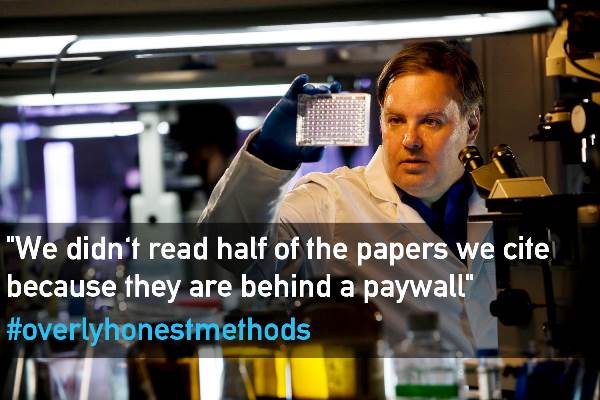
This and more #OverlyHonestMethods can be found here.

I really love putting things in order: Around my house you’ll find tiny and neat stacks of paper, alphabetized sub-folders, PDFs renamed via algorithm, and spices arranged to optimize usage patterns. I don’t call it life hacking or You+, its just the way I live. Material and digital objects need to stand in reserve for me, so that I may function on a daily basis. I’m a forgetful and absent-minded character and need to externalize my memory, so I typically augment my organizational skills with digital tools.  My personal library is organized the same way Occupy Wall Street organized theirs, with a lifetime subscription to LibraryThing. I use Spotify for no other reason that I don’t want to dedicate the necessary time to organize an MP3 library the way I know it needs to be organized. (Although, if you find yourself empathizing with me right now, I suggest you try TuneUp.) My tendency for digitally augmented organization has also made me a bit of a connoisseur of citation management software. I find little joy in putting together reference lists and bibliographies, mainly because they can never reach the metaphysical perfection I demand. Citation management software however, gets me close enough. When I got to grad school, I realized by old standby, ProQuest’s Refworks wasn’t available and my old copy of Endnote x1 ran too slow on my new computer. So there I was, my first year of graduate school and jonesing heavily for some citation management. I had dozens of papers to write and no citation software. That’s when I fell into the waiting arms of Mendeley. more...

Congressman Darrell Issa (R-CA) is the sponsor of the "Research Works Act"

It seems as though Congress, having grown tired of pissing off large swaths of the country, are now opting to write bills that anger a very particular group of people. Almost a month ago, on December 16, 2011, California Republican Congressman Darrel Issa introduced the “Research Works Act” which would kill government-assisted open-access journals. As PJ said before, journals (especially the closed private ones) are the dinosaurs of academia and as Patricia Hill Collins later noted, more...

Editor’s Note from PJ Rey: Several months ago, I wrote a post called “Why Journals are the Dinosaurs of Academia,” which argued that goal of academics to circulate their ideas as widely as possible was hindered by their own backward practice of attributing excessive symbolic value to print media. In fact, the academia’s incentive structure rewards the best practices of yesteryear, while wholly ignoring modern communication. This is largely a product of the entrenched interests powerful senior scholars who seeks to consolidate their privileged position by reifying their own established habits. I concluded that, for the academy to continue to be relevant (or, rather, to start being relevant again), we must begin to reward blogging, tweeting, wiki editing, etc.

Given recent interest in the topic, I thought I would repost Patricia Hill Collins’ response.

I agree that the status of a journal should be decoupled from the fact of whether or not it exists in print. The wind is already blowing in that direction as publishers realize how expensive print really is.

I don’t think that journals are necessarily dinosaurs. A good peer reviewed journal by experts in a field can become one important location that can help us wade through seemingly endless ideas on the web with an eye toward influencing informed decisions about quality. The sheer volume of ideas that are now available on the Web means that we need some sort of system (or multiple systems) of vetting those ideas. The journal system, especially in an era of ever-more-specialized journals, can help do that. Digital journals are well-positioned to help with this task. I, for one, don’t want a “thumbs up” Facebook model of voting on intellectual quality. more...