academia

When the team here at Cyborgology first started working on The Quantified Mind, a collaboratively authored post about the increasing metrification of academic life, production, and “success”, I immediately reached out to Zach Kaiser, a close friend and collaborator. Last year, Zach produced Our Program, a short film narrated by a professor from a large research institution at which a newly implemented set of performance indicators has the full attention of the faculty.

For my post this week, then, I’d like to consider Zach an Artist in Residence at Cyborgology—someone using the production and dissemination of works that embody the types of cultural phenomena or theories covered on the blog (as it turns out, this is not Zach’s first film featured on Cyborgology). I suppose it’s up to him if he’d like to include the position on his CV. In the following, I would like to present some of my reactions to the film and let Zach respond, hopefully raising questions that can be asked in dialogue with the ones presented at the end of The Quantified Mind. In full disclosure, I am very familiar with Zach’s scholarship and art (I’m listed as a co-author or co-artist on much of it, though not Our Program in particular), so I hope I don’t lead the witness too much here.

But first, the film:


more...

Image Credit: Marco Paköeningrat

Ugh. I hate the new Facebook. I liked it better without the massive psychological experiments.

Facebook experimented on us in a way that we really didn’t like. Its important to frame it that way because, as Jenny Davis pointed out earlier this week, they experiment on us all the time and in much more invasive ways. The ever-changing affordances of Facebook are a relatively large intervention in the lives of millions of people and yet the outrage over these undemocratic changes never really go beyond a complaint about the new font or the increased visibility of your favorite movies (mine have been and always will be True Stories and Die Hard). To date no organization, as Zeynep Tufekci observed, has had the “stealth methods to quietly model our personality, our vulnerabilities, identify our networks, and effectively nudge and shape our ideas, desires and dreams.” When we do get mad at Facebook, it always seems to be a matter of unintended consequences or unavoidable external forces: There was justified outrage over changes in privacy settings that initiated unwanted context collapse, and we didn’t like the hard truth that Facebook had been releasing its data to governments. Until this week, it was never quite so clear just how much unchecked power Facebook has over its 1.01 billion monthly active users. What would governing such a massive sociotechnical system even look like? more...

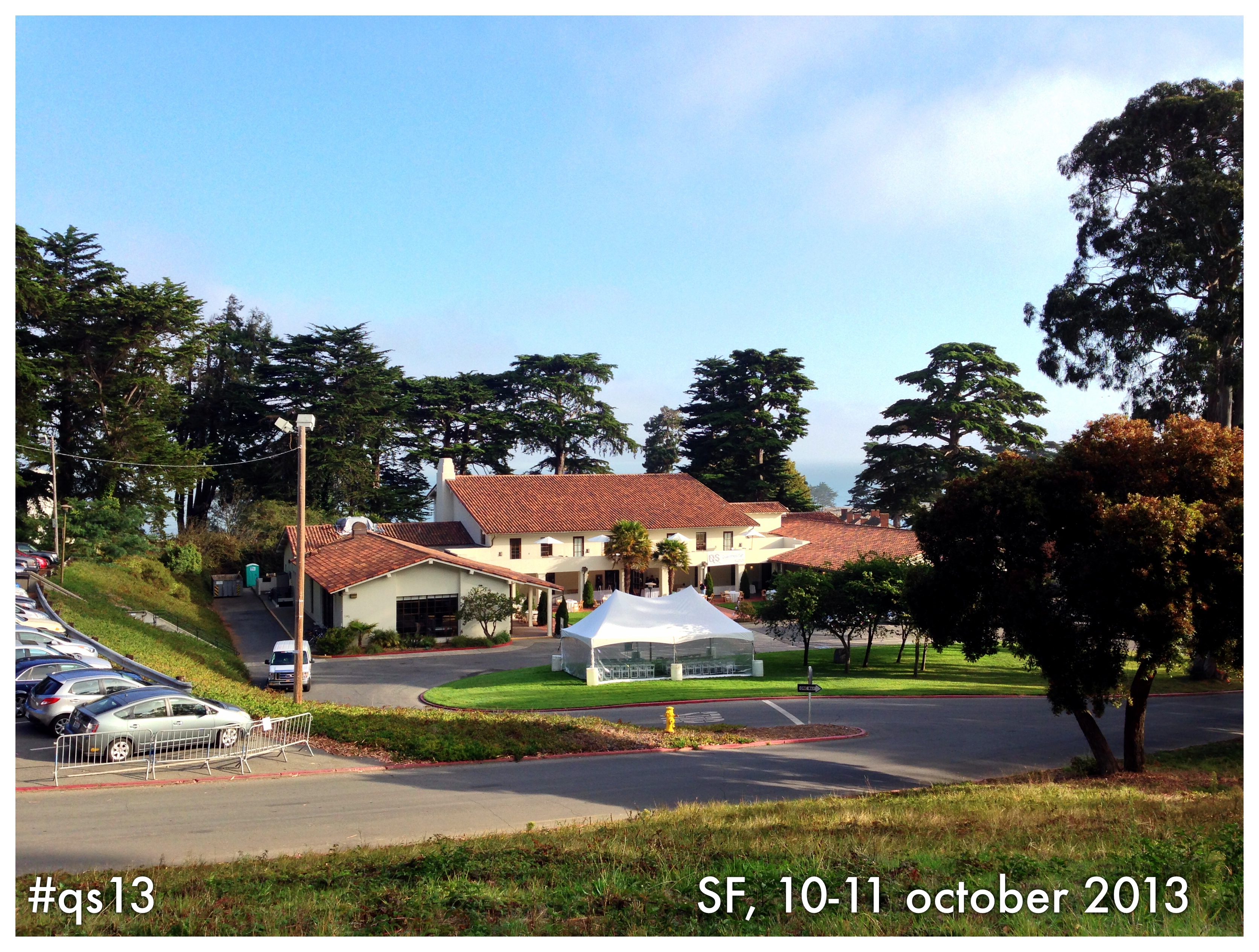
#qs13 took place in San Francisco's Presidio. Image credit: Whitney Erin Boesel
#qs13 took place in San Francisco’s Presidio. Image credit: Whitney Erin Boesel

It’s almost a week now since I attended the 2013 Quantified Self Global Conference in San Francisco, and I’m still not sure where to begin with my summary of the event itself. Instead of jumping in with an overview, this time I’ll cover my own session—in which what started out as asking how researchers studying Quantified Self could better connect with each other became an (at times) intense debate about what Quantified Self is, what Quantified Self should be, and what role (if any) academic or institutional research and researchers should have within the Quantified Self community.

more...

2890229556_1b90a0ab83_z

“If it weren’t for all of you I would have lost my mind at my job.” Its a familiar refrain that I hear at lots of small conferences and, occasionally, on Twitter backchannels. Its an amazing compliment to hear that your weak tie with someone means so much, but its also an immensely troubling prospect. Hundreds (maybe thousands?) of highly trained professionals have serious misgivings about their professional associations, their home institutions, and maybe even their life’s work. I had heard variations on this theme most recently this past week when I helped out at the (really, really cool) Engineering, Social Justice, and Peace Conference hosted here in Troy, New York. The conference was attended by an array of people: engineers, educators, activists, and social scientists like myself. Some people worked in industry, others in academia, and a significant portion worked for NGOs like Engineers Without Borders. And again, I just want to reiterate: No single person said the exact phrase above, and I certainly don’t want to (mis)characterize any of the attendee’s personal feelings about their jobs or work. Rather, what I witnessed at ESJP is more accurately characterized as a feeling of “coming home.” Think of it as the positive side of the same disaffected coin. This anecdotal trend was in my mind when I read this Seattle Times article about social scientists finding new and inviting homes in tech companies. Are social scientists finding better intellectual homes in industry than in academia? Or am I connecting two totally separate phenomena? Is it just the pay? More to the point: can social scientists do more and better things for the world working in Silicon Valley than the Ivory Tower?
more...

[This is cross-posted at Its Her Factory.]

A few recent events and articles/news items have me thinking, in a somewhat disjointed fashion, about both what it means to “do theory” or to practice philosophy, and how, exactly, one should go about doing and practicing these things.

YouTube Preview Image

In particular, it seems like philosophy is stuck between being reduced to a hard science, on the one hand, and being incompatible with “digital humanities,” on the other. And in the end I think this double-bind has the very troublesome effect of discouraging, silencing, and marginalizing what could be the most innovative things philosophy has to offer science, digital humanities, and contemporary intellectual life more generally.  more...

From #whatshouldwecallgradschool titled "Reflecting Back on Grad School"
From #whatshouldwecallgradschool titled “Reflecting Back on Grad School”

Here is a list of skills that, as a grad student at one time or another, I’ve been expected to have with absolutely no offered training whatsoever: more...

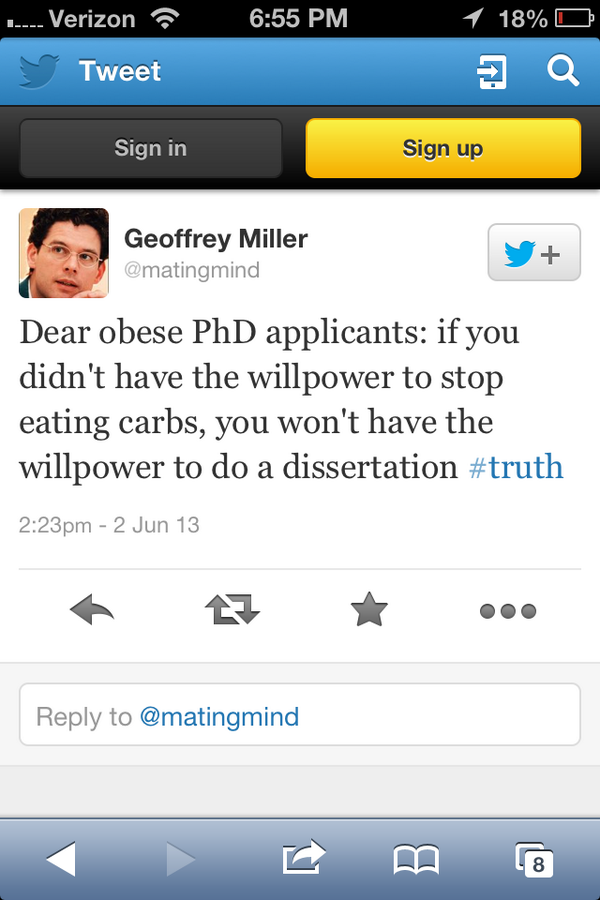
Earlier this month Geoffrey Miller (@matingmind), the now infamous professor of evolutionary psychology, punched out a really awful tweet. He said this:

Tygm

His message is blaringly ironic, coming from a man who clearly lacked the willpower to think through the statement before making it public #truth. Although he later deleted the tweet, his followers had already created screen captures and sent the image into a spiraling journey of virality.

I don’t want to spend my post today harping on Miller’s particular indiscretion. Others have been busy doing just that, quite eloquently, for the past week and a half. Instead, I want to talk about Fatness as a moral stigma, and the ways in which Miller’s tweet first, exposed the moral nature of body size and in turn, offered Fat Activists an opportunity to publicly reject Fatness as a marker of immorality. This was facilitated, I argue, by the affordances of new technologies coupled with determined and conscientious social actors. more...

Below is a partial transcript of the introductory remarks I gave at the Technoscience as Activism Conference held in Troy, New York and hosted by Rensselaer Polytechnic Institute from June 26-28, 2012. The conference was funded by the NSF’s GK-12 Fellowship Program

I almost never read my presentations but we’re short on time and there’s a lot of stuff that I want to share with you and I don’t want to miss anything. Publicly reading an apology for reading in public is an apt metaphor for what this conference is about, or more precisely what it is a response to. When I approached Dr. Ron Eglash about putting on this conference I told him I only wanted to do it if I could make the conference reflect the kind of politics espoused in the presentations. I don’t want to invite a bunch of brilliant people to Troy, who want to talk about democratizing science and technology, and keep them in a single room all day. Troy should benefit from some of your unique experiences, and the people of Troy have done some amazing things that I think the visitors will enjoy and appreciate. more...

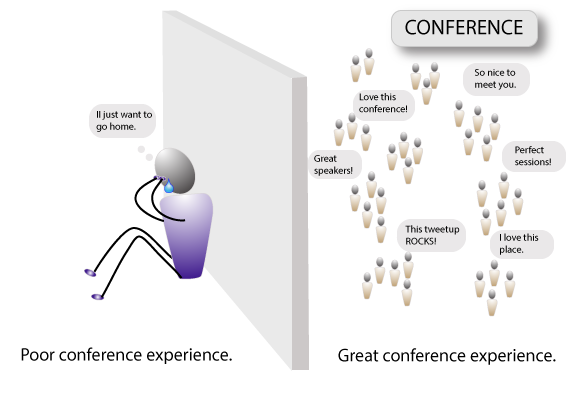
Academic conferences: the model needs to change.

As the 2012 meeting of the American Sociological Association (#ASA2012) kicks into gear, I want to use this post to start a conversation about a somewhat-contentious topic: academics’ use of Twitter, particularly at conferences. I begin by extending some of what’s already been written on Cyborgology about the use of Twitter at conferences, and then consider reasons why some people may find Twitter use off-putting or intimidating at conferences. I close by considering what Twitter users in particular can do to ease the “Twitter tensions” at ASA by being more inclusive. The stakes here include far more than just “niceness”; they include as well an opportunity to shape the shifting landscape of scholarly knowledge production.

more...

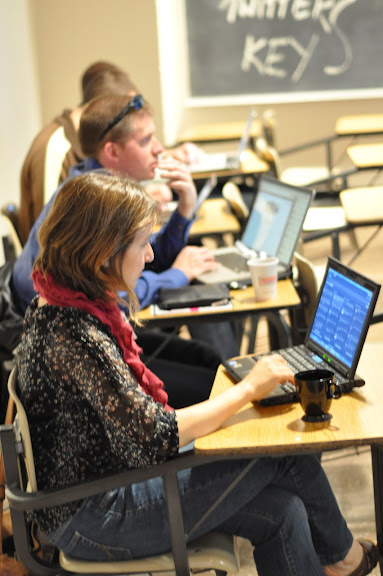
The Twitter backchannel in action. Photo by Rob Wanenchak.

Last weekend, I had the double pleasure of presiding over an excellent panel on technology and protest, and having David Banks as my extremely capable Twitter backchannel moderator and Livestream assistant. Both the Twitter backchannel and the Livestream were getting their first serious run as an institutional part of Theorizing the Web, and despite some minor difficulties with mics and cameras, I think they were a clear success.

But the experience of presiding on a panel and then serving as the backchannel moderator for the panel immediately after delivered some interesting revelations regarding what these kinds of technology actually mean for how our conferences work, and for how we engage with and in our spaces of knowledge production.

more...