ableism

AccessibleIconVector-1
Pic via: The Accessible Icon Project

Let me start by saying, accessibility is a human rights issue, not an afterthought. Frankly, it’s an insult to people with disabilities that access is even a subject of debate. And yet…

The Technology, Equality, and Accessibility in College and Higher Education Act (i.e., the TEACH Act) is currently under debate in congress. The legislation requires that technologies used in college classrooms be accessible to all students, including students with disabilities. It is entirely possible that you have not heard of the TEACH Act, but for those who it most affects—students with bodies that deviate from the norm—the stakes are quite high. The bill has some strong support, but also strong opposition, from surprising sources.   more...

Note: This article touches on slut shaming, body shaming, homophobia, and ableism.

original (2)

I love swearing. It’s a weekly miracle that my essays don’t include “totally fucked” or “fucked up and bullshit” in every paragraph. If I were reborn as a linguist, I would study swearing and cursing. I watch documentaries about cursing, I play a lot of Cards Against Humanity, and this interview with Melissa Mohr, the author of Holy Shit: A Brief History of Swearing is my favorite episode of Slate’s just-nerdy-enough podcast Lexicon Valley. If you’ve been in the audience when I give a presentation, you probably (despite my efforts to the contrary) heard me swear five or six times. I would hate to live in a world without swearing because it would be fucking dull. Unfortunately, my (and most English-speaking people) love of swearing comes into direct contradiction with inclusionary social politics. I need a new arsenal of swear words that punch up and tear down destructive stereotypes. Every time I swear, I want to be totally confident that I’m offending the right people. more...

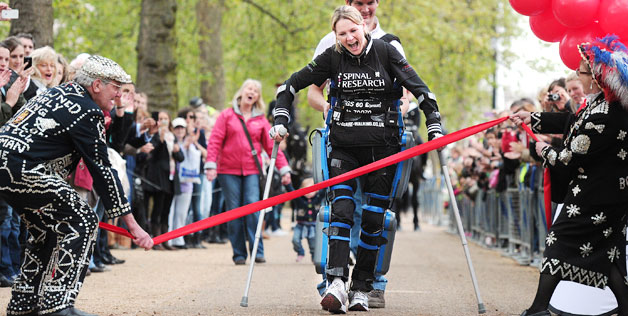
Claire Lomas, promoted by the media as the “Bionic Woman” just made history and sparked inspiration by completing the London Marathon in 16 days.  Averaging about two miles per day, this woman with below-chest paralysis walked her 26.2 miles to finish proudly in 36,000th place. She did so with the help of a ReWalk suit, a supportive family, and the goal of raising money for spinal cord injury research.

The ReWalk suit resembles closely the Ekso suit that I wrote about previously and raises similar questions. They both enable people with spinal cord injuries to stand and walk. They are heralded by the companies as tools to enhance rehabilitation, mobility, and dignity. They also both leave me with the same uncomfortable uncertainty: is this progress or ableism? (See link above for a full delineation of this uncertainty and a lengthy discussion in the comments section). more...


Eksobionics, a company dedicated to the augmentation of the human body, recently developed Ekso—a “bionic exoskeleton that allows wheelchair users to stand and walk.” In this post, I pose a question to which I honestly do not have a definitive answer: Does this development represent human progress or does it further perpetuate the subordination of physically impaired bodies?

I begin with a brief background on the company and a description of the product. I then present arguments for both progress and ableism. Finally, I question —but ultimately defend—the validity of this dichotomy. more...

Photo by Howard Schatz

My post today comes from a class on ableism and disabled bodies that I taught earlier this past semester in my Social Problems course. Its inception came from the point at which I wanted to introduce my students to Donna Haraway’s concept of cyborgs, because I saw some useful connections between one and the other.

My angle was to begin with the idea of able-bodied society’s instinctive, gut-level sense of discomfort and fear regarding disabled bodies, which is outlined in disability studies scholar Fiona Kumari Campbell’s book Contours of Ableism. Briefly, Campbell distinguishes between disableism, which are the set of discriminatory ideas and practices that construct the world in such a way that it favors the able-bodied and marginalizes the disabled, and ableism, which is the set of constructed meanings that set disabled bodies themselves apart as objects of distaste and discomfort. In this sense, disabled bodies are imbued with a kind of queerness – they are Other in the most physical sense, outside and beyond accepted norms, unknown and unknowable, uncontrollable, disturbing in how difficult they are to pin down. Campbell identifies this quality of unknowability and uncontainability as especially, viscerally horrifying.

more...