uncategorized

all photos in this post by nathan jurgenson

The role of new, social media in the Occupy protests near Wall Street, around the country and even around the globe is something I’ve written about before. I spent some time at Occupy Wall Street last week and talked to many folks there about technology. The story that emerged is much more complicated than expected. OWS has a more complicated, perhaps even “ironic” relationship with technology than I previous thought and that is often portrayed in the news and in everyday discussions.

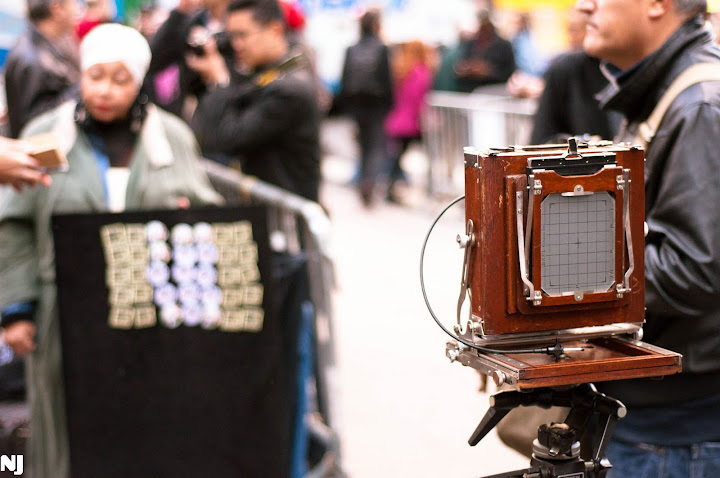
It is easy to think of the Occupy protests as a bunch of young people who all blindly utilize Facebook, Twitter, SMS, digital photography and so on. And this is partially true. However, (1) not everyone at Occupy Wall Street is young; and (2), the role of technology is certainly not centered on the new, the high-tech or social media. At OWS, there is a focus on retro and analogue technologies; moving past a cultural fixation on the high-tech, OWS has opened a space for the low-tech.

What I want to think about there is the general Occupy Wall Street culture that has mixed-feelings about new technologies, even electricity itself. I will give examples of the embracing of retro-technology at OWS and consider three overlapping explanations for why this might be the case. I will also make use of some photographs I took while there. more...

A short psychological thriller titled “Take This Lollipop” has been circulating The Net just in time for Halloween. This video depicts a presumably psychotic man (pictured above) hacking into and becoming irate about, YOUR Facebook page. Not only does the video literally embody fears about digital security, but captures numerous aspects of the web 2.0 culture. The experience is personalized and interactive, as the video incorporates actual content from each viewer’s Facebook page. The experience is augmented, as the viewer’s heavily digital experience (watching an online video, about digital insecurity, incorporating the viewer’s own digital persona) elicits corporeal fear. Finally, the experience is broadcast and re-documented, as people tape themselves watching the video and share their reactions on YouTube (see one after the jump). more...

A couple of weeks ago, I wrote a post about theOWS movement. Jeffrey Goldfarb, from the blog Deliberately Considered, provided insightful comments on this post which led to a productive e-mail exchange, and a plan to continue the conversation. Last week, I posted on Deliberately Considered, and Goldfarb responded. Below is my DC post and Goldfarb’s response.

Slacktivism Matters

Posted on Deliberately Considered by Jenny Davis, October 6th, 2011

Two recent posts on Deliberately Considered, one by Scott Beck and the other by Jeffrey C. Goldfarb, examine the role of social media in social movements. They demonstrate the way in which social media allow us to harness the power of the people, contest the interpretations of mainstream media, organize, and mobilize. They show how, through communications on digital networks, physical bodies have come together in physical spaces, protesting both ideological and material conditions.

The points made by Beck and Goldfarb are important ones, yet I believe they should be extended. In particular, we need to address not only the ways in which these new media technologies work to bring together and document the physical bodies who occupy physical spaces. We also must examin the role of those whose activism never goes beyond the digital realm. We must look at how this latter group, colloquially referred to as slacktivists, matter.

Slacktivism matters in two interrelated ways: 1) increasing visibility and 2) generating a particular zeitgeist surrounding social movements. more...

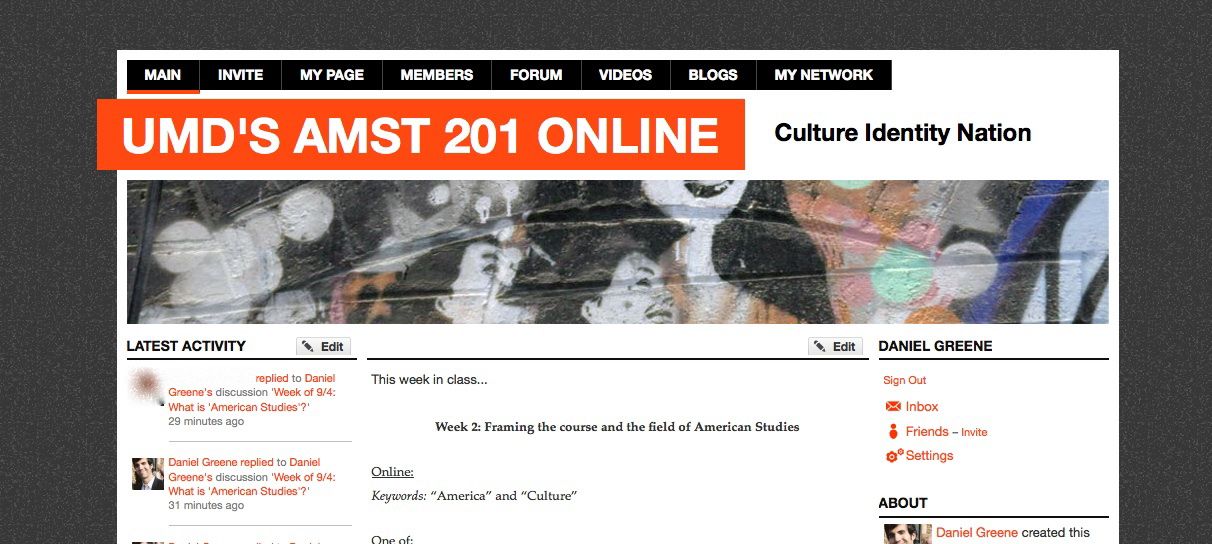
AMST 201 landing page
Landing page for my Introduction to American Studies course site

The research and writing featured on this blog generally build from the idea that digital information and material experience do not exist in two separate realities à la The Matrix, but coexist in one augmented reality where the informational and material play a role in constituting one another. This semester at the University of Maryland, I’m exploring those moves between informational spaces and physical ones in a mixed online and in-person version of an American Studies course and wanted to share and get feedback on the process of planning, designing, and enacting this augmented introduction to the study of American culture. This design is specific to this course and its themes, but the general principles should work elsewhere and the cultural context of online higher education is important to anyone involved with that system.

Online education is playing a larger and larger role in the economics and pedagogies of the increasingly privatized and ‘right-sized’ U.S. research university and my course is certainly a product of these changes. At the same time, researchers and teachers in a variety of disciplines are using this moment of transition to question and revise outdated pedagogical routines and are designing classes to better facilitate multiple levels of student engagement with reference to the real world outside the ivory tower. I would have loved to have explored interventions such as contract grading or an increased focus on navigating and designing information systems within my course but, like many graduate students, I had to work within the boundaries of an already existing syllabus. The general shape of the course was set; so my pre-semester work become more about adjusting the course’s weaknesses and flexing its strengths within the mixed online/in-person environment, knowing that the different parts of that environment would lend themselves to different kinds of learning. I organized this effort around a few core principles that apply in any learning environment: more...

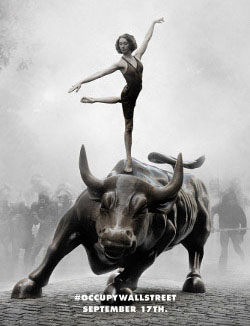
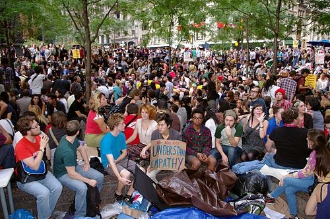
On September 17th, Wall Street was occupied. It was occupied by the bodies of about 500 protesters. The protests, aimed at the unjust hierarchical distribution of resources, were explicitly modeled after the Arab Spring, utilizing social media and a “leaderless” structure to organize a democratic revolution. Unlike the reality of the Arab Spring, however, protesters were asked to remain peaceful as they occupy downtown Manhattan for months to come. They aim to swell their numbers up to 20,000 or more.

What I find interesting about this, is the strategic emphasis on spontaneity, the romanticizing of the grass roots element, and framing, by organizers, of this event as something of a “social media” revolution. This is interesting because these protests are highly organized–not spontaneous. Organizers even went through a “practice run” before the day of the main event. Moreover, the protests do not stem from a small group of renegade revolutionaries, but are linked to established organizations–especially Adbusters, who launched the call for this protest months in advance. 

more...

This is the first of a two-part series dedicated to answering the question “Do we need a new World’s Fair?” It is an honest question that I do not have an answer to. What I aim to do here is share my thoughts on the subject and present historical data on what these sorts of events have done in the past. In the first part, I explore what previous World Fairs have accomplished and what we must certainly avoid. The second part will investigate what a new 21st century fair might look like, and how it would help our economy. Part 2 is here.

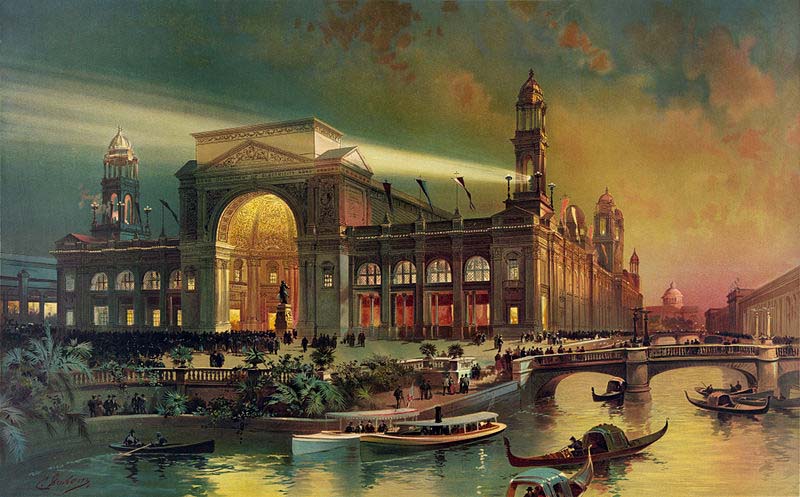
electrical building
By Charles S. Graham (1852–1911). Printed by Winters Art Litho. Co. (Public domain c/o Wikipedia.)

A “World Fair” is first and foremost, a grand gesture. They are typically months if not a few years long. Think of them as temporary theme parks, or the the olympics of technological innovation. They are extravagant, optimistic, and brash. But let’s be clear here. All of the World Fairs held in Paris, Chicago, New York, and Seattle had sections that are deeply troubling. The 19th century fairs had human zoos and “freak shows.” The 20th century fairs were, in many ways, launchpads for the corporate take-over of the public realm and the plundering of the very cities that hosted them (more on that later). But that does not mean the form is totally useless or inherently bad. In fact, a new American World Fair might be just what we need. more...

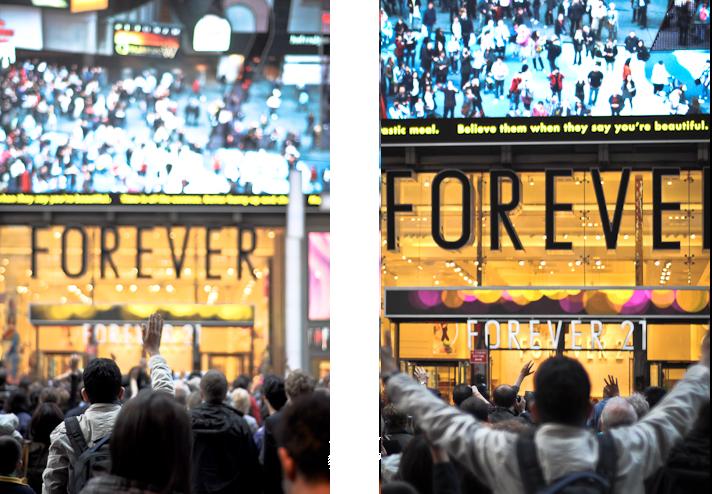
Crowds in Times Square waving at themselves on the big screen. Photos in this post by nathan jurgenson.

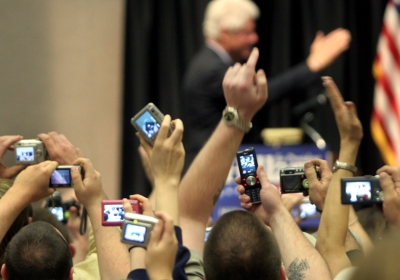
Something interesting has been happening in Times Square this summer. As has been occurring for a century, the crowds gather with necks perched upward looking at all the famously illuminated billboards. But now there is a new type of buzz in the crowd: they stand together facing the same direction, cameras held high and their hands waving even higher. They are not just watching celebrities or models in this the most expensive ad-space in the world; today, they are watching themselves on the big screen.

This is all part of a new billboard for the company Forever 21 currently in use in Times Square in the heart of New York City. It struck me that this billboard is nothing short of a consumer-capitalism-happening, and started snapping photos and thinking about what this all might mean. more...

I have archived trials and tribulations surrounding WiFi access at the 2011 American Sociological Association with the hope it might encourage ASA to give higher priority to this issue at future events:

#ASA2011 folks: RT if you’d be willing to pay higher registration fees to have wifi @ #ASA2012
pjrey
August 15, 2011

more...

I recently met with the marketing department of a local organization. They asked to speak with me about social media, and how they could incorporate it into their “branding.” I know nothing about branding (or marketing) but I love to talk about social media, and I wanted to support my community, so I agreed.

The meeting attendants included: two marketing executives, their 21 year old intern, and me. We sat down at a table in a coffee shop. The three of them looked at me expectantly with blank yellow note pads and poised pens.

We began with the two (middle aged) marketing executives asking about the isolation caused by social media, and wondering if we should be “weeping” over the demise of our culture. Specifically, one of the executives described a “sad” situation, in which a group of students were waiting for the bus, engrossed with their phones and oblivious to each other.

I gently calmed their dystopian fears and explained the fallacy of digital dualism. The 21 year old intern immediately relaxed and chimed in. “We are being social” she said in reference to the bus stop phone incident.

The second marketing executive was unconvinced. She referenced a recent family trip, where her two teenage sons were on their iphones, missing the historic landmarks that the family had traveled to see. This time, I did not need to say a thing. The intern informed us all that looking at their phones in no way means that they missed the historic landmarks. “We are used to a lot of things going on around us at the same time, it’s how we do things” she said. The executives looked at me questioningly. I backed up the intern, explaining that the re-articulation of an experience is part of the experience for many youth today (although this is debatable).

You think you have been given the most difficult task of your life – hiring the best SEO Company to provide various on-page and off-page optimization services to your company. There is the internet today to help you ease your work. You open your PC or laptop, type relevant keywords on Google to get the list of dozens of companies promising to offer the best SEO services. You randomly pick up a few companies and start calling them up to gather necessary details about each one. But, as you speak with the customer support team, you get exhausted knowing the same things over and again. I mean all the SEO companies are saying the same things. Surely, it will make your job all the more difficult. As a potential customer, how you are going to hire the best SEO firm for your company?Click here if you want to get more about the raleigh seo.

Instagram is one of the most preferred social media used for sharing images while offering a great platform for businesses to share their products’ images, ideas and interacting with people all over the world. With this website, bloggers can share their opinions with alluring images and business owners get the opportunity to advertise the services and products that they offer. Instagram helps you market your business effectively in a cost effective manner. Key market players of different niches also use this platform to showcase their services and products to reach maximum target customers instantly. Search engine optimization, or SEO, allows you to promote your product by increasing traffic to your website via Internet marketing. By implementing SEO Adelaide techniques on your product website, you can gain better visibility in search engine results. Increasing the search engine results ranking can bring in higher quantities of traffic to the site, which advertises your product to a greater number of potential customers. This can be done at no cost to yourself, but you can enhance your efforts by paying for some services.

For instance, you can share photos containing snapshot of any even of your company, satisfied customers using your services or products, or any other relevant pictures. To promote your brand on Instagram and to reach thousands of followers in a day, it is necessary to have many targeted followers. An Instagram account without followers can’t be used to advertise your brand. The more genuine followers you have, the more the impact of your promotion efforts will be.

You can get only a bunch of followers by using proven strategies such as following others, posting interesting photos, leaving genuine comments on other people’s photos, sharing your posts on other social networking sites, tagging your photos, and using # tags. Additionally, these strategies are time consuming and will take many months and even years to collect any particular number of genuine followers. There is an effective way that can help you reach your goals of getting a large volume of followers within a short period of time – Buy instagram followers helpwyz.com

Buying followers is the best strategy to get many Instagram followers quickly. Even if you have started Instagram, you can get thousands of genuine like in a day or two. The targeted followers you buy will help you promote your brand and increase popularity on Instagram. Additionally, when people will see that you have a large following, they will be encouraged and will follow you to keep up with your interesting posts.

more...

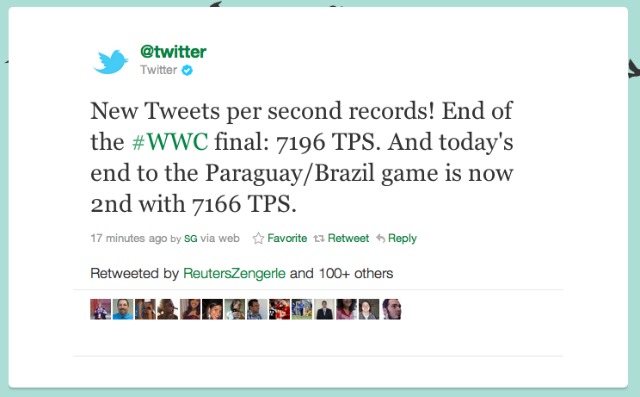
Twitter users set two new records for tweets per second on Sunday during the FIFA Women’s World Cup. The top spot goes to the championship game between USA and Japan, with 7,196 tweets per second at the end of the match. The Paraguay vs. Brazil game takes the number-two spot with 7,166 tweets per second. Putting this in context, this surpasses both the super bowl (4,063 tweets per second) and the 2010 Men’s World Cup final (3,283 tweets per second). If soccer is the world’s game, we see here a global community, where physically and geographically dispersed people come to share in a conversation. Moreover, we see the increasing integration of new technologies as an integral part of social experience, as tweets about the game became part of the event itself, and the event, by setting a new tweets/second record, became part of technological history.