archive

giphy


Pulled from the archives, here are some posts we’ve written on the (sexy/racist/postmodern) ghosts, ghouls, and goblins that pervade our augmented society.

giphy-1

Cultural Appropriation: Halloween’s Post-Modern Problem by PJ Rey

Modern Myths: Mundane Enchantment and Creating Ghosts by David A Banks

The Atemporality of “Ruin Porn” The Carcass & the Ghost by Sarah Wanenchak

And the email was coming FROM INSIDE THE HOUSE by Sarah Wanenchak

The Zombie in Film (FULL ESSAY: Parts I, II, and III) by Dave Paul Strohecker

Have an Anti-Racist Halloween: Some Materials From Around The Web by Jenny Davis

Postmodern Ghouls by Jenny Davis

Yet Another LiveJournal Post by David A Banks
giphy-1

Google

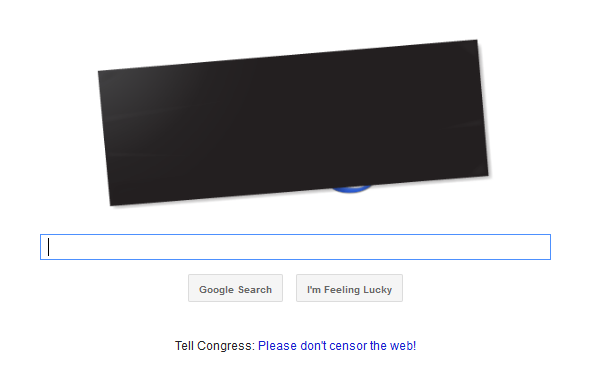
While tech geeks and Silicone Valley execs have been decrying the the Stop Online Piracy Act (SOPA) and its sister bill, the Protect Intellectual Property Act (PIPA), today, January 18, 2012, marks an unprecedented day of action across the Web. The protest is remarkable because it fully utilizes the Internet’s unprecedented ability blend top-down and bottom-up organization. Specifically, the action achieves maximum effect because major sites like Wikipedia, Google, and reddit have blacked-out part or all of their pages while individuals users also black-out their own profile images and posts. As a result, it is near impossible to surf the Web without encountering a deluge of such images and, thereby, being encouraged to do at least a little investigating into why these bills provoke such ire.

Interestingly, the debate of intellectual property law pits new, social media against old, broadcast media. For this reason, the anti-SOPA movement may be the clearest demonstration to date of social media’s superior capacity for organizing and mobilizing social or political movements (vis-à-vis broadcast media). New media is clearly winning the messaging war. A recent Zogby poll finds that 60% of likely voters are aware of the SOPA legislation and 68% of them oppose it; the same number also believe it infringes on First Amendment Rights.

The following is as scrapbook-style archive of anti-SOPA images from across the Web. more...

Credit: Andrew Hoppin

Cyborgology editors Nathan Jurgenson (@nathanjurgenson) and PJ Rey (@pjrey) live-tweeted Personal Democracy Media’s From the Tea Party to Occupy Wall Street and Beyond: A Flash Conference. Below is an archive of the conference backchannel (also here) as well as the video from the event. more...

Robert Manning
George Ritzer


The Consumer Studies Research Network held a pre-conference to ASA 2011 at the University of Las Vegas.  The following is an archive of audio, video, and images from the concluding spotlight panel featuring: more...

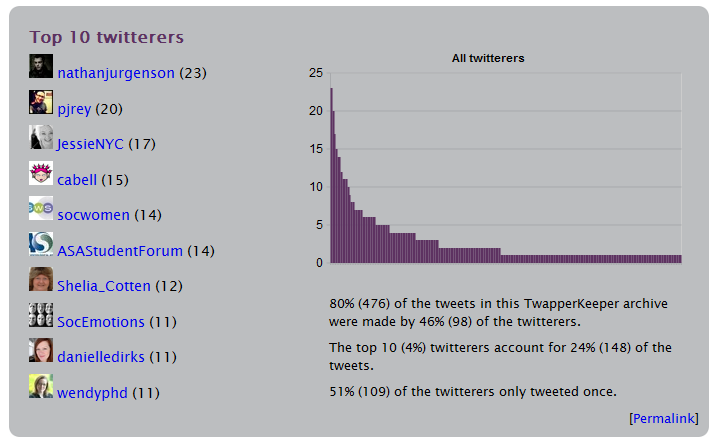
Tweet archive for ASA 2011

TwapperKeeper archive URL: <http://twapperkeeper.com/hashtag/ASA2011>

Total tweets: 1349
Total twitterers: 317
Total hashtags tweeted: 157
Total URLs tweeted: 143 more...

Tweet archive for ASA 2011

TwapperKeeper archive URL: http://twapperkeeper.com/hashtag/ASA2011

Total tweets: 596
Total twitterers: 211
Total hashtags tweeted: 86
Total URLs tweeted: 90

In a post titled “Why Journals are the Dinosaurs of Academia,” I recently considered whether traditional journals may, increasingly, be serving to hinder the communication of ideas, rather than optimally facilitating such exchanges.  I argued two main points:  1.)  We need to get beyond the notion that the mere fact that journals is printed makes it somehow more legitimate than digital-only journals.  2.) In the age of the Internet, conventional articles may no longer be the most efficient way to communicate some ideas (which was the original justification for making journals the centerpiece of disciplinary discourses).

Over the past few days, Twitter has been abuzz with academics discussing another, related issue: Whether disciplinary discourses are better facilitated by non-profit, open-access journals or proprietary, pay-walled journals.  I have archived that discussion below and will follow up with my own thoughts later in the week. more...