Here’s a breakdown of free vs. paid apps in Apple’s App Store:
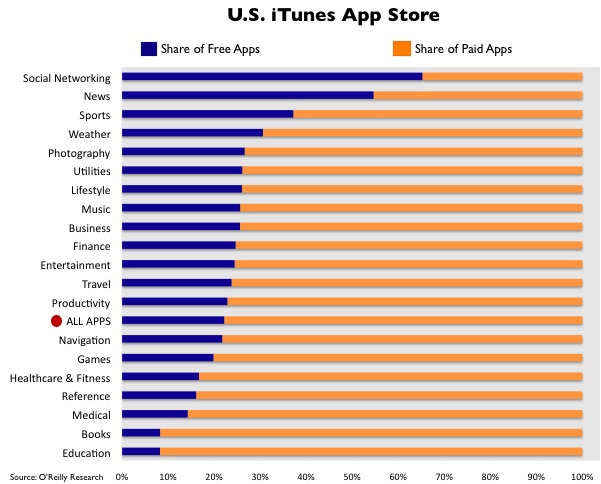
The thing that catches my eye: that the “Education” category has the highest proportion of paid apps. You might think—if you had no experience with the educational publishing industry in our country—that educational applications might be made freely available more frequently than games, financial or photography programs, just to name a few. Sadly, anyone that’s had to pay tuition and/or buy publications like textbooks, journals or (ahem…) magazines from educational institutions know that’s not the case: the educational publishing industry somehow manages to rip-off everyone in an age where content is becoming cheaper and cheaper in every other sector, and where you would think the primary creators and consumers of the content (educators and students) would be the most willing to freely share their knowledge. To be honest, I can imagine a bunch of explanations, but I’m not entirely sure why this is the case. This is just one more example of the trend though.