higher education

Don Tapscott, who wrote Growing Up Digital, has an intriguing post in which he argues that the digital revolution will transform higher education to such an extent that it will lead to the demise of the university as we know it.

In Tapscott’s view, small, selective liberal arts colleges (SLACs) are the best prepared to meet the challenges of the digital era. Other types of institutions will not fare as well:

But the same cannot be said of many of the big universities that regard their prime role to be a centre for research, with teaching as an inconvenient afterthought, and class sizes so large that they only want to “teach” is through lectures.

These universities are vulnerable, especially at a time when students can watch lectures online for free by some of the world’s leading professors on sites like Academic Earth. They can even take the entire course online, for credit. According to the Sloan Consortium, a recent article in Chronicle of Higher Education tells us, “nearly 20 per cent of college students — some 3.9 million people — took an online course in 2007, and their numbers are growing by hundreds of thousands each year. The University of Phoenix enrolls over 200,000 each year.”

It’s a provocative notion, but I think that Tapscott underestimates the the importance of context (setting, peer pressure, inspirational professors) for motivating students. And, on the “demand” side – or student side, I think that Tapscott wildly overestimates the level of student motivation to learn in the absence of the context of higher education. Later in this long post, he points to the example of MIT’s Open CourseWare as an ideal type:

Some are taking bold steps to reinvent themselves, with help from the Internet. Massachusetts Institute of Technology, for example, is offering free lecture notes, exams and videotaped lectures by MIT professors to the online world. Anyone in the world can watch the entire series of lectures for some 30 courses….

While there may be interest in online courses of ‘star’ professors, I’m skeptical about how motivated potential students might be without the incentives of grades, deadlines for assigned coursework, and the degree credential. Tapscott’s over-the-top optimism about the desire for learning among the generation he refers to as “digital natives” strikes me the perspective of someone who has never stood before a class and asked, “has anyone done the reading?” only to look out a sea of blank faces staring back.

The prediction about the demise of the university may be premature, as were the predictions a decade or more ago, about the demise of the book. Yet, like the publishing of books has been modified somewhat by the growth of e-books and digital readers like the Kindle, the university – rather than come to an end – is going to be modified in some ways by the digital revolution. At this point, no one knows what those changes will be.
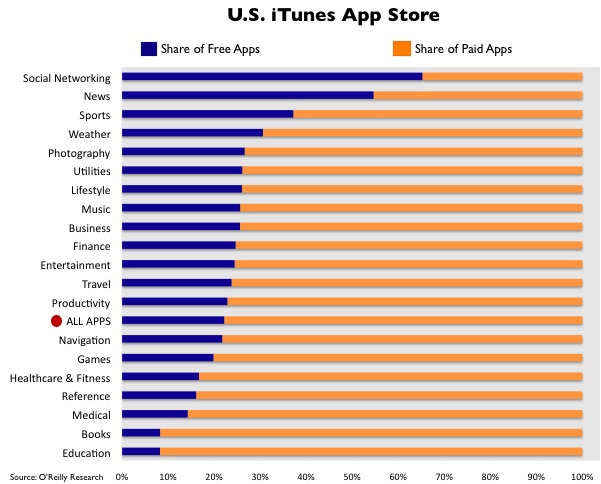
Here’s a breakdown of free vs. paid apps in Apple’s App Store:

The thing that catches my eye: that the “Education” category has the highest proportion of paid apps. You might think—if you had no experience with the educational publishing industry in our country—that educational applications might be made freely available more frequently than games, financial or photography programs, just to name a few. Sadly, anyone that’s had to pay tuition and/or buy publications like textbooks, journals or (ahem…) magazines from educational institutions know that’s not the case: the educational publishing industry somehow manages to rip-off everyone in an age where content is becoming cheaper and cheaper in every other sector, and where you would think the primary creators and consumers of the content (educators and students) would be the most willing to freely share their knowledge. To be honest, I can imagine a bunch of explanations, but I’m not entirely sure why this is the case. This is just one more example of the trend though.

One of these days, I’m going to make it to Educause. Until then, I will just have to enjoy the presentations I can find online. Sarah “Intellagirl” Robbins has a marvelous slide show (featuring an excellent use of presentation software) called “Social Media and Education: The Conflict between Technology and Institution Education, and the Future,” that’s well worth a look:

Educause08: Social Media and Education

View SlideShare presentation or Upload your own. (tags: 2.0 web)

I was especially struck by her insights about the changing role of educators in an information society, “relating as more experienced co-creators rather than employers.” I see this in my own practice in a class I’m teaching now in which I, and all my students, are blogging. I’ve done this a couple of times before in different classes, and in those courses I’m very much a co-creator with them in that experience rather than an employer-professor-taskmaster.

There are some real challenges to this as a pedagogical strategy, however. If you’re working at anything but an elite educational environment with hyper-motivated and highly skilled students, it can be difficult to get students who are used to the professor-taskmaster model of education to engage with social media in a meaningful way. The dilemma is not the technology, per se, as much as it is the shift in pedagogical strategy. For students who are used to mass-produced textbooks and multiple-choice exams, the unboundedness of blogging and being in charge of their own educational process can be a little disorienting at first. I try to provide my students with some structure by giving them a “Blog Rubric” for how their blogs will be graded, but still, this can be a daunting task for some students. Even with these challenges, I think it’s worth the effort for those us in front of the classroom to figure out ways we might shift our pedagogical strategy so that we become a “guide at the side” rather than the traditional taskmaster-employer-professor.

This article, from Bryan Alexander, illustrates the way that the web, and particularly social media gets talked about in higher education. Bryan does a nice job deconstructing the – ooh~scarey! – image that the editors chose to run with the story. It’s ironic that this piece appears at just the time when the Pew Internet & American Life Project has just released a new study, co-authored by sociologist Barry Wellman, that addresses the talk the pervasiveness of social media in most households.  The study also points out the way that technology brings families together. Here’s a little from the Pew on this study:

Instead of driving people apart, mobile phones and the net are helping them maintain social ties, says the Pew Internet report.

Families are also among the keenest users of technology, the survey of 2,252 Americans revealed.

It found that using the net was often a social activity within families, with 51% of parents saying they browsed the web with their children.

“Some analysts have worried that new technologies hurt family togetherness, but we see that technology allows for new kinds of connectedness built around cell phones and the internet,” said Tracy Kennedy of the University of Toronto who helped to write the Networked Families report.”

Personally, I see a lot of fear and loathing of technology in higher education.   And, I also come from a family that’s not incredibly connected via social media.   Yet, my chosen-family and friends are mostly in the “always connected”  category.  I’m curious about what sorts of things people may be hearing and seeing unfold in their own institutions of higher learning and in their own families. Do you see the kind of disconnect that my juxtaposition of these two articles suggests?