digital content

Here’s a breakdown of free vs. paid apps in Apple’s App Store:
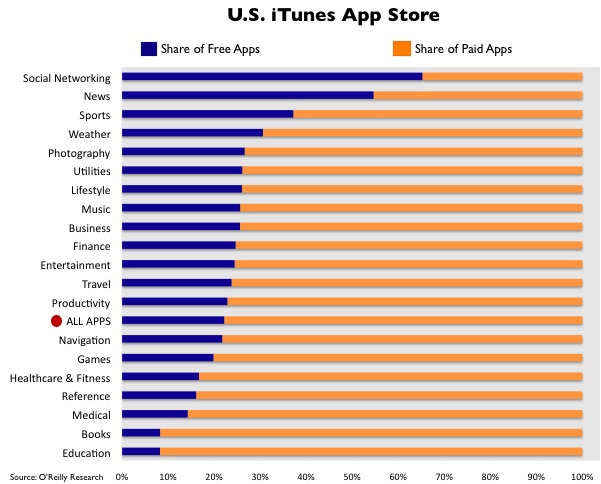
The thing that catches my eye: that the “Education” category has the highest proportion of paid apps. You might think—if you had no experience with the educational publishing industry in our country—that educational applications might be made freely available more frequently than games, financial or photography programs, just to name a few. Sadly, anyone that’s had to pay tuition and/or buy publications like textbooks, journals or (ahem…) magazines from educational institutions know that’s not the case: the educational publishing industry somehow manages to rip-off everyone in an age where content is becoming cheaper and cheaper in every other sector, and where you would think the primary creators and consumers of the content (educators and students) would be the most willing to freely share their knowledge. To be honest, I can imagine a bunch of explanations, but I’m not entirely sure why this is the case. This is just one more example of the trend though.

One of the perils of the migration to digital format for books, magazines and newspapers is the threat to future generations of researchers.  In fact, one researcher warns that if the current trend continues we could be headed for what he calls a “digital dark age,” according to  Jerome P. McDonough, assistant professor in the Graduate School of Library and Information Science, at the University of Illinois at Urbana-Champaign.    The problem is accessibility.  Think about trying to play a VHS tape when there are only DVD players around.   Several generations from now, much of the data we produce could be lost to inaccessibility.   And, there’s a lot of digital content, some 369 exabytes at last count.

This has very real implications for sociologists and not just those of us interested in digital culture.  A wide range of cultural products (think music or film) and large data sets (think GSS or the census data) are vulnerable to being lost in the “black hole” of inaccessibility.   Part of the problem is proprietary software.   Remember WordPerfect?   Perhaps you don’t, but it was a word-processing software product popular about ten years ago.  Today, no one’s using and few people have heard of it.  If you get a file that’s saved as a WordPerfect document, chances are you won’t be able to open the file and whatever content is in there is effectively lost.    McDonough argues that part of the solution to the threat of a “digital dark age” is open source software.   So, for example, instead of using Microsoft Office’s proprietary “Word” program, if more people used OpenOffice (an open source word processing program), digital content would be less vulnerable to unintentional loss.

That’s only part of the solution, however, as digital content is also vulnerable to deliberate erasure:

“E-mail is a classic example of that,” he said. “It runs both the modern business world and government. If that information is lost, you’ve lost the archive of what has actually happened in the modern world. We’ve seen a couple of examples of this so far.” McDonough cited the missing White House e-mail archive from the run-up to the Iraq War, a violation of the Presidential Records Act.

The power to erase content, and along with it, important parts of the historical record is not new.  This is something that sociologist Poulantzas warned about thirty years ago in his Political Power & Social Classes.   The difference with digital content is that this sort of information-power-move is much easier to accomplish.    Of course, some are taking note of this threat, and working on preservation through a variety of digital collections, but sociologists would be wise to take note of this trend.