Seeing as the last post on this blog was almost a year ago, we’ve decided to make it official and close Contech. We’ll keep the blog online for posterity’s sake, but there will be no new posts and we’ve turned off comments.
Thanks for reading!
Seeing as the last post on this blog was almost a year ago, we’ve decided to make it official and close Contech. We’ll keep the blog online for posterity’s sake, but there will be no new posts and we’ve turned off comments.
Thanks for reading!
Here’s a breakdown of free vs. paid apps in Apple’s App Store:
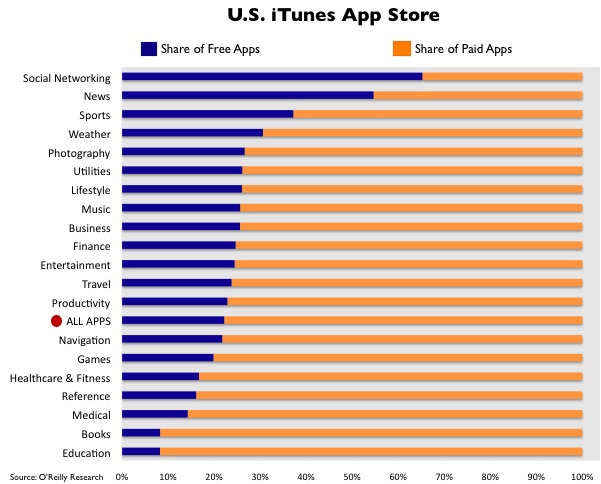
The thing that catches my eye: that the “Education” category has the highest proportion of paid apps. You might think—if you had no experience with the educational publishing industry in our country—that educational applications might be made freely available more frequently than games, financial or photography programs, just to name a few. Sadly, anyone that’s had to pay tuition and/or buy publications like textbooks, journals or (ahem…) magazines from educational institutions know that’s not the case: the educational publishing industry somehow manages to rip-off everyone in an age where content is becoming cheaper and cheaper in every other sector, and where you would think the primary creators and consumers of the content (educators and students) would be the most willing to freely share their knowledge. To be honest, I can imagine a bunch of explanations, but I’m not entirely sure why this is the case. This is just one more example of the trend though.
Tim O’Reilly saying interesting things about Twitter:
In many ways, Twitter is a re-incarnation of the old Unix philosophy of simple, cooperating tools. The essence of Twitter is its constraints, the things it doesn’t do, and the way that its core services aren’t bound to a particular interface.
It strikes me that many of the programs that become enduring platforms have these same characteristics. Few people use the old TCP/IP-based applications like telnet and ftp any more, but TCP/IP itself is ubiquitous. No one uses the mail program any more, but all of us still use email. No one uses Tim Berners-Lee’s original web server and browser any more. Both were superseded by independent programs that used his core innovations: http and html.
What’s different, of course, is that Twitter isn’t just a protocol. It’s also a database. And that’s the old secret of Web 2.0, Data is the Intel Inside. That means that they can let go of controlling the interface. The more other people build on Twitter, the better their position becomes.
O’Reilly also talks about how a large number of Twitter users use Twitter to update their Facebook status, which is exactly what I do. In fact, if you just look at my Facebook page, it looks like I’m fairly active on Facebook, until you realize that almost every thing in my profile is pulled into Facebook from other services like Twitter or this blog (via Wordbook). Thanks to the demise of Scrabulous, I pretty much only go to Facebook any more to approve friend requests and respond to people who comment on my Twitter status inside of Facebook instead of in Twitter.
I’m not sure what a Facebook that tried to untie its data from its interface like O’Reilly recommends would look like though. But an even more interesting thought experiment is this: what about a Facebook-like social networking system that works like laconi.ca, a Twitter-like piece of software where the data itself is decentralized on individual instances of the software but where the social networking & communication can occur across each instance. This gets around both the centralization of interface, but also the centralization of data, which is really a much bigger problem!
These articles from June’s Atlantic are a couple months old now, but they’re still interesting reads in the run-up to the election:
In a sense, Obama represents a triumph of campaign-finance reform. He has not, of course, gotten the money out of politics, as many proponents of reform may have wished, and he will likely forgo public financing if he becomes the nominee. But he has realized the reformers’ other big goal of ending the system whereby a handful of rich donors control the political process. He has done this not by limiting money but by adding much, much more of it—democratizing the system by flooding it with so many new contributors that their combined effect dilutes the old guard to the point that it scarcely poses any threat.
Improvements to the printing press helped Andrew Jackson form and organize the Democratic Party
[…]
Abraham Lincoln became a national celebrity, according to the historian Allen Guelzo’s new book, Lincoln and Douglas: The Debates That Defined America, when transcripts of those debates were reprinted nationwide in newspapers, which were just then reaching critical mass in distribution beyond the few Eastern cities where they had previously flourished
[…]
Franklin Delano Roosevelt used radio to make his case for a dramatic redefinition of government itself, quickly mastering the informal tone best suited to the medium.
[…]
And of course John F. Kennedy famously rode into the White House thanks in part to the first televised presidential debate in U.S. history, in which his keen sense of the medium’s visual impact, plus a little makeup, enabled him to fashion the look of a winner (especially when compared with a pale and haggard Richard Nixon).
[…]
The communications revolution under way today involves the Internet, of course, and if Barack Obama eventually wins the presidency, it will be in no small part because he has understood the medium more fully than his opponents do.
I’m generally inclined to agree with Vint Cerf’s twist on the famous anarchist slogan: “Power corrupts. PowerPoint corrupts absolutely.”
Nonetheless, many of us—myself included—end up using slides anyway. Done right, they can be a very good thing.
A fellow Minnesota grad student, Wes Longhofer, has developed a unique style of PowerPointing that really pushes the technology in a fun, creative way. I asked Wes if I could share one of his presentations here, and he said yes: Download the PDF here.
I’ll mostly let the slides speak for themselves, but a few notes:
And Wes puts this kind of care into every lecture he prepares. (Is anyone surprised he won our department’s Outstanding Graduate Instructor Award this year?)
Contexts just wrapped up the first phase of an online roundtable titled, “The Social Significance of Barack Obama.” We solicited short statements from six sociologists on the significance of Obama’s candidacy and potential Presidency, published them online & then held a group discussion about the statements in the comments.
The roundtable is now public & open for comments. One of the topics that hasn’t been discussed much so far has been the role of technology & the internet in Obama’s campaign and in modern politics generally. In fact, I might just head over over there and chime in about this myself… Come join us & encourage others to join in as well!
Last night I watched the DNC live online and I had a very odd thought: the politics of watching this online was getting in the way of my enjoyment…of a political convention? Well, given the fact that conventions focus more on personalities & life stories than political issues, it shouldn’t be surprising that most of my political thoughts had to do with two technology issues surrounding the online broadcast: Microsoft’s Silverlight technology (being used to stream the video online) and high speed internet policies in the US.
Silverlight & online multimedia
On the web generally, a set of “open standards” has more or less won out: HTML, CSS and Javascript. There are several good competing web browsers out there today, they all support HTML, CSS & Javascript1 and no one company owns these technologies: instead independent groups like the W3C oversee these technologies.
In the space of digital audio & video, however, proprietary technologies still reign. Adobe’s Flash technology now dominates online video (think YouTube for an example of Flash video). Relative to the mess of competing, incompatible video formats of a few years ago (remember the Real Player?), this is probably, on balance, a good thing for internet video. However, Flash exists solely to benefit Adobe, and they are free to decide what platforms to support, what features to add (& not add), and what hoops developers must jump through to develop Flash.
Silverlight is Microsoft’s brand new attempt to defeat Flash. It basically does exactly what Flash does, actually has some very cool features and is, in some ways, more “open” than Flash.2 Last night was my first experience with Silverlight—I installed it just to watch the DNC as we recently got rid of our TV—and I was impressed. Our “television” is a 20-inch iMac and in fullscreen mode, the video looked great. Easily the best streaming live video I’d ever seen…minus a few hiccups. (More on the hiccups in a bit.)
So what’s the problem? Like Flash, Silverlight ultimately exists to serve Microsoft’s interests, and Microsoft clearly plans to use Silverlight to extend Windows into the web. Signing lucrative deals with NBC over the Olympics and now with the political conventions, Microsoft’s plan is clear: get Silverlight on every PC and then make Flash irrelevant. There are open alternatives, though: Ogg Theora for video and, of course, the web standards trio of HTML, CSS & Javascript for building rich web applications. If keeping the web open, competitive & free of control by any one entity is an important political objective in the digital age, then Silverlight is something to watch closely.
Broadband in the US
The video did look reallly good though. Most of the time. Every few minutes the video would degrade form crisp near-HD quality to the blurry, pixelated YouTube-quality video we know and love, and about ten times or so throughout the evening, the video cut out entirely for 10-30 seconds. Now I don’t know if the problem was on my end or theirs, though we do pay for one of the faster DSL plans, so our internet is reliably fast. Either way, my point is that it was just good enough to give us a glimpse of how the internet could work as a fully-functioning alternative to traditional television or cable. The technology is there. It works well. The only thing holding it back is more bandwidth made more widely available. To borrow the great Ted Stevens phrase, we just need bigger tubes. Yet the US now lags behind other countries in internet infrastructure:
Americans invented the Internet, but the Japanese are running away with it.
Broadband service here is eight to 30 times as fast as in the United States — and considerably cheaper. Japan has the world’s fastest Internet connections, delivering more data at a lower cost than anywhere else, recent studies show.
Accelerating broadband speed in this country — as well as in South Korea and much of Europe — is pushing open doors to Internet innovation that are likely to remain closed for years to come in much of the United States.
The speed advantage allows the Japanese to watch broadcast-quality, full-screen television over the Internet, an experience that mocks the grainy, wallet-size images Americans endure.
Why isn’t this happening here? Government policy:
In sharp contrast to the Bush administration over the same time period, regulators here compelled big phone companies to open up wires to upstart Internet providers.
In short order, broadband exploded. At first, it used the same DSL technology that exists in the United States. But because of the better, shorter wire in Japan, DSL service here is much faster. Ten to 20 times as fast, according to Pepper, one of the world’s leading experts on broadband infrastructure.
(And here’s a more in-depth article on this topic from a few years back.)
Since starting Contexts Blogs, I’ve had the chance to talk to lots of blogging sociologists. I’ve also had the chance to have a lot of non-blogging sociologists firmly say “No!” to my attempts to turn them into blogging sociologists. So over the last year or so I’ve given a lot of thought to why more sociologists don’t blog, and of course the related question of what drives those who do. Here’s my current take on the topic:
The most common reason people give for not blogging is that they “don’t have time.” Of course, as is usually the case with this excuse, it’s not much of a reason. Of course we’re all pressed for time. Yet most of us manage to do things that are not all-work all-the-time. What you’re really saying when you say you “don’t have time” is that while there may be aspects of blogging that appeal to you, there are other downsides or barriers to blogging that outweigh the perceived benefit. Not to make it sound all “rational choice” or anything either (Hey, I know my audience): I think people get the feeling they wouldn’t like blogging (or don’t like blogging, if they’ve already dipped their toes in a bit), and when you press people on what it is about blogging that scares them off, it’s not “time” necessarily, but other factors that make them uncomfortable with the idea:
Expertise: If you look at most “sociology blogs,” a good percentage of the posts are not “academic sociology” in any way. They’re bloggers, who happen to be sociologists and sometimes write about sociology, but frequently just blog about their lives, current events, news in the discipline, etc. In other words, many would probably be bloggers if they weren’t sociologists.1 And when they do blog about sociology, the aim isn’t to do “public sociology” really: it’s insider shop talk & if people want to follow along, great. If not, fine.2
However, when you tell a sociologist “Hey, you should blog,” that’s not usually what they have in mind. A blog is supposed to be some grand “public sociology” project, where you bring your knowledge to the masses. In particular, you bring general knowledge to the masses. Yet many sociologists are not comfortable speaking in public about anything beyond their tiny niche.3 This makes sociologists tough interviews for the media, and it’s not ideal for blogging either. If you’re blogging primarily as a sociologist, then that can be kind of paralyzing to the extent that you feel you’re “speaking for the field.”
Audience: Of course, we “speak for the field” all the time. In our teaching and also in our writing: it’s called a “literature review.” Sociologists are very comfortable writing for a small audience they share a lot of common knowldge with. There’s good & bad that comes from this, but when it comes to blogging, the fact that anyone can read what you write—and that they might, gasp, misinterpret something you write—terrifies some people. The only safe writing is writing where you’re guaranteed that people reading it will think exactly like you and likely agree with you as a result, right? The fact that a few months of blogging can be worth more than a career’s worth of academic publishing in your Google search results scares people, too.4
Then there are bloggers. To blog, you have to be comfortable with an unknown audience. Most bloggers I’ve talked to about this admit they mostly write for themselves. Not because of vanity (well, not only because of vanity anyway), but because the process of writing is something they enjoy, and if they can find a small community of readers & fellow bloggers, it’s a lot of fun.
Technological: I’m a geek, so to me it seems natural that academics, who are, at root, experts in knowledge & information, should be attracted to information technology. However, there’s a strong anti-technology aesthetic in academia. Academics who “don’t get computers” are often proud of this fact, bragging that they still handwrite their notes and papers and prefer the chalkboard to powerpoint or even transparencies. Perhaps this is just a rational response, for an expert to react strongly against the utopian notion that technology is going to let everyone be an expert. Perhaps it’s just a response to reading student paper after student paper plagiarizing Wikipedia. Whatever the reason, academics are generally hesitant to adopt new technology. Of course there are exceptions, but in general it’s perfectly acceptable to reject technology and those that are “early adopters” are often viewed as naive, frivolous and kind of obnoxious. (And maybe we are.)
So my point is that asking sociologists to blog is asking them to engage with (potential) audiences they’re not comfortable with, about a wider range of topics than they’re used to speaking about in a public & authoritative way, using a publishing vehicle towards which they are, at best, unfamiliar and, at worst, cynical & distrustful.
The other side of the coin is who could & should be blogging: people comfortable writing for many audiences; who feel constrained by only ever speaking about their tiny little corner of sociology & are both adventurous enough to write about a wide variety of topics yet still articulate, honest & humble enough to be clear about when they’re taking educated guesses, when they are truly representing the state of the research and when they’re just having fun; and people who see blogging & the internet for what they are: potentially powerful tools that can be either good, bad or ugly depending on how they’re used.
As you might have noticed from the new (temporary) banner, changes are afoot here at Contech.
I started this blog as a primarily internal resource for people blogging at thesocietypages.org. Whenever people asked me questions about things like blogging clients or adding images to posts, I’d write up a post on Contech instead of just replying individually. However, I always secretly wanted to do a little more with this blog as well…
So from now on, all the “how-to” posts will now live at thesocietypages.org/howto. Contech is, as the blog description says, now about putting “social media in social contexts.”
What does that mean? Technology and the internet are obviously huge factors in our lives today. Most importantly, in our opinion, they are huge factors in our social lives. New “social media” and technologies like blogs, wikis and social networking sites have the potential to radically impact and transform the way we communicate, the relationships we form, and the knowledge we have about the world. The web is full of sites filled with daydreaming and speculation about the social causes and consequences of new technologies. Our aim is to bring social science research and theory to bear on these new developments. What does empirical data about social media technologies tell us? And in the absence of hard data, we think we can offer at least slightly more informed daydreaming and speculation. 🙂
I’m going to have company! Jessie Daniels and Chris Toulouse will both be writing for Contech. Chris specializes in teaching with technology & Jessie studies the convergence of race, gender and digital media. Over time, we hope to have others join in as well!1
So pardon the mess for a little bit, but the new Contech will be up and running very soon!
We read things on a computer screen differently than we do on paper. It’s that simple. So when we write for the web, we should be aware of that and write accordingly. This is easier said than done for academics accustomed to writing books and journal articles.
Michael Agger has an interesting article on “usability expert” Jakob Nielsen’s thoughts on writing for the web. Using techniques like eye tracking, researchers have learned a lot about how people read on a computer screen versus paper and what writers need to do about it. In short, people don’t read: they scan. How to make scannable text?
- highlighted keywords (hypertext links serve as one form of highlighting; typeface variations and color are others)
- meaningful sub-headings (not “clever” ones)
- bulleted lists
- one idea per paragraph (users will skip over any additional ideas if they are not caught by the first few words in the paragraph)
- the inverted pyramid style, starting with the conclusion
- half the word count (or less) than conventional writing