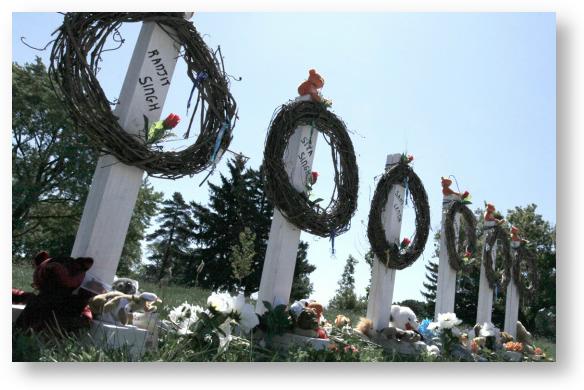
As many of you already know, on August 5, 2012, a gunman opened fire on a worshippers at the Sikh Gurdwara temple in Oak Creek, Wisconsin, killing six and wounding three others before killing himself. The shooter has been identified as Wade Michael Page, an Army veteran and a self-avowed White supremacist.
Clearly, words fail to convey the nature of sadness, loss, and tragedy of this event. My thoughts and heartfelt condolences go out to the families of those killed and wounded, to the Sikh American community in the area, and to all of us as human beings that have to live with the specters of hate and violence all around us.
Many, particularly our political leaders, have called this incident “senseless,” implying that it was an irrational and mindless act of a clearly deranged and mentally ill individual. Unfortunately, this sentiment fails to acknowledge that rather than being an isolated incident, these killings have a cause and origins beyond just the state of mind of the person who pulled the trigger.
In other words, there is an entire sociological context to why the killer did this and multi-level factors that, without a doubt, influenced the killer’s thinking and pushed him to go on his murderous rampage.
War on Terrorism an its Collateral Victims
We can start with the legacy of 9/11 and how the subsequent “war on terrorism” has left thousands, perhaps even millions, of innocent bystanders in its destructive wake. Specifically, I am talking about groups such as Muslim Americans, Indian Americans, and particularly Sikh Americans who have been and continue to be perceived as terrorists. In the case of Sikh Americans, much of this unfortunate association is tied to the turban that the men are required by their religious faith to wear. In other words, in the mind of racists, they’re just another “towelhead” and therefore, a terrorist.
Unfortunately, this is not the first time that Sikh Americans have been murdered as a direct result of 9/11 hysteria — four days after the events of September 11, 2001 and as illustrated in the excellent documentary “A Dream in Doubt,” Balbir Singh Sodhi was similarly gunned down by a person who perceived him to be a Muslim and therefore, a terrorist. On top of that, political “leaders” such as Peter King, Michelle Bachmann, and Joe Walsh continue to use their public positions to fan the flames of suspicion and hostility against all Muslim Americans, all of which lends more credibility to equating Muslim with terrorism.
Combined with the recent killings at Oak Creek WI, these incidents of racial and religious hate against anyone perceived to be Muslim are not isolated. Instead, they are part of a clear pattern of mistaken identity, irrational guilt by visual association, and jingoistic hysteria that unfortunately is still alive and well almost 11 years after 9/11.
Anti-Immigrant Nativism and Xenophobia
Related to this is the nativist and xenophobic climate that has also strengthened since 9/11. Much of this anti-immigrant sentiment is seemingly directed at undocumented immigrants but unfortunately, since hate and intolerance cut a wide path, has also been directed at legal immigrants and racial/ethnic groups that have a large immigrant contingent such as Latinos and Asian Americans.
The foundation of this nativist and xenophobic climate is the belief that immigrants (legal and otherwise) are not “real,” “legitimate,” or “official” Americans. In turn, much of this belief about who is a “real” American is based on the “traditional” image of those who are perceived as “real” Americans — White, Protestant, and born in the U.S. Those who lack one of more of these traits are seen by many who do as being inferior to them and therefore, less deserving of the identity of “American.”
This conscious and unconscious perceived distinction between “real” Americans and “foreigners” exists even though immigrants and groups of color make numerous contributions to the U.S.’s political, economic, and cultural institutions by bridging diplomatic divides across national borders, investing in local communities and creating jobs for Americans, and by connecting the U.S. to an increasingly globalized and transnational world and diverse cultures.
Economic Competition Breeds Racial Hostility
As I tell my students, one of the most time-tested and historically consistent patterns in U.S. society is that whenever there is economic competition, almost always, it will lead to racial/ethnic hostility. This pattern has played itself out over and over again, and has involved basically every group of color throughout American history. Unfortunately, it is also rearing its ugly head once again today as the current recession has led to heightened competition for increasingly scarce economic resources between Whites (who have been used to enjoying a relatively stable standard of living but are now fighting just to stay in the middle class) and groups of color and immigrants (who many Whites perceive to benefiting at their expense).
Unfortunately, the conditions for heightened economic competition seem to be the “new normal” as the gulf between the rich (i.e., the top 1%) and everyone else (i.e., the 99%) widens, as powerful financial corporations continue to exploit their political influence and gain unfair advantages in their quest to maximize profit, and as ordinary Americans fight even more among ourselves for an ever-decreasing piece of the pie. With all of this in mind, the bottom line then becomes more clear — when people feel threatened, they become defensive at guarding whatever they have left and hostile towards those who they feel are try to take what is “rightfully” theirs.
White Backlash
This lashing out is part of a larger “White backlash” movement that I have described before. Faced with changing demographics and how the U.S. population is gradually but surely becoming less White, the emergence of people of color, the continuing consequences of globalization and decline of U.S. superiority around the world, and the normalization of economic instability, it is not hard to see why many Whites have become quite angry that their position at the top of the American racial hierarchy is being politically, economically, and culturally threatened.
At the moment, many White Americans are feeling very threatened and upset by the changes taking place around them — their economic stability and standard of living are on the decline and, unable to see the institutional forces that have created this situation, their immediate reaction is anger and to lash out at “those other people” — minorities and immigrants.
This individual and collective anger has emboldened many Whites to publicly, forcefully, and passionately lash out at people of color and immigrants, with examples across the spectrum of violence. The institutional shifts and societal changes that influence these examples of backlash are not going away any time soon, and unfortunately, neither do I expect such examples of White backlash to decline any time soon.
And Yet, There is Still Hope
In the midst of all this, there is still the bright glimmer of humanity — the power of shared suffering to bring us together and for friends and strangers to unite and help each other out. No doubt you have seen examples of this in the aftermath of natural disasters as our fellow Americans donate what little discretionary funds we have to help those who have lost everything, and for friends, neighbors, and total strangers to help rebuild the devastated communities.
The same thing can happen in the wake of acts of violence like this. As the NBC News clip below shows, the memorial service to honor the six Sikhs killed was attended by about a thousand people, with Sikhs and non-Sikhs united in grief, sympathy, and hope.
Ideally, no, it should not take mass murders and hate crimes like this for us as Americans to wake up, recognize how our social environment and many of our national leaders are fanning the flames of hostility and hate, and to unite as human beings to change things are the better. But it seems that sometimes it takes a spark to light a fire, something Asian Americans have known for a while now.
Maybe this is that spark and hopefully, there will be a silver lining to this tragedy.
This article originally published at Asian-Nation.org and is copyrighted © 2013