Tag Archives: race

Resisting Race Labels

Australian census forms

An Associated Press exclusive, published by Fox News, explained that 1 in 14 people went beyond the standard race labels in the 2010 Census.

The figures show most of the write-in respondents are multiracial Americans or Hispanics, many of whom don’t believe they fit within the four government-defined categories of race: white, black, Asian/Pacific Islander or American Indian/Alaska Native. Because Hispanic is defined as an ethnicity and not a race, some 18 million Latinos used the “some other race” category to establish a Hispanic racial identity.

Three million other write-ins came from Arabs, Middle Easterns, or others and who don’t fully view themselves as “white.”  To better understand this, the Associated Press turned to a sociologist.

“It’s a continual problem to measure such a personal concept using a check box,” said Carolyn Liebler, a sociology professor at the University of Minnesota who specializes in demography, identity and race. “The world is changing, and more people today feel free to identify themselves however they want — whether it’s black-white, biracial, Scottish-Nigerian or American. It can create challenges whenever a set of people feel the boxes don’t fit them.”

Though it’s personal, racial identity is also a highly political issue.  Census data are used to distribute federal aid, draw political districts, and enforce anti-discrimination laws.  As the number of people identifying as “some other race” has jumped 3.7 million in the last decade, it’s clear this personal and political issue will be something Americans continue to wrestle with.

Teaching Privilege to the Privileged

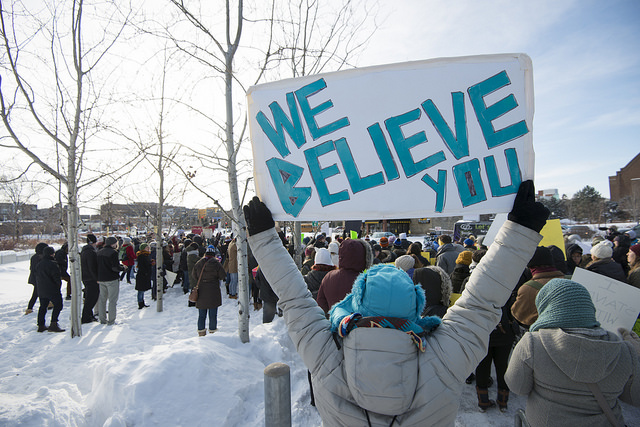
Photo by Josh Parrish via flickr.com

Photo by Josh Parrish via flickr.com

In explaining the purpose of a “whiteness studies” course—the kind offered at dozens of colleges and universities in the United States—Alex P. Kellogg of CNN.com writes:

The field argues that white privilege still exists, thanks largely to structural and institutional racism, and that the playing field isn’t level… educators teach how people of different races and ethnicities often live very different lives… The field has its roots in the writing of black intellectuals such as W.E.B. DuBois and author James Baldwin.

Still, “In the past, detractors have said the field itself demonizes people who identify as white.” So, then, how did the courses manage to continue, and why are they seemingly on the way out now?

Eduardo Bonilla-Silva, a sociologist at Duke and the University of Pennsylvania, tells the reporter:

Having Obama is, in a curious way, putting us behind… You have a growing racial apathy. People are telling you, I don’t want to hear about race, because we’re beyond that… But we still have a white America and a Black America.

Another sociologist, Charles Gallagher of Philadelphia’s La Salle University, said that he still has to convince his students that inequality exists. “Gallagher, whose latest book Retheorizing Race and Whiteness in the 21st Century was published last year,” writes Kellogg, ” is teaching intro to sociology and urban sociology classes this semester, and while neither is strictly about race, he says he will make a point to talk about modern day racism and white privilege.” Still, “he expects his students—and increasingly, some who are black—will be there ready to push back, particularly on the notion that race still determines your lot in life.” Gallagher asks:

How do we talk about race or racism in the United States if people think racism is gone?

The article moves on to discussing whether, rather than being privileged, whites, as some suggest, are actually racially oppressed. Charles Mills, a philosopher at Northwestern, argues, Kellogg says, “that whites in particular have a self-interest in seeing the world as post-racial. In that world, everyone has an equal opportunity to succeed… your success in life [is] not determined by race, but by how hard you work.”

Even as classes on whiteness studies instead seem to be dissolving into interdisciplinary race courses which take the time out to discuss persistent white privilege, academics tell CNN.com that “in the past, conservatives derided whiteness studies as anti-white, but the sharp vitriol against the discipline has largely subsided,” and the field “continues to evolve.” As Kellogg concludes, “While the filed is still little known in some corners, and criticized as being obsolete in others, proponents of… whiteness studies say that’s all part of progress.”

American Apartheid, Melting Slowly?

Racism Moves Out, peterthomasryan.com

Not only are we excited to spot Reynolds Farley’s Contexts article “The Waning of American Apartheid?” (Summer 2011) written up in the Emerging Ideas section of the Jan.-Feb. 2012 issue of the Utne Reader, we’re gratified to see the elegant treatment it’s received in this “Citings & Sightings” style piece. Further, the illustration (at left, by Peter Thomas Ryan, peterthomasryan.com) wittily gets at the heart of the matter. What more could an editorial team want?

In the piece, the author writes of Farley and his fellow researchers’ extensive longitudinal work:

The stats aren’t evidence of a racial utopia (50 percent of thse respondents hit the edge of their [neighborhood] comfort zone at a 50-50 split in racial composition), but from block to block, there does seem to be slow and steady progress toward a more racially integrated America.

To check out the original article, please visit contexts.org.

Continuing Jim Crow

The New Jim Crow CoverAs part of its programming surrounding our national day of remembrance in honor of the Rev. Dr. Martin Luther King, Jr., NPR’s Fresh Air brought scholar Michelle Alexander to the airwaves last night for a lengthy, fascinating interview. Alexander is the author of the book The New Jim Crow: Mass Incarceration in the Age of Colorblindness (out now in paperback with an introduction by Cornel West), and she argues persuasively that, as NPR puts it, “Jim Crow laws are now off the books [but] millions of blacks… remain marginalized and disenfranchised… denied [the] basic rights and opportunities that would allow them to become productive, law-abiding citizens.”

President Reagan’s “War on Drugs,” was declared, Alexander said, “primarily for reasons of politics—racial politics. … [these] racially coded ‘get-tough’ appeals on issues of crime and welfare appeal to poor and working-class whites, particularly in the South, who were resentful of, anxious about, and threatened by many of the gains of African Americans in the civil rights movement.” And so, the war on drugs keeps Jim Crow going:

Today there are more African Americans under correctional control—in prison or jail, on probation or parole—than were enslaved in 1850, a decade before the Civil War began. …In major American cities today, more than half of working-age African American men are either under correctional control or branded felons and are thus subject to legalized discrimination for the rest of their lives

In her conversation with Dave Davies, Alexander went on to explain that, while some, like criminologist David Kennedy, believe  anyone who’s spent time with those fighting the “War on Drugs” on the streets (that is, who’ve embedded themselves with beat cops and DEA agents) knows there’s absolutely no racial or class bias in who gets arrested for what, she’s found in her research that, for white, middle and upper-class kids, some crimes are considered rites of passage deserving only a slap on the wrist. Just a few miles away, though, in poorer communities of color, those same crimes (particularly the sale and use of recreational drugs, which Alexander says research has found are no more likely among black adolescents than white nor among poor vs. white kids) relegate young people to a life haunted by the legal system.

This, Alexander goes on, is especially problematic in one under-examined way: the disenfranchisement of convicted felons means that these communities, which are already low in political capital (that is, real political power), don’t even have the ability to go and vote for the politicians (and policies) that might improve their lives. “My experience and research has led me to the regrettable conclusion that our system of mass incarceration functions more like a caste system than a system of crime prevention or control,” concludes Alexander.

Why is Running so White?


TXU Energy Turkey Trot

Photo by Neighborhood Centers, Inc. via flickr.com

Each year, millions of people don their running kicks and spandex and tackle 5ks, marathons, or the occasional holiday-themed trot.  But if you’ve ever been a spectator at one of these events, you’ve perhaps wondered what Runner’s World’s Jay Jennings found himself asking: Why is running so white?

That perception has become a truism, and the truism has become a joke. The popular satirical blog “Stuff White People Like,” which spawned a best-selling book, ranked marathons 27th on the original list, just behind farmer’s markets and Wes Anderson movies. More scathing was comedian Daniel Tosh, in a segment on his show, Tosh.0: “The only reason marathons are still around is so 20,000 white people can chase three black guys through the streets of Boston like the good old days.”

But how valid is the idea that running is indeed a predominantly white sport?

Well, pretty darn valid, according to Running USA’s recently released biannual National Runner Survey. Media spokesperson Ryan Lamppa stresses that its methodology is “opt-in” from 60 running organizations and clubs nationwide and “may not be a representative sample” of the actual running population. Still, the numbers, compiled between January and May 2011 from nearly 12,000 respondents, are eye-opening: “Core runners” (who tend to enter running events and train year-round) are 90 percent Caucasian, 5.1 percent Hispanic, 3.9 percent Asian/Pacific Islander, and, in perhaps the most startling figure, only 1.6 percent African-American. (The sample adds up to more than 100 percent because respondents could mark more than one choice.) Those numbers are consistent with ones from other surveys, such as Runner’s World’s, and have remained low even as the number of runners has grown by 56 percent in the past decade, according to the National Sporting Goods Association. (The overall population, from the 2010 U.S. census, is 72 percent white, 16 percent Hispanic or Latino, 13 percent black or African-American, 5 percent Asian, and 1 percent American Indian or Alaska native.)

The next question is, of course, why?  In search of an answer, Jennings spoke with new and well-trod runners, heads of national organizations, race directors, coaches, and academics. Through these conversations, he learned that there are economic and cultural roadblocks for minority runners.

Arguably, a potential runner needs only a pair of shoes (barefoot enthusiasts will say not even that!) and a stretch of pavement, but in reality, dedicated running shoes (which RunnersWorld will tell you elsewhere are critical for injury prevention) and race entrance fees can be expensive, especially over time.  Moreover, poor neighborhoods may lack safe avenues for running.

In fact, ‘Lacking a safe place to exercise’ was the top barrier to physical activity for African-American women age 40 and older in a 2000 study published in the journal Health Psychology. In another study for the American College of Sports Medicine in 2007, Simon J. Marshall, Ph.D., the lead researcher, commented,

“People in poverty are more likely to live in neighborhoods where public recreation is unavailable or dangerous,” but he added, this does not mean that culture does not play a role.

Martin Beatty, an African-American head track and field coach at Middlebury College in Vermon, cites social pressure to participate in football and basketball as a factor resulting in low participation in cross-country.  Another interviewee told Jennings,  “Within African-American culture, if your kids don’t play football and basketball, in a lot of communities, it’s not respected.”  Low minority participation in the sport means that there are few role models, on the street or in ad-campaigns, to inspire non-white runners. And when African-Americans do participate in running, stereotypes tend to funnel them toward short-distance events.

Why does all of this matter?  Health disparities, for one, says Harvard University sociologist, David R. Williams.

[The] professor (and two-time Detroit Marathon finisher) who studies racial differences in health, told Steve Barnes on an Arkansas public-affairs television broadcast, “You cannot take individuals who have been shackled by chains and put them at the start of a line to run a marathon…and expect them, if they haven’t had any training or preparation, to be successful.” He was speaking metaphorically, but a very real fact he cited is that “96,000 African-Americans die every year prematurely from racial disparities in health.”…”All of our institutions,” he said, citing schools, churches, and others, “Need to be encouraging healthy choices.”


Wall Street, Wages, and Whiteness

Money!

Photo by Thomas Galvez, togalearning.com

The current political and cultural upheaval focused on the American economy has Wall Street under the microscope. The New York Times DealBook section recently reported on a study by CUNY Graduate Center sociologist Richard D. Alba which dissected some of the income stratification occurring within financial industry. His findings? Not surprisingly, Wall Street remains an old boys’ club. White men are making significantly more than their female or non-white coworkers:

The median compensation for a white man in the financial industry between 2005 and 2009 was $154,500, 55 percent percent more than that for a white woman, according to the study, which used United States Census data. He made 55 percent more than a Latino man, and 72 percent more than a black man. A typical white woman, with a salary of $100,000, made 59 percent more than a Latina woman, and 65 percent more than a black woman.

Historically, white males have dominated the financial sector, and their wage superiority has remained consistent despite growing diversity within the field:

In 2000, more than 67 percent of older workers were white men, the study shows. In the period between 2005 and 2009, that dominance showed signs of eroding, as white men were less than 46 percent of the youngest workers, those just starting out on Wall Street.

While Wall Street has been quick to adapt to complicated new financial instruments and markets, according to Alba, it shows few signs of adapting to an already-changed labor market.

Changing Demographics

According to a recent New York Times article, white children will soon be in the minority in the United States.  In fact, a new report based on Census 2010 data showed that the population of white children fell by 4.3 million (10%) in the last decade, while the population of  Hispanic and Asian children grew by 5.5 million (38%).

The Census Bureau had originally forecast that 2023 would be the tipping point for the minority population under the age of 18. But rapid growth among Latinos, Asians and people of more than one race has pushed it earlier, to 2019, according to William Frey, the senior demographer at the Brookings Institution who wrote the report about the shift, which has far-reaching political and policy implications.

The largest increase was among Hispanics, whose birth rates are much higher than non-Hispanic whites, in large part because the U.S. white population is aging.

As a result, America’s future will include a far more diverse young population, and a largely white older generation. The contrast raises important policy questions. Will the older generation pay for educating a younger generation that looks less like itself? And while the young population is a potential engine of growth for the economy, will it be a burden if it does not have access to adequate education?


The Land of the Color-Blind?

64/365: Color Macro

Sociologist Charles A. Gallagher recently wrote an Op-Ed for the Philadelphia Inquirer that expressed concern about the belief that racial equality has been achieved in the U.S.

With some minor caveats, what has moved to center stage in our national dialogue on race is the idea that the goals of the civil rights movement have been achieved, with Exhibit A being the election of the first black man as president of the United States. White Americans can point to President Obama as proof of this new racial egalitarianism, cementing the widespread belief that we are indeed a color-blind nation and that white privilege is a prerogative of the past.

And that’s not all.

Consider these figures from polls of white Americans: 71 percent were satisfied with the way society treats blacks (Gallup 2007); 43 percent said that racial discrimination toward blacks is not serious; 55 percent believe that racism is not widespread, but 42 percent believe racism against whites to be widespread (Gallup, 2007, 2008). A 2010 New York Times poll found that close to half, 48 percent of whites, agreed with the statement that “discrimination against whites has become as big a problem as discrimination against blacks and other minorities.”

Gallagher counters the idea that America has become a color-blind nation by explaining that every quality of life indicator (on health, employment, incarceration, longevity, etc.) varies by race, “with racial minorities being on the short end of the stick.”

Yet, with many Americans viewing color-blindness as an accepted social fact, race-conscious policies and actions may be construed as reverse racism against whites.

I have witnessed such pushback, almost exclusively from my white students, when discussing racial inequality in the university classroom. Students challenge any talk about institutional racism with the “What about Obama?” retort, which implies we are beyond race because there is a black man in the White House. This is a fair question from 18-year-old college students, many of whom were raised in almost exclusively white, middle-class suburbs. But we must realize that for many whites of all ages, “What about Obama?” is now the default answer to questions about racial equality in the United States.

Check out the full Op-Ed here.


Affirmative Action

Hörsaal

In November, Arizona joined California, Florida, Georgia, Michigan, Nebraska, Texas, and Washington by banning affirmative action in higher education.  Miller-McCune recently reflected on how these bans are failing to “keep pace with the changing demographics” of the United States.

Take the case of California, as reported in Equal Opportunity in Higher Education, a new book on the state’s voter-approved ban on affirmative action known as Proposition 209. In 1994, four years before the measure went into effect, when colleges were giving a boost to applicants based on race, 38 percent of high school graduates and 18 percent of University of California students were African American, Latino or Native American. In 2008, after a decade with the ban, these minorities represented nearly half of high school graduates but only 20 percent of UC students.

“By stepping back from its commitment to affirmative action, we believe California and other states and colleges have contributed to an increase in racial and ethnic stratification,” wrote co-editors Eric Grodsky, a sociologist at the University of Minnesota, and, Michal Kurlaender, a professor of education at the University of California, Davis. Within college types, [underrepresented minority] students tended to shift from higher- to lower-quality colleges and universities. … African American and Latino undergraduates in the state of California may be worse off now than they were 10 years ago.”

Peter Hinrichs, an economist at Georgetown, also weighs in on the effects of these bans.

Taking a broad look at college enrollment and racial composition across the country between 1995 and 2003, economist Peter Hinrichs found that affirmative action bans have no effect on the typical four-year college or the typical student. But at public universities in the top 50 of the U.S. News & World Report rankings, he found, the numbers of blacks and Latinos typically drop 30 percent and 27 percent, respectively, after affirmative action bans are imposed, compared to pre-ban enrollments, while the numbers of whites and Asian Americans increase 5 percent to 6 percent.

Over a broader range — the top 115 public and private colleges in the U.S. News rankings — the numbers of black and Latino students drop 17 percent and 16 percent, respectively, at schools with affirmative action bans, Hinrichs found.

Some supporters of the bans claim that many students who are ethnic and racial minorities attend mediocre high schools and are thus not equipped for the academic rigors of college.  But, social scientists have found otherwise.

A 2010 study co-authored by Marta Tienda, a Princeton University sociologist, showed that black and Latino students who were admitted to the University of Texas at Austin on the basis of their high school rankings consistently got as good or better grades in college than the affluent whites with higher SAT scores whom they replaced. The minority students also were equally or more likely to graduate in four years.

Read more about these  studies and attempts to replace affirmative action laws in the full article.

Facebook & Friendships

Facebook

The website that many of you will visit after this one (or may have already visited!) is providing sociologists with new research opportunities.

Andreas Wimmer and Kevin Lewis used facebook to study friendships among college freshman and found that race’s impact on friendships may be overstated.

“Sociologists have long maintained that race is the strongest predictor of whether two Americans will socialize,” says lead author Andreas Wimmer, professor of sociology at UCLA. “But we’ve found that birds of a feather don’t always flock together. Whom you get to know in your everyday life, where you live, and your country of origin or social class can provide stronger grounds for forging friendships than a shared racial background.”

To reach these conclusions, Wimmer and Lewis studied the social networks of college freshmen by examining tagged photos on facebook.

True to past research, the sociologists initially saw same-race friendships develop rapidly: White students befriended each other one-and-a-half times more frequently than would be expected by chance, Latino students befriended each other four-and-a-half times more frequently, and African American students befriended each other eight times more frequently. But when the researchers dug deeper, race appeared to be less important than a number of other factors in forging friendships.

“Much of what at first appeared to be same-race preference, for instance, ultimately proved to be preference for students of the same ethnic background,” Lewis says. “Once we started controlling for the attraction of shared ethnic backgrounds or countries of origin, the magnitude of racial preference was cut almost in half.”

While Wimmer and Lewis stress that racial discrimination is still a problem, they believe past research may have exaggerated the role of race in social relationships.  Instead, social and physical constraints play a bigger role.

To read the entire article, click here.