
poverty

  • Roger Southall (Professor of Sociology at the University of Witwatersrand) wrote an article for The Conversation on poverty and inequality in South Africa. According to recent polls, 60% of South Africans think that the government of national unity is working well and there has been a recent upturn in the economy. However, while the unity government’s policies may reduce poverty, Southall warns that they may not address class inequalities. “Unless its benefits become socially inclusive, it might well collapse.”

  • The New York Times ran a story on governmental efforts to increase fertility rates in wealthy countries around the world. Kumiko Nemoto (Professor of Business Administration at Senshu University) and Ylva Moberg (Researcher at the Swedish Institute for Social Research at Stockholm University) commented on gender, childcare and work in Japan and Sweden, respectively. In a study of Japanese women in executive or managerial positions, Nemoto found that the women were either childless or relied on their parents or child care services. “Almost all of these women said their husbands did not help them,” Nemoto said. In 1995, Sweden introduced paternity leave policies to encourage men to take on more childcare responsibilities. “That has created a change in cultural expectations on what it means to be a good father,” Moeberg said. However, fertility rates in both countries remain low.

  • Scott Scheiman (Professor of Sociology at the University of Toronto) wrote an article for The Conversation, asking: will Kamala Harris’s pro-work message resonate in an age of “anti-ambition” rhetoric? Scheiman examines data from the General Social Survey (GSS) about sentiments about work. While, compared to the late 80s, fewer Americans today think ambition and hard work are essential or important for getting ahead in life, “sweeping sociological claims that we’re living in an age of anti-ambition and that most people are quiet quitting simply aren’t justified.” However, Scheiman notes that “economic pessimism remains entrenched despite objective evidence to the contrary. Harris may therefore have her work cut out for her in selling an “opportunity economy” message as election day draws closer.”

  • Eve Ewing (Sociologist and Professor of Race, Diaspora, and Indegeneity at the University of Chicago) moderated a discussion with Ta-Nehisi Coates (Author of The Message) and Rami Nashashibi (MacArthur Fellow and Founder of the Inner-City Muslim Action Network) at the Chicago Humanities Festival. Ewing asked the panel about how oppressed groups turn to nationalism as a response to loss and displacement. Coates stated that nationalistic attitudes “must necessarily come at the expense of another people. It’s just no way around that.” This story was covered by The TRiiBE.

  • Jessi Streib (Associate Professor of Sociology at Duke University) wrote an article for The Conversation describing how hiring practices (and luck) can equalize opportunities for college graduates of different socioeconomic backgrounds. Many prospective employers hide key job information (salary range, detailed job descriptions, criteria for evaluation, etc.) and refuse to negotiate with new hires. This can lead to less income disparity for new hires, as all students are navigating their job searches with limited information.
  • In a New York Times audio essay, Matthew Desmond (Professor of Sociology at Princeton University) interviews a resident of the Water Street Mission shelter in Lancaster, PA – a shelter striving to “address not just people’s material needs, like housing and employment, but the whole person, including their emotional, even their spiritual needs.” Desmond calls for mobilizing resources to alleviate poverty and homelessness: “When it comes to abolishing poverty or solving the homelessness crisis, America’s problem has never been a lack of resources. Our problem has been a lack of moral clarity, moral urgency.”
  • The New York Times ran an article on the increasing mainstream popularity of drag performance in the Philippines. Athena Charanne Presto (Sociologist at the University of the Philippines) described the tension between evolving social values and the “entrenched legacies” of Roman Catholic religious views: “While more globally oriented younger generations may drive liberalization, the church’s influence remains. [But] many Filipinos find a way to reconcile faith and support for diverse identities,” Presto said. Jayeel Cornelio (Professor of Development Studies at the Ateneo de Manila University) added: “What we are seeing is a transformation of what it means to be Catholic or Christian for the youth, who are looking for authenticity. Sometimes they find this outside the institution or traditional practices.”
  • The Cut interviewed Gretchen Sisson (Sociologist at Advancing New Standards in Reproductive Health (ANSIRH) at the University of California San Francisco) about her new book Relinquished: The Politics of Adoption and the Privilege of American Motherhood, which highlights experiences of birthmothers in the adoption industry. Sisson describes how many birthmothers want to become parents, but participate in adoption for financial reasons: “We have to understand adoption largely as a product of inequity and poverty, and that is a fundamental understanding that we just don’t have in this country,” Sisson says.
  • Eric Klinenberg (Professor of Social Science and Director of the Institute for Public Knowledge at NYU) appeared on Plain English with Derek Thompson to discuss the “hanging out crisis” (the decline in face-to-face interactions), the importance of social infrastructure, and why “aloneness isn’t always loneliness.”
  • Robert Bullard (Distinguished Professor and Director of the Robert D. Bullard Center for Climate and Environmental Justice at Texas Southern University) appeared on Living on Earth to discuss how an elevated highway has caused destructive flooding in Shiloh, Alabama. “This is one of the worst cases of environmental racism that I have seen in the 40 years that I’ve worked on this. … If you look at the damage that has been caused over the last six years, you can see the drainage systems are pointed like cannons into the community. It’s almost as if the state is saying “We want you out of here. And if you don’t leave, we’re gonna drown you. We’re gonna drive you out.” Bullard discussed how pollution, vulnerabilities to climate change, and vulnerabilities to harmful infrastructure are racially segregated. This story was picked up by Inside Climate News.

Photo by Sandra Cohen-Rose and Colin Rose, Flickr CC

Originally published March 6, 2018.

In the United States, poor parents face intense scrutiny for their purchasing decisions, especially for buying unhealthy food for their children. New research sheds light parents’ decisions to buy or not buy junk food for their kids. In a recent op-ed for the Los Angeles Times, Priya Fielding-Singh explains that junk food consumption is an emotionally-rooted decision for impoverished parents.

Fielding-Singh observed the food-purchasing habits of 73 families. Families experiencing poverty honored their children’s requests for junk food more often than affluent parents. For poor families, junk food was one of few affordable luxuries. It was sometimes the only chance for parents to say “yes” to something their kids asked for. Fielding-Singh notes,

For parents raising their kids in poverty, having to say ‘no’ was a part of daily life. Their financial circumstances forced them to deny their children’s requests — for a new pair of Nikes, say, or a trip to Disneyland — all the time. This wasn’t tough for the kids alone; it also left the poor parents feeling guilty and inadequate.”

More affluent parents, on the other hand, had the means to grant these more indulgent requests. Saying “no” to junk food was their way of encouraging their children to have better dietary habits, as well as discipline and willpower. This doesn’t mean poor parents were unconcerned with their children’s nutrition. According to Fielding-Singh, “poor parents honored their kids’ junk food requests to nourish them emotionally, not to harm their health.” So, health disparities are not just about lacking healthy options or resources. This research shows that we also need t0 consider the emotional side of decision-making related to health. 

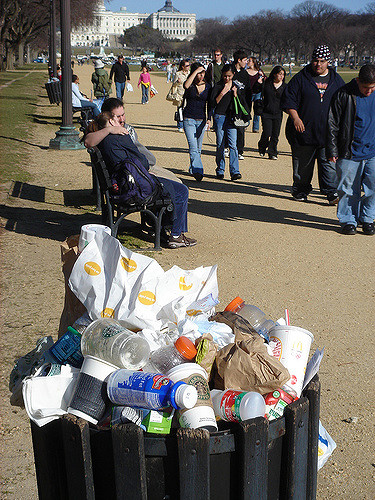
Photo of a Trash Bin in Washington D.C. by David Lisbona, Flickr CC

Today, the term “white trash” is used colloquially to identify white people who do not conform to the established ideas about what it means to be “white,” usually indicating they are poor, uneducated, unemployed, or backwards. This term emerged as a racial slur for white indentured servants — poor whites from England and other European countries that came to the United States in search of citizenship in exchange for labor. In a recent segment on NPR’s podcast Code Switch, sociologist Matt Wray discusses why “white trash” remains a powerful insult against poor whites and people of color alike.

Wray argues that although the term is meant to disparage poor whites, it simultaneously demeans other races by maintaining that there is something about being white that is superior to other racial groups. This is why the modifier “trash” is used. Code Switch news assistant Leah Donnella sums up Wray’s argument well:

“. . . ‘white’ is the only racial group that needs a modifier for it to become a slur. There’s no ‘black trash’ or ‘Hispanic trash’ or ‘Native American trash,’  presumably, because for most of American history, those people were assumed by those in power to be poor, uneducated and criminal.”

Wray also suggests that the term is used to reinforce the long-standing idea that poor whites are more racist than middle class or white elites. This allows affluent whites to escape criticism as racists, while stereotyping poor whites as representative  of “real” racism. Accordingly, Wray states:

“Whites who use the term are saying, ‘Look, I’m not racist. The person down the road is racist. The one who drops the N-word, or has the Confederate flag flapping off the back of their truck. That’s real racism.’ “

In short, Wray’s research shows how the term “white trash” reinforces ideas of white superiority, today and throughout history.  Since it first emerged in the colonial era, the term symbolized how important the intersection of race and class was — and still is — for personal belonging and worth in the United States.

Photo by Brandon Atkinson, Flickr CC

The procedure for the Marshmallow Test is simple: give a child one marshmallow, and promise them one more if they can resist the first. This test, originally conducted by psychologist Walter Mischel, is intended to measure self-discipline and future success, and is arguably one of the most well-known studies in social science research. But in a recent article in The Atlantic, sociologist Jessica Calarco argues that success never stemmed from the ability to “delay gratification” — in this case, by not eating the marshmallow — but from one’s social and economic background.

A new study replicating the marshmallow test, which also accounts for mother’s education level and household income, finds a child’s capacity for self control does not influence their achievement later on. What does matter is socioeconomic standing and the opportunities that come with it. Children of lower socioeconomic standings have fewer opportunities for success and are less motivated to wait due to the conditions of their daily lives. Calarco explains,      

“For them, daily life holds fewer guarantees: There might be food in the pantry today, but there might not be tomorrow, so there is a risk that comes with waiting. And even if their parents promise to buy more of a certain food, sometimes that promise gets broken out of financial necessity.”

Amidst today’s “replication crisis,” the Marshmallow Test is just one of many classic social science studies to falter. In this case, social environment proves to reveal much more about a person and their future than impulsivity. Calarco concludes,

“The failure to confirm old assumptions pointed to an important truth: that circumstances matter more in shaping children’s lives than Mischel and his colleagues seemed to appreciate.”

Flowers and Candles for Kiante Tay Campbell. Photo by George Kelly, Flickr CC

Despite the current administration’s affirmations of high crime rates and push for more tough on crime policies, their approach does not align with the reality of crime in the United States, where violent crime fell substantially over the past 25 years. In a recent article in The New York Times, sociologist Patrick Sharkey discusses his research on both the causes and social benefits of the violent crime drop.

Reductions in crime improved the overall climate in major cities, but especially improved social conditions in disadvantaged communities of color. Declines in homicide led to increased life expectancy for young Black males. Sharkey’s research also demonstrates that declines in homicide helped to narrow the achievement gap between Black and White children and decreased concentrations of poverty in many cities. According to Sharkey, “living in poverty used to mean living with the constant threat of violence. In most of the country, that is no longer true.”

Undervalued forms of violence prevention —  non-profit organizations in particular — could help keep levels of violent crime low. Sharkey argues that a method that focuses on safety and creating community, rather than tough policing and prosecution, is the next step to a further reduction in violent crimes:

“These findings suggest a new model for combating urban violence. While police departments remain crucial to keeping city streets safe, community organizations may have the greatest capacity to play a larger role in confronting violence. Working directly with law enforcement and residents, these organizations are central to the next stage in the effort to make our cities even safer.”

In The Princess and the Frog, Tiana and her parents can only dream of opening a restaurant.

Originally published March 30, 2016

Disney movies get a lot of flack for promoting unrealistic gender expectations, especially for young girls. But kids are getting messages about more than just gender. A recent article in New York Magazine featured a study helmed by sociologist Jessi Streib that revealed that successful G-rated movies, including many Disney films, communicate unrealistic depictions of social class.

In over half of the 32 films they studied, the main characters were upper- or the upper middle-class, clearly misrepresenting the distribution of wealth both in the U.S. and the world. In addition, many downplayed or even romanticized the hardships of lower-class status. For instance, in Aladdin, wealth and poverty are depicted as two sides of the same coin with each equally constraining individuals’ lives. Unlike in adult films where working class characters tend to be portrayed as irresponsible, in G-rated films, working-class characters are shown as warm members of a tight-knit community. In fact, in Mary Poppins and The Sound of Music, it is the lower-class characters who teach their upper-class characters about humanity, empathy, and love:

The key takeaway, from the authors’ point of view, is that these films legitimize and reinforce class structures. Middle-class and poor people are de-emphasized, as are the difficulties associated with not having enough money. Moreover, climbing the class ladder isn’t presented as particularly difficult.

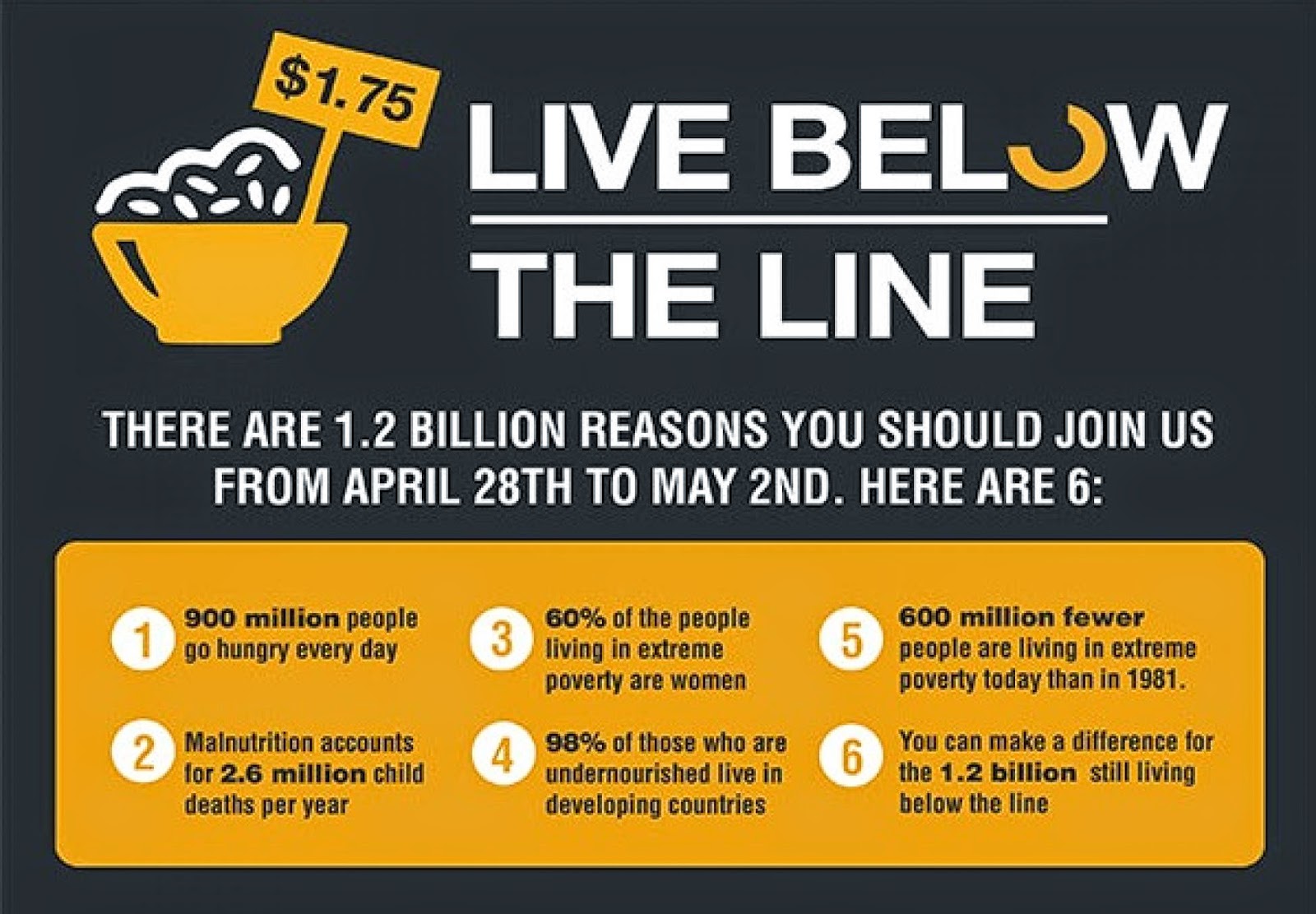
The Live Below the Line campaign helped people in many countries express solidarity with fellow citizens working to make ends meet.
The 2015 Live Below the Line campaign helped people in many countries express solidarity with fellow citizens working to make ends meet.

The U.S. presidential election is beginning to take on issues of poverty and class. Such conversations often look at “the poor” from a careful remove, but work by Thomas Hirschl of Cornell and Mark Rank of Washington University says that outsider angle is a comfortable farce. As explained by an article in Salon, the unpleasant fact is that over fifty percent of Americans will experience poverty during our lifetimes. Impoverishment and “the poor”—and the politics and policies that affect them—are actually very close to home.

Of course, demographic factors are a big part of predicting one’s likelihood of experiencing poverty. (If you’re interested in calculating your own odds, check out Hirschl and Rank’s poverty calculator!) Education is one big factor, as is race: white people are half as likely as non-white people to fall into poverty. And married people are less likely to become poor than singles. Still, as candidates and voters debate nature of class and poverty in America, we would do well to remember that they affect us all. To pretend like anyone’s above poverty would be a poor show.

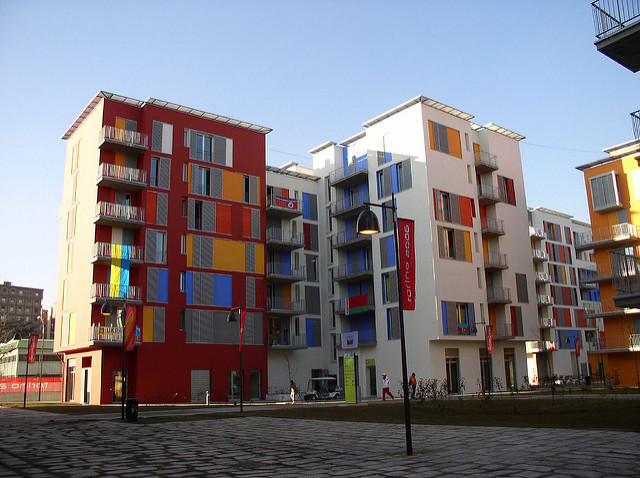
Turin's Olympic Village in 2005, before the athletes arrived. Marco Scala, Flickr CC. https://flic.kr/p/aiymh
Turin’s Olympic Village in 2005, before the athletes arrived. Marco Scala, Flickr CC.

Ever wonder what happens to Olympic villages once the athletes and spectators leave? Some thrive, and some end up as ghost towns.

Turin, Italy’s village has taken an interesting turn. The city tried to make an international name for itself with the 2006 Olympic Winter Games. Sociologist Sergio Scamuzzi, a member of an academic Games-monitoring group called the Olympics and Mega Events Research Observatory, told the Guardian that the Olympics “gave an opportunity to the inhabitants to be proud of the city, of its capacity for innovation, its capacity to organise such a big event.” Soon after the games ended, however, the area was almost abandoned.

Today, Turin’s Olympic village hosts more than 1,000 refugees from over 30 countries. Many of these occupiers were migrant workers from African countries who found themselves out on the streets in 2013, when Italy’s Emergency North African program ended abruptly, and some still survive on seasonal labor farm jobs. The village now features a weekly pop-up medical clinic, common spaces for office and legal advice drop-ins, language classes, barber shops, restaurants, and stores. However, many of the buildings are overcrowded and falling apart. Plans to redevelop the area have been made, and eviction orders have been issued by the government.

The actual eviction of so many seems almost impossible, and residents continue their daily lives despite the threat. According to a resident formerly from Senegal, “For now it’s just words, no one knows what will happen.” In the meantime, an international community lives on in the dormitories and cafeterias that once hosted international athletics’ elite.