
Tag Archives: land

to farm or not to farm?


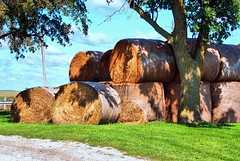
Iowa Round BalesAgriculture Online reports results from the Farm and Rural Life Poll, an annual survey of Iowa farmers conducted by Extension Sociology at Iowa State University.

The latest [survey] indicates concerns are growing surrounding the passage of farms to the next generation. In the 2008 poll, 42% of farmers responding said they were planning on retiring in the next 5 years, and among those, 56% said they had identified a successor, according to J. Gordon Arbuckle, Jr., leader of a team of ISU Extension sociologists administering the poll.

The survey explores what the farmers think motivates their children to take on the family farm:

“The 735 farmers who were over 55 — approaching retirement age — had 350 children who farmed, a proportion (48%) that represents less than half of the number that will be needed to replace the current generation of farmers as they retire,” he adds.

Of those saying the younger generation planned to take the reins of the farm, reasons like quality of life and love of farming topped the list of motivations.

“Following in importance were quality of life considerations and having grown up wanting to farm. Seventy-two percent of farmers rated these factors as having been important or very important criteria in their children’s decisions to farm,” Arbuckle says. “Ability to be their own boss (68%), desire to stay close to home (56%), desire to carry on family tradition (55%), and family ability to help get them started (55%) were also rated as important or very important by a majority of Farm Poll participants.”

Why are members of the next generation planning on other careers instead of returning to the farm? Arbuckle says income opportunities elsewhere comprised the top motivator, while industry entrance hurdles like input costs, high land rents and excessive overall financial risk topped the list of drivers toward other careers.

“In contrast to the factors influencing the decision to farm, most of the reasons that were rated as most important in the choice of a non-farm career were economic,” Arbuckle says.

“On the whole, results suggest that for those individuals who chose farming as their career, cultural and lifestyle factors were the predominant reasons underlying that choice. Whether regarding their own decisions to farm, or their children”s decisions, love of farming and quality of life issues were fundamental,” he continues. “On the other hand, for those children who did not choose to farm, parents’ assessments clearly point to economic factors as the most important decision criteria, whether in the form of economic barriers to farm entry or better income opportunities elsewhere.”

Check out the site for “The Farm Poll” for great summary reports of surveys dating back to 1982.

public (sociological) spaces

F1000011What could decorative rocks and park benches have to do with sociology? The San Francisco Chronicle suggests one possibility:

For Jeffrey Miller, landscape architecture is more than just plants, waterfalls and decorative rocks. For Miller, the founder of San Francisco’s Miller Company Landscape Architects, it’s about uniting living spaces and bringing people together.

“My impetus to be a landscape architect came out of a question – how to design social and public space so that there were better relationships between people,” he said. “It wasn’t a nature-based beginning, it came from more of a sociological perspective.”

Since forming Miller Company in 1980, the former sociology student and filmmaker has been involved with some of the more dramatically landscaped residential communities in the Bay Area.

Miller applies his sociological imagination to landscaping by envisioning public spaces as opportunities for social interaction and connection, especially in big cities.

Ultimately, Miller realizes that the outdoor space of a development is almost always larger than the interior space, and what you do with that is as important as creating comfortable living rooms and spacious kitchens.

“The largest space that we have with these projects is everything that’s outside of the buildings,” he said. “So the care and design of the world outside of buildings is tremendously important to the way we live, especially in urban places. This is kind of our public living room – what we have outside – and the more we can create sociable environments for communities coming together, the better social environment we’re going to have.”

women’s farming revolution

Week 28 (42)The Christian Science Monitor reported on a new trend in Iowa where women are poised to ‘lead a farming revolution.’ Reports indicate that as wives inherit their husbands’ farmland, they emphasize conservation above maximizing yield and profits. Today in Iowa women own nearly half of the state’s farmland, but suffer from recurring problems when, “The men they hire to farm their land often don’t treat it with the tender care they expect – and often won’t listen when they complain about it.”

The Christian Science monitor provides a sociological perspective on the issue:

Jean Eells, a sociologist who focuses on environmental education, has studied how Iowa’s large share of older women who own farmland are faring in getting their land-conservation views heard.

“As a whole,” says Ms. Eells, “these women have a strong view of land as community – as a source of food and water for animals, birds, as well as people – rather than just producing a commodity. But while that conservation ethic makes them natural allies for agricultural conservation programs, women often feel their views are out of sync [with state or federal programs].”

Partly it’s because women don’t know or use standard terminology to talk about land conservation, Eells says. Partly it’s that agricultural system representatives tend to think and talk production – even when discussing conservation, she adds.

“If a woman brings up something about farming, and a man blusters authoritatively about it, women are socialized to just clam up,” Eells says. “So to the extent that a woman landowner starts discussing conservation, there are a lot of reasons why this might not go well.”

Read more.