

free speech

Alice Wong–writer, disability rights advocate, and 2024 MacArthur Genius–recently passed away at the age of 51. Wong earned a master’s degree in medical sociology from UC-San Francisco in 2004 and is known for her prolific writing on her own experiences of discrimination growing up in Indiana with muscular dystrophy, life-long work amplifying the stories of others, and policy advocacy against laws that overlooked the needs of people with disabilities. In 2014, she founded the Disability Visibility Project, which collected hundreds of oral histories about the lives of disabled Americans. This story was covered by the New York Times, Teen Vogue, and LGBTQ Nation.

Alice Wong

Scott Schieman (Professor of Sociology at the University of Toronto) and Alexander Wilson (Sociology PhD Student at the University of Toronto) wrote an article for The Conversation on whether Canadian workers think AI will displace them. They found mixed opinions. Among Canadians who thought job loss was likely, they found concern over corporate greed and loss of dignity and respect for workers. Others felt more confident that the market would adapt and adjust roles to fit new technologies. “Understanding worker attitudes toward automation is a crucial part of studying AI’s broader impact on work and society,” Schieman and Wilson wrote. “If large segments of the workforce feel threatened or left behind by AI, we risk not just economic disruption but a loss of trust in institutions and technological progress.”

Scott Schieman and Alexander Wilson

Musa al-Gharbi (Assistant Professor at Stony Brook University) spoke at a Center for Expanding Viewpoints in Higher Education event at Tufts University on how liberal elites have gained “a lot more influence over society and culture, but the consequences of that are not what we might have hoped or have expected.” Al-Gharbi described that elites focus on “symbolic change more than substantive change” and that the ways they engage in political action can be off-putting: “During these periods of Awokening, we become much more militant about mocking, demonizing, and censoring people who disagree with us, even for views that we adopted five minutes ago,” he said. This story was covered by TuftsNow.


Musa al-Gharbi

Murat Haner (Assistant Professor  of Criminology & Criminal Justice at Arizona State University), Justin Pickett (Professor of Criminal Justice at the University at Albany), and Melissa Sloan (Professor of Sociology & Interdisciplinary Social Sciences, University of South Florida) wrote an article for The Conversation on U.S. political violence. In the 1970s, the bulk of political violence was aimed at property, now the targets are specific people. In a survey study, the authors found that belief in white nationalism was the strongest predictor for support of political violence and argued that “white nationalism poses substantial danger to U.S. political stability.”
Murat Haner, Justin Pickett & Melissa Sloan

Charlie Eaton (Associate Professor of Sociology at the University of California-Merced) wrote an opinion piece for The New York Times discussing how many universities–fearing retribution or sanction–have attempted to appease the Trump administration (particularly by altering or removing DEI initiatives, expelling or suspending student activists, or placing entire departments under review). Eaton argues that “top universities must instead exercise the financial independence afforded by their endowments, which are commonly valued in the tens of billions. Their leaders should collectively declare they will not suppress lawful free speech, diversity programs or campus research to appease any president.” Eaton notes that universities often limit endowment spending to ensure future generations of students have comparable resources, but argues that “in this climate, intergenerational equity is little more than a fallacy. If those universities fail to defend free speech and scientific research now, future generations could lose their treasures to creeping authoritarianism.”

Charlie Eaton

Stephen de Weger (Lecturer in the Center for Justice at Queensland University of Technology in Brisbane, Australia) recently gave a webinar sponsored by the Archdioceses of St. Paul and Minneapolis on the topic of clergy sexual misconduct with adults. “Since 2002, all bishops in the United States have known exactly how to address an allegation if a cleric sexually abuses a child. It’s black and white,” de Weger said. “But the manner in which allegations of sexual misconduct of adults are handled looks nothing like those clear procedures. Bishops everywhere find themselves vexed — and frequently — about exactly how they should handle allegations of clergy sexual misconduct involving adults, and generally they just want to push them aside.” This story was covered by OSV News.

Stephen de Weger

Los Angeles Sentinel ran a feature on Karida L. Brown’s (Professor of Sociology at Emory College) forthcoming book, The Battle for the Black Mind. The book examines the historical struggle to control the education of African Americans in the United States, questioning: What is a ‘colored’ school? “This book looks at a system that attempted to oppress and subjugate Black minds that were designed not for us, not by us, and not about us,” Brown explains. “But the part I love the most is [that] I interrogate that, despite all this, what did Black teachers and parents do? What did Black youth do to organize, dream, and imagine futures where they could see themselves? How did they use education as a vehicle for economic and social mobility? This book is a history, a road map, and a call to action because our education system is again under attack.”

Karida L. Brown

Cristobal Young (Associate Professor of Sociology at Cornell University) and Erin Cumberworth (Sociology Researcher at Cornell University) recently published a new book, Multiverse Analysis: Computational Methods for Robust Results, that explores how multiverse analyses can lead to more robust empirical research. “ In physics, the multiverse refers to parallel universes – alternate realities where things unfold differently,” Young explained. “Research is a garden of forking paths: Every study involves dozens of decisions, such as how to define variables, which controls to use, what statistical model to run. Statistical theory provides only rough guidance, and reasonable researchers could make different choices.” Young describes how studies that describe one, polished analysis create a gap in information between researchers and readers. “Our goal is to use computational power to inform the reader, not just the analyst,” Young said, emphasizing that multiverse analysis can help readers understand how researcher choices impact results. This story was covered by the Cornell Chronicle.

Cristobal Young and Erin Cumberworth

With states such as Minnesota and Maryland voting on same-sex marriage amendments in this year’s election, a surprising group is taking on the issue (and free speech): NFL players. In one early example, Baltimore Ravens linebacker Brendon Ayanbadejo publicly supported gay marriage in 2009. He was met with some shock and backlash, but remains outspoken on the issue. So much so that an elected official sat up and took notice this fall, leading to a rather public war of words.

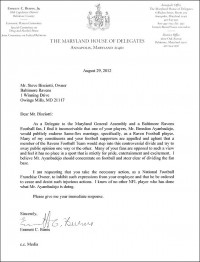
Rep. Burns’s controversial letter to Ravens owner Scott Bisciotti.

Maryland state delegate Emmett C. Burns, Jr. wrote to Ravens owner Steve Bisciotti asking him to “inhibit such expressions from your employee.” In the letter, released by a local television station and republished by Yahoo! Sports, Burns goes on to state that “many of my constituents and your football supporters are appalled and aghast that a member of the Ravens Football Team would step into this controversial divide,” and assert that he had no knowledge of any other players taking similar stances. Burns turned to familiar ideas about sport, saying Ayanbedejo had no place in the same-sex marriage debate because such political issues have no place “in a sport that is strictly for pride, entertainment, and excitement.”

Minnesota Vikings punter Chris Kluwe did not take kindly to Burns’s request for censorship. He went on to write an open, colorful, scathing, and, many would argue, entertaining response (in clean—but hilarious—and uncensored versions) to the Maryland delegate. In his letter, originally published by Gawker Media’s sport site Deadspin, Kluwe condemns Burns’s attempts to quiet Ayanbedejo, saying that not only do politics hold an important place in sport (as evidenced by athletes’ successful work to end segregation in their sports), free speech is a protected right, and, even further, stating simply “that gay people getting married will have zero effect on your life.” He closed by refuting the politician’s note that players haven’t been talking about gay marriage: “I’ve been vocal as hell about [it.]”

Other players took to the papers and airwaves to respond to Burns, too. Ayanbedejo’s teammate (who has played with Kluwe in the past), Ravens Center Matt Birk wrote for the Star Tribune, defending his teammate’s right to free speech. Instead of backing Ayanbedejo’s beliefs, however, Birk articulately and respectfully voiced his opposition, stating that marriage should remain between a man and a woman because same-sex marriage would negatively affect the welfare of children. This time, Kluwe, too, responded in the Star Tribune, armed with facts rather than expletives. He delineated the problems he saw in Birk’s argument one by one, providing many well-honed arguments and citing various social facts, statistics, and a meta-study showing no difference between children of heterosexual and GLBT families as borne out by 17 social scientific studies.

In the end, all of these players demonstrated the power of free speech, showing they had every right to be on the field of public discourse. Why should they be forced to the sidelines when they can bring their opinions and even well researched arguments to an often heated and controversial public debate—simply because they play a game for a living? It’s certainly not news that politicians (from Emmett C. Burns, Jr. to Barack Obama and everyone in between) have used sport to their advantage for many years.

To follow the unfolding debates, you can find Brendon Ayanbadejo (@brendon310) and Chris Kluwe (@ChrisWarCraft) on Twitter, Maryland State Representative Emmett C. Burns, Jr. at his official state website, and information about Matt Birk (including headlines) at his official NFL player page