
food

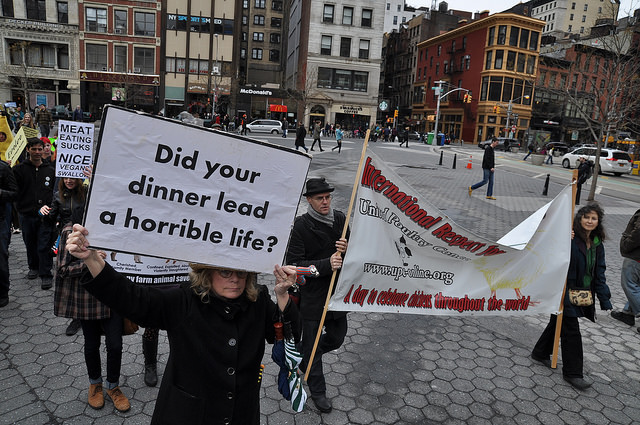
Protester holding a sign that says “did your dinner lead a horrible life?” Photo by Alan & Pamela Rice, Flickr CC

The devastation of Hurricane Florence is not limited to the loss of human lives. It is estimated that millions of chickens and thousands of pigs died in North Carolina from the flooding. Vegan social movements have pointed to this major loss of animal life as one of the many reasons to reduce our reliance on meat and the consumption of other animal products. However, these groups face a difficult path ahead as factory farming is a massive U.S. industry. A recent article in The Atlantic highlights research by sociologists Corey Wrenn, Nina Gheihman, and Elizabeth Cherry on the many obstacles that can thwart veganism from blossoming into a large-scale social movement.

According to Wrenn, one of the main barriers to mobilization of any social movement is that they allow “free-riders”, or individuals who may identify with the movement but do not change their behavior. In the case of veganism, including “flexitarians” — people who are interested in vegetarianism or veganism but still eat meat and other animal products — waters down the cause’s overall message. Wrenn argues that including flexitarians “maintain[s] the illusion of mass support, [while] real power is reserved for core members.” Wrenn suggests that smoking cessation campaigns provide a key example of how an “all or nothing” approach can bring about meaningful change in consumption behaviors.

In the same article, Elizabeth Cherry and Nina Gheihman push back against Wrenn’s claims, advocating that incrementalism and inclusion of those who aren’t strictly vegan may lead to more success for vegan social movements. Cherry, who has a book comparing animal rights activism in France and the United States, argues that vegan social movements promoting meat reduction rather than complete elimination parallels the often incremental shift by many vegans into a plant-based diet. Gheihman agrees with Wrenn that flexitarianism may damage vegan social movements in the long-term, but also believes that including those at the margins of the movement accounts for the multiple motivations people may have for going vegan. Gheihman expands further,

“I do believe that flexitarianism as an initial approach is worthwhile, as there are many people who are not willing to adopt the ideological stance of the animal-rights movement within a society that does not yet embrace it. As well, they may have alternate motivations for following a plant-based diet, including health and environmentalism, and I believe these motivations are as valid as that of animal rights.”
3835018716_4d03a3b0c7_o
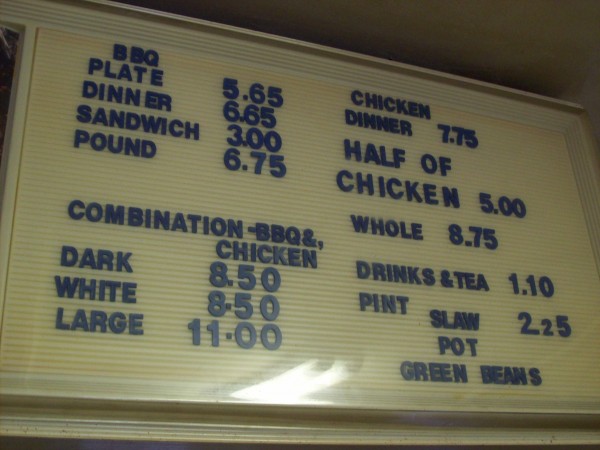
A barbecue restaurant menu in Greenville, NC. Photo via Flickr, Alan Pike for the Southern Food Alliance.


Barbecue is to the American south what wine and cheese are to Europe. That is, a deeply ritualistic cultural practice that differs greatly by region and, more subtly, by micro-locality. Travel across the south and one will find different cuts of meat, cooking techniques, sauces, side dishes and beverages. Or so says John Shelton Reed, Sociology Professor Emeritus at the University of North Carolina, Chapel Hill, in Calvin Trillin’s recent article “In Defense of the True ‘Cue,” for The New Yorker. The article zeroes in on the “Campaign For Real Barbecue,” an effort to preserve traditional North Carolina barbecue and what Professor Reed believes to be it’s vital role in North Carolina social life.

In his darker moments, he sees his beloved barbecue joints being replaced by the soulless outposts of some franchise operation he calls the International House of Barbecue, which uses “barbecue” to mean meat with bottled barbecue sauce on it—your choice of meat, your choice of sauce. Just as the Campaign for Real Ale believes in “well run pubs as the centres of community life,” John Reed believes that the traditional barbecue joint is a place in the South where people from all walks of life and all races, from the sheriffs’ deputies to the construction workers to the town bankers, gather to eat the local specialty at a price just about anybody can afford. (A barbecue sandwich at Stamey’s goes for three dollars and twenty-five cents.) A passage in “Holy Smoke” [one of Reed’s books] says, “North Carolina barbecue is an edible embodiment of Tradition. For many of us, barbecue symbolizes Home and People.”

Read the full article here.

Most people have favorite food memories—maybe a favorite holiday dish or fresh local fruit at its peak. Sociologist Jennifer Jordan talks to The Lake Effect about her new book Edible Memory, all about how food shapes culture, culture shapes food, and collective memory forms around what we grow, cook, and eat.

Jordan says that collective memories come from pieces of the material world, and that food memories are both personal and social. A personal memory about kitchens, food, and gardens often speaks to broader patterns of those things at a particular point in history or regional/local space because food is so often communal. Large groups may share similar food memories, revealing how food brings people together (and sometimes divides).

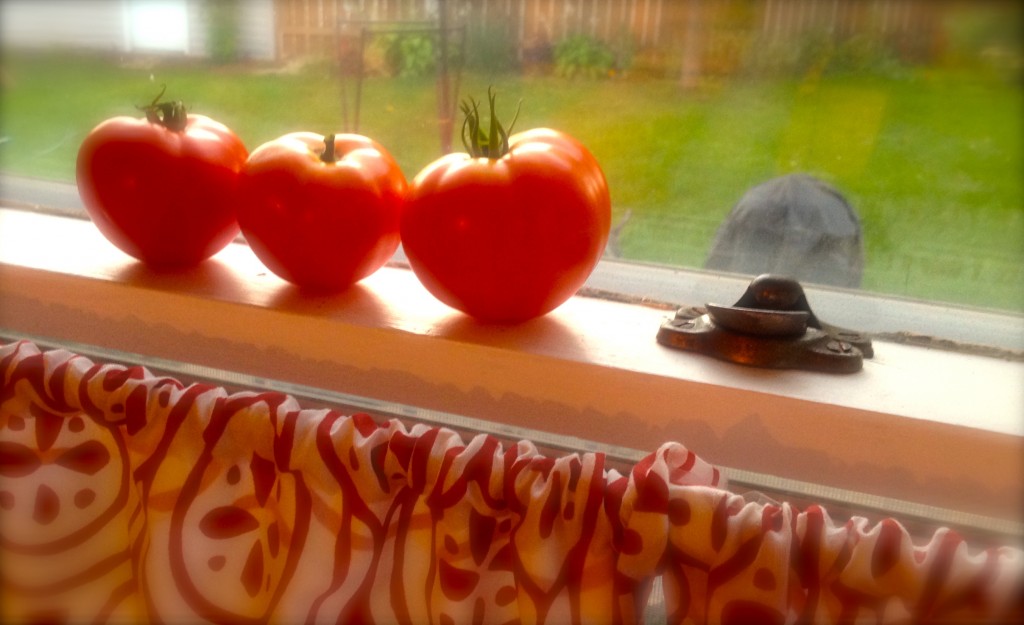
Tastes in foods change over time, too. Jordan says just as the broccoli florets people tried to feed to the dog as children become adulthood favorites, a similar phenomenon occurs on a much grander scale. The tomato, for instance, is technically a “new world” food from South America. When it reached Europe in the 15th and 16th centuries, people feared the fruit was toxic. Only recently has it become an essential part of the identity of food cultures including Italian and Spanish fare.

Meanwhile, in United States and elsewhere, we see the standardization of foods and genetic strains of produce. Instead of highly local heirloom tomato, a more mass-produced “beefsteak” variety better lends itself to feeding whole populations because of its hardiness during transport. Food, thus, becomes more homogenous on a national level, while, on the regional and local level there remains a more vibrant array of products: individual families and small-scale farmers preserve older genetic strains of plants and older family recipes that use regional produce. Consider okra in the American South, rhubarb in the upper Midwest, springtime fiddlehead ferns in the Northeast, or fresh avocados right off a Southern California tree—can’t you just taste them now?

Paxson's new book, available from UCPress.
Paxson’s new book, available from UCPress.

American cheeses—not just the individually-wrapped slices—are making a comeback, as documented by MIT’s Heather Paxson, who recently published The Life of Cheese: Crafting Food and Value in America. The anthropological work details her research into the people and processes behind artisan cheeses in the U.S. Looking over the last 50 years, Paxson indentifies a host of factors behind the re-emergence of American artisanal cheese: environmentalism, feminism, markets (both local and international), and 9/11, among others. In an interview with the Boston Globe, she commented:

Like most social movements, it only looks like a movement in retrospect… Cheesemaking appealed to people the way that some start-up dot-coms did. It was the rural counterpart to that.

Paxson, who studies “how people craft a sense of themselves as moral beings through everyday practices, especially those activities having to do with family and food,” became curious about artisanal cheese after eating a sample of Hooligan, a Connecticut cheese, and asking the questions that are the genesis of so much social science research: Who? How? Why?

Photo by Robert Schrader via flickr

While many turn up their noses at the thought, a recent article in the Star Tribune profiles a growing group of people who don headlamps and explore dumpsters for discarded edibles.

Some, calling themselves “freegans,” have a philosophy that shuns spending money and capitalism, and do it to protest waste.

Others just want to take advantage of free food.

The practice is rife with detractors, however, including food safety experts and most of the expiration date-abiding public. Taking food from dumpsters in public areas is not exactly against the law (at least no one has been prosecuted for it). Some cities, however, do have ordinances against dumpster diving, so most divers keep a low profile about their escapades.

Geographer Valentine Cadieux explains why such habits of food procurement might offend some:

 “Food is such a huge part of our lives, wrapped up in our identities and cultures and habits, not to mention survival — so we experience tremendous resistance to questioning the way we get this food,” Cadieux wrote in an e-mail.

While some dumpster divers may do it for practical reasons, like survival or cutting down on food costs, others might be looking to make a bigger statement.

“Dumpster divers are demonstrating a way to call into question something that seems really legitimate and scientific [expiration dates or the convenience of throwing away food],” Cadieux said. “The general guilt that we feel about how many people are hungry is exactly the kind of thing that adds additional meaning to what may not be intended as a part of a social movement — but dumpster diving ends up being legible to people as a critique of throwing away too much food.”

Though perhaps not looking to start a broader social movement, dumpster divers certainly make an impression. And, apparently, their exploits can make for a well-stocked fridge.

“All the produce, just tons of green peppers and red peppers; they looked perfect,” Graham recalled with not a small bit of awe. “This was the first time I was diving, and I couldn’t believe it.”

Myung-Dong-Tofu-Cabin-San-Mateo_0008The Globe and Mail has published an interview with two University of Toronto sociologists who have written a new book on “foodies.” According to the article:

As the authors explain in their new book Foodies: Democracy and Distinction in the Gourmet Foodscape, for which they interviewed 30 people and analyzed hundreds of articles, today’s foodies might find classic French haute cuisine stuffy. They may be willing to try goat testicles and sheep brains. And they’ll happily visit the city’s best hole-in-the-wall eateries, no matter how dumpy the decor. But one thing foodies flat-out refuse to eat is dinner at a mundane, generic chain restaurant.

Sociologists Josée Johnston and Shyon Baumann argue that being a foodie isn’t just about consuming good food, it’s also about garnering cultural capital. Says Johnston:

A lot of elements of foodie culture are still relatively exclusive, and part of what foodie culture is about is dabbling in all sorts of different ethnic cuisines and food traditions. What makes that a kind of privilege is to have the kind of knowledge to go to all of these kinds of places [whether it’s a fancy restaurant or hole-in-the-wall eatery], so you’re not just familiar with one type of ethnic cuisine, you’re familiar with the whole range of them. And that can end up constituting a kind of cultural capital people use to display their sophistication.

However, this may entail ignoring inequalities. Says Baumann:

…if you’re going to be a foodie and value authentic and exotic cuisine, it’s going to lead you to places of poverty, to contexts of impoverished food production and consumption. Through romanticizing those conditions of poverty, you can get the good food without having to dwell on the uncomfortable fact of poverty.

The authors also noticed gender differences among foodies:

Johnston: One thing that was surprising to me was the different ways that men and women embody their foodie culture. Men often emphasize their expertise more, and they’re often much more interested in the exoticism, especially eating things that are wildly unconventional, like goat testicles. And women didn’t do that as much. They talked more about how their interest in food was also about protecting the health of their family.

ABC News explores some possible causes of obesity that are often overlooked.

Sure, most of the nation needs to eat less and move more. But is that the only reason America is so fat?

As more scientists and sociologists look at our bulging waistlines, some unusual explanations for the nation’s weight gain in the last 30 years are popping up.

The article discusses an intestinal bacteria that may contribute to weight gain and particular genes that may influence the success or failure of dieting.

Beyond these physical explanations, social factors may also contribute to obesity. A Harvard medical sociologist weighs in:

In 2007, an article in the New England Journal of Medicine used 30 years of data on 12,000 people to show obesity and weight loss may actually be contagious — things that spread among people who know each other.

“They key idea is that people are influenced by the behavior and actions of those around them. This applied to something that people may not have thought of, which is body size,” said Dr. Nicholas A. Christakis, author of the recent book “Connected,” which looks at how various phenomena from depression to obesity spreads through society.

Over the three decades, Christakis showed how obesity in one person in a circle of friends statistically meant more people in their circle of friends would become obese. The same was true of weight loss.

“We’re not saying we found the cause of the obesity epidemic. We’re not,” said Christakis. “Social networks have a general property that they magnify what they are seated with.”

While Christakis could show an obesity epidemic spreading through friend networks, he could only make an educated guess why.

“One possibility is that you start doing things — certain behaviors that I copy,” said Christakis.

So if one friend starts serving beer and cookies all the time, perhaps another friend will pick up the habit. Or if one friend joins a running club, perhaps another friend will join it too.

Christakis said another possibility is that “What’s spreading between people is an idea, or a norm.”

For example, if most people a person associates with are overweight, then that person’s idea of “normal weight” is likely to be bigger than what is actually healthy.

Read more.

Day 167/365 - Pure EvilMany skinny Americans are fed up with obesity, reports the Los Angeles Times:
“Americans as a society are getting fed up with the matter of obesity. No doubt about it,” said Douglas Metz, chief of health services for American Specialty Health, a San Diego-based company that offers wellness programs to employers. “Some pockets of society are taking positive action, and unfortunately others are taking negative action. That’s what happens when a society hasn’t figured out what the fix is.”

Recent notable actions include:

* A recent and ultimately unsuccessful plan at Lincoln University in Pennsylvania sought to take the body mass index of every enrolling student and require the obese to lose weight or take a fitness class before they could graduate.
* In Mississippi, legislators tried to pass a bill to let restaurants prohibit obese people from dining.
* In an interview with the New York Times last August, Toby Cosgrove, chief executive of the Cleveland Clinic, one of the nation’s largest medical centers, provoked national outrage when he said that, if it were up to him, he would stop hiring the obese. He later apologized for his remarks.
* Last summer in Florida, animal rights activists at People for the Ethical Treatment of Animals (PETA) took aim at heavy women in a “Save the whales” billboard campaign that featured an overweight, bikini-clad woman. It read: “Lose the blubber. Go vegetarian.” Angry reactions caused the organization to remove the signs.

Statistics about obesity are being assessed in the current debates on how to reduce the nation’s health care costs:

A report by Emory University researchers projected last November that by 2018 the United States could expect to spend $344 billion on healthcare costs attributable to obesity. Obesity-related costs would account for 21% of healthcare spending, up from 9.1% today, said the report, sponsored in part by the United Health Foundation and the American Public Health Assn.

Providing a different take on the issue, it’s time to call in the sociologist:

“In our society, being heavy has become more of a stigma lately because we’re struggling with other issues of consumption,” says Abigail Saguy, associate professor of sociology at UCLA.

The economic climate, a recent history of people buying more than they can afford as well as environmental issues, including the depletion of our planet’s resources, are making people feel more angry about society’s overconsumption, she says. Obviously overweight people are an easy target.

“They’re almost a caricature of greed, overconsumption, overspending, over-leveraging and overusing resources,” says Saguy. “Though it’s not entirely rational, it’s an understandable reaction, especially in a country founded on the Puritan ethics of self-reliance, sacrifice and individual responsibility. If people feel they’re sacrificing, then see someone spilling over an airplane seat, they feel angry that that person is not making the same sacrifices they are.”

Research indicates that discrimination based on weight has been increasing in recent years:

Rebecca Puhl, a researcher at Yale University’s Rudd Center for Food Policy and Obesity, published [two papers] last January — one in the journal Obesity, the other in the International Journal of Obesity — Puhl reported that weight discrimination in the United States increased 66% over the prior decade.

“Weight discrimination is highly prevalent in American society and increasing,” said Puhl, who cites several possible reasons. Among them are a lack of legislation to prohibit weight discrimination and an increase in media coverage of obesity (up fivefold from 1992 to 2003). Most media framed the problem of obesity as one of personal responsibility, she reported.

New research on the social network effects of obesity was recently reported in the Guardian UK:

Children at schools where older students are obese or otherwise overweight are significantly more likely to suffer weight problems themselves, researchers report.

For each one per cent increase in the prevalence of obese students aged 16 to 18 years, the odds of a student at 14 to 16 years old attending that school also being overweight increased significantly.

“It was the one risk factor that held true across every school we looked at,” said Dr Scott Leatherdale, the chair of research at Cancer Care Ontario and lead investigator with the School Health Action, Planning and Evaluation System.

Commenting on the obesity connection between older and younger students, Leatherdale says:

It could be that younger students look up to older students, and so emulate their sedentary behaviour and bad eating habits and do not judge the older children’s body shape.  Or it could be that the school doesn’t encourage enough physical activity among its students, and the older students’ weight issues are an indication of that.

Sociologist Steve Fuller at Warwick University concurs with his assessment:

Obesity is one phenomenon that medical sociologists have nominated as an ‘epidemic’ that is transmitted by copying the behaviour of peers.  Certain connections between overeating and social activities become contagious. Young people gather together in more stationary modes than in the past: in front of computers and video games rather than sports.

The reason it’s called an ‘epidemic’ is because the pattern is reinforced by regular contact, so that if one is not in regular contact with the pattern, one doesn’t spontaneously do it The idea is that you overcome obesity by breaking up the networks where it’s transmitted.

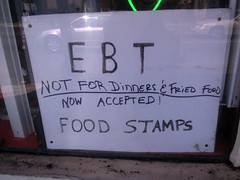
Sociologists predict that half of all U.S. children will be on food stamps at some point in their childhood, according to the EBT
Philadelphia Inquirer
.

In a stark and surprising finding, about half the children in the United States will be on food stamps at some point during their childhood, a new study of 29 years of data shows.

One in three white children and 90 percent of all black children – ages 1 through 20 – will use the program, according to the research, published this month in the Archives of Pediatrics and Adolescent Medicine.

“This means Americans’ economic distress is much higher than we had ever realized,” said Thomas A. Hirschl, a sociology professor at Cornell University and a coauthor of the study with Mark R. Rank, a sociologist at Washington University in St. Louis.

The survey finds that continued food-stamp usage signifies a kind of poverty that is “a threat to the overall health and well-being of American children, and, as such, represents a significant challenge to pediatricians in their daily practice.”

Although the data used in this study ends in 1997, and thus does not account for the current recession, these findings seem to correspond with a report published Monday by the U.S. Department of Agriculture:

The persistent poverty described in the survey dovetails with the findings of a U.S. Department of Agriculture study released Monday. It determined that 49 million Americans – 17 million of them children – were unable to consistently get enough food to eat in 2008. Nearly 15 percent of households were having trouble finding food, the highest number recorded since the agency began measuring hunger in 1995.

The study’s authors note that kids are often overlooked in U.S. social programs:

“The number-one poverty program in the United States is Social Security,” Hirschl said. “There is no such system for children.”

But how trustworthy is the prediction that 50% of all U.S. kids will use food stamps at some point in their childhood?

Because there was so much data, the authors were able to use a very long window of observation, which helped them extrapolate into the future about food-stamp usage, said John Iceland, a sociology professor at Pennsylvania State University. Iceland, who is familiar with the methodology used in the Hirschl-Rank paper, described it as “very solid work.”

“It’s like determining the likelihood of developing heart disease from health data,” Rank said.

The Michigan study is well-known and widely used by social scientists, and it has proven to be accurate over the years, Iceland said.

The finding that 50 percent of children will be on food stamps in their lifetime is conservative, Hirschl said.

That’s because only about 60 percent of households eligible for food stamps actually get them, a finding backed up by the newly released Department of Agriculture study. Stigma and ignorance of the program hold people back, he said.