
economics

Photo of flight attendant inside a plane. Photo by peter burge, Flickr CC

For many people, coining a term and having it become part of common conversations would be a huge achievement. But such popularity sometimes means that these terms lose their original meanings. This is what happened to Arlie Hochschild’s term, “emotional labor.” Initially coined to identify what is so exhausting about jobs such as flight attendants, nursing home attendants, and child-care workers, emotional labor is increasingly used as a catch-all term for mental work, care work, or any burdens that disproportionately fall on women.  

In a recent interview with The Atlantic, Arlie Hochschild reminds us of the core definition of emotional labor:

“Emotional labor, as I introduced the term in The Managed Heart, is the work, for which you’re paid, which centrally involves trying to feel the right feeling for the job. This involves evoking and suppressing feelings . . . The point is that while you may also be doing physical labor and mental labor, you are crucially being hired and monitored for your capacity to manage and produce a feeling.”

In addition to a lack of a social-class perspective in the recent usage of the concept — in one example, emotional labor was used to describe calling the maid — Hochschild contends that emotional labor may be overextended in ways that are unproductive, particularly during important conversations about alienated labor and household responsibilities. Some of her other books, including The Second Shift and The Time Bind, are more relevant to the uses of emotional labor that are fundamentally talking about household responsibilities and family dynamics. While Hochschild appreciates the attention to her work, she also believes maintaining analytic precision is essential — especially in mobilizing the concept of emotional labor to recognize inequality and alienation in the workplace.

“We’re trying to have an important conversation but having it in a very hazy way, working with [a] blunt concept. I think the answer is to be more precise and careful in our ideas and to bring this conversation into families and to the office in a helpful way…If you have an important conversation using muddy ideas, you cannot accomplish your purpose. You won’t be understood by others. And you won’t be clear to yourself.”


Photo by futureatlas.com, Flickr CC

In the decades since the Holocaust, the international community created mechanisms like the 1951 Genocide Convention in order to ensure that the world would “never again” experience such tragedy. Even so, genocide and mass violence continue to occur across the world. Recent AP reports provide even more evidence of a genocide in Myanmar, yet military response and global governance are again lacking. In a recent article in The Washington Post, Aliza Luft addresses these failings and suggests that economic tactics may succeed where others have failed.

Many factors can influence violent behavior, like prejudice and propaganda, but for many who commit violence, economic considerations are essential. For example, some governments use poverty to motivate civilians to engage in violence, offering resources in exchange for participation. According to Luft:

“Thus, one strategy for intervention is to even the economic playing field: to lower the capital of the génocidaires while increasing that of their potential recruits. Responses can include targeted financial measures such as asset freezes and economic divestment from major firms that help fund genocidal governments. Additionally, non-governmental relief efforts might focus not only on food, medicine, and housing for the displaced, but also on creating economic opportunities to reduce the potential for recruitment by genocidal authorities.”

Economic strategies can take many forms, including organizations that guide companies towards pro-human rights policy, as well as online campaigns that have dissuaded companies from working with genocidal regimes. Luft argues that anyone can aid in genocide prevention through personal spending choices, outreach, and activism. She suggests civilians use financial strategies that may influence politics and policy:

“To deepen the link between investment or operations abroad and commitments to human rights, civilians can emply boycotts and social media campaigns to pressure these companies over their complicity in genocide. Research has shown that economic and reputational concerns can motivate a company to change its policies. It is time to mobilize on behalf of the Rohingya, and to target businesses whose taxes and revenue fund violence.”

Photo by madebyWstudio, Flickr CC

In the past 50 years, marriage rates among U.S. adults have declined significantly. Social science suggests that financial success may play an central role in this trend. For example, in 2015 65% of adults 25 and older with a four year degree were married, while only 50% of those with a high school education were married. In a recent article in The New York Times, sociologists Sharon Sassler and Andrew Cherlin weigh in on this divergence in marriage rates.  

According to social scientists, some of the change has to do with economic trends. The decline in manufacturing jobs in the United States has made men without college educations less “marriageable.” According to Sassler, “women don’t want to take a risk on somebody who’s not going to be able to provide anything.” This decline has not, however, corresponded to a decline in births — births are just happening outside of marriage more often now. The article explains, 

“In reality, economics and culture both play a role, and influence each other, social scientists say. When well-paying jobs became scarce for less educated men, they became less likely to marry. As a result, the culture changed: Marriage was no longer the norm, and out-of-wedlock childbirth was accepted. Even if jobs returned, an increase in marriage wouldn’t necessarily immediately follow.”

On the other hand, those with college degrees are more likely to postpone marriage and children until after they feel financially stable, but then they do get married. They also may benefit from their own parents’ help in paying for education, birth control, and rent, allowing them the advantages of achieving stability not often available to lower and working class adults. Privilege, therefore, can play a key role in the decision to get married.

Photo by catulle, Flickr CC

As discussed in a recent piece in The New York Times, economists have had an influential role in 20th century social and economic policy. Economics research has been instrumental in many policy decisions, from education to health care, and this continues today. As writer Neil Irwin suggests, however, other social science fields might also have the tools necessary to assist policymakers, and one of those disciplines could be sociology.

Some of the social forces and dynamics that economists study, such as wages and employment, can be understood more thoroughly when you also consider the sociological angle. Jobs are about more than paychecks for many people, acting as a source of identity and purpose. As sociologist Herbert Gans explains, “Unemployment isn’t just losing wages, it’s losing dignity and self-respect and a feeling of usefulness.” Research by Ofer Sharone shows that unemployed white-collar workers saw their inability to land a job as an indication of their self-worth. When they got rejected, they gave up more quickly. This phenomenon helps explain why the economy never fully recovered the jobs lost in 2008 — people didn’t feel confident about trying to find another job. Similarly, Jennifer M Silva finds that, for some young working class adults, past economic milestones such as buying a house or getting a job feel out of reach in today’s world, creating a sense of economic precariousness.

Another issue that sociologists can contribute to are poverty and housing. Sociologist Matthew Desmond’s book Evicted adds another layer to a discussion that has traditionally focused on subsidies, incentives, and lending. Evicted talks about how the cyclical struggle people in poverty face goes beyond dollars, and involved issues of stigma, discrimination, and unequal access to resources. These ideas may not normally be something policymakers focus on, especially when you consider that economists have been the primary go-to social scientists. But other fields could help add nuance to the conversation, which could lead to more comprehensive policy. Michele Lamont states that because of the influence that economics has, policymakers may find that “the only questions worth asking are the questions that economists are equipped to answer … That’s not to take anything away from what they do … It’s just that many of the answers they give are very partial.”

You've got to know how your product is used. Photo by FourTwentyTwo via flickr.com.
You’ve got to know how your product is used. Photo by FourTwentyTwo via flickr.com.

The era of bothersome consumer surveys and robo-calls may be coming to a close, as these shallow techniques of data collection just don’t cut it in the information age. In a recent article in The Atlantic, Graeme Wood describes a growing trend in market research: big business hiring social scientists to do fieldwork. Corporations have long researched the quantitative aspects of their sales, but qualitative knowledge about the use of the products has been somewhat limited. Social scientists and those business researchers known as “consumer behavior” (vs. “quantitative”) economists—long since part of the business discussions within academia—are now being hired to uncover how products are used, as well as who uses them and how those users feel about the products.

After realizing that they new little about the home consumption of their product, for instance, Absolut Vodka commissioned ReD, a forerunner in what we might think of as anthropological market research, to study the home party scene and the rituals and norms of drinking. One consultant on the project, former Yale anthropology Ph.D. student Min Lieskovsky, noted some party trends that Absolut quickly applied to their marketing:

‘One after another, you see the same thing,’ Lieskovsky told me. ‘Someone comes with a bottle. She gives it to the host, then the host puts it in the freezer and listens to the story of where the bottle came from, and why it’s important.’ And then, when the bottle is served, it goes right out onto the table with all the other booze, the premium spirits and the bottom-shelf hooch mixed together.’

The quality and status of the liquor seemed to be much less important to the consumer than their personal association with it. Despite years of market research, without this use of social science, the social significance and human connection of the product might have gone overlooked—and fewer bottles of Absolut might have gotten sold.

John Denney of The Weirdos checks out photographer Alice Bag pretending to be... John Denney. Weird. Photo by Alice Bag via flickr.com.
John Denney of The Weirdos checks out photographer Alice Bag pretending to be… John Denney. Weird. Photo by Alice Bag via flickr.com.

When you’re regularly “weird,” you get used to others’ asking you to “just be reasonable.” However, a new trend in sociological approaches to economics and psychology suggests that our version of “reasonable” may be, well, pretty weird.

In a recent article for Pacific Standard, Ethan Watters reviews the work of Joe HenrichSteven Heine, and Ara Norenzayan, three scholars whose work on the western, educated, industrialized, rich, democratic mind suggests that “rational” thought means very different things to different people. As the authors watched games based on economic exchange play out around the world, the concept of getting a fair deal seemed to have everything to do with social context:

The distinct ways Americans and Machiguengans [indigenous Amazonians] played the ultimatum game, for instance, wasn’t because they had differently evolved brains. Rather, Americans, without fully realizing it, were manifesting a psychological tendency shared with people in other industrialized countries… Our economies hadn’t been shaped by our sense of fairness; it was the other way around.

Stranger still, it seems this assumption that the weird mind is normal has a huge impact on the practice of psychological research—not to mention our understanding of rationality in the social world.:

A 2008 survey of the top six psychology journals dramatically shows how common that assumption was: …96 percent of human subjects in these studies came from countries that represent only 12 percent of the world’s population.

Westerners (and Americans in particular) tend to reason analytically as opposed to holistically. That is, the American mind strives to figure out the world by taking it apart and examining its pieces.

And here is the rub: the culturally shaped analytic/individualistic mind-sets may partly explain why Western researchers have so dramatically failed to take into account the interplay between culture and cognition. In the end, the goal of boiling down human psychology to hardwiring is not surprising given the type of mind that has been designing the studies.

Who’s weird now? Probably everyone.


The state of affairs
Photo by Satish Krishnamurthy, satishk.tumblr.com

The U.S. social safety net continues to grab headlines, this week in the New York Times. We’ve noted before the play programs like food stamps are getting in the current presidential campaign. The NY Times article notes that, paradoxically, “Some of the fiercest advocates for spending cuts have drawn public benefits.” Why might this be?

An aging population and a recent, deep recession seem to be at the crux of the issue.

The problem by now is familiar to most. Politicians have expanded the safety net without a commensurate increase in revenues, a primary reason for the government’s annual deficits and mushrooming debt. In 2000, federal and state governments spent about 37 cents on the safety net from every dollar they collected in revenue, according to a New York Times analysis. A decade later, after one Medicare expansion, two recessions and three rounds of tax cuts, spending on the safety net consumed nearly 66 cents of every dollar of revenue.

The recent recession increased dependence on government, and stronger economic growth would reduce demand for programs like unemployment benefits. But the long-term trend is clear. Over the next 25 years, as the population ages and medical costs climb, the budget office projects that benefits programs will grow faster than any other part of government, driving the federal debt to dangerous heights.

As a result, many Americans have benefited from government safety net programs.

Almost half of all Americans lived in households that received government benefits in 2010, according to the Census Bureau. The share climbed from 37.7 percent in 1998 to 44.5 percent in 2006, before the recession, to 48.5 percent in 2010.

Yet many do not realize that it is no longer just programs for the “undeserving poor” that dominate the scene. Rather, it’s programs such as an expanded Earned Income Tax Credit and increasing Medicare costs that have stretched safety net resources.

Medicare’s starring role in the nation’s financial problems is not well understood. Only 22 percent of respondents to the New York Times poll correctly identified Medicare as the fastest-growing benefits program. A greater number of respondents, 27 percent, chose programs for the poor.

Why the misperception? Perhaps it’s because, as political scientist Suzanne Mettler explains in her book, The Submerged State: How Invisible Government Policies Undermine American Democracy, policies in recent decades have turned from more obvious provision of cash benefits to methods such as tax breaks, incentives, and other “hidden” forms of support. As a result, most citizens  have no idea that they rely on the safety net at all.

No doubt politicians, commentators, and scholars will all continue to debate the form and function of the safety net. But everyday Americans aren’t at all sure what’s best to do.

Americans are divided about the way forward. Seventy percent of respondents to a recent New York Times poll said the government should raise taxes. Fifty-six percent supported cuts in Medicare and Social Security. Forty-four percent favored both.

As one Minnesotan profiled in the NY Times story put it, “I’m glad I’m not a politician…We’re all going to complain no matter what they do. Nobody wants to put a noose around their own neck.”


Money!
Photo by Thomas Galvez, togalearning.com

The current political and cultural upheaval focused on the American economy has Wall Street under the microscope. The New York Times DealBook section recently reported on a study by CUNY Graduate Center sociologist Richard D. Alba which dissected some of the income stratification occurring within financial industry. His findings? Not surprisingly, Wall Street remains an old boys’ club. White men are making significantly more than their female or non-white coworkers:

The median compensation for a white man in the financial industry between 2005 and 2009 was $154,500, 55 percent percent more than that for a white woman, according to the study, which used United States Census data. He made 55 percent more than a Latino man, and 72 percent more than a black man. A typical white woman, with a salary of $100,000, made 59 percent more than a Latina woman, and 65 percent more than a black woman.

Historically, white males have dominated the financial sector, and their wage superiority has remained consistent despite growing diversity within the field:

In 2000, more than 67 percent of older workers were white men, the study shows. In the period between 2005 and 2009, that dominance showed signs of eroding, as white men were less than 46 percent of the youngest workers, those just starting out on Wall Street.

While Wall Street has been quick to adapt to complicated new financial instruments and markets, according to Alba, it shows few signs of adapting to an already-changed labor market.

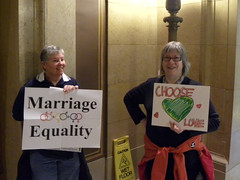
Protest against a constitutional amendment banning same sex marriage

In a recent op-ed in the New York Times, sociologist Jaye Cee Whitehead shared her thoughts on economic arguments for gay marriage.

In a letter to the New York State Legislature last month, top business executives endorsed same-sex marriage on the ground that “attracting talent is key to our state’s economic future.” The signers — among them the banker Lloyd C. Blankfein, the financier Ronald O. Perelman, the real estate developer Jerry I. Speyer and the publisher Mortimer B. Zuckerman — declared that legalizing gay unions would “help maintain our competitive advantage in attracting the best and brightest people the world has to offer.”

This letter is one of many examples of promoting marriage equality as good for business.

States and cities are, as the New York executives pointed out, competing to attract talent in a globally competitive labor market. The wedding industry benefits, of course, when more couples are allowed to marry. And marriage equality is associated with revenue gains from sales taxes and license fees. Backers of gay marriage speak openly of the gains from “marriage tourism” in states that have legalized same-sex marriage.

So why shouldn’t gays and lesbians have equality and bolster the economy at the same time?  In Whitehead’s eyes,

. . . supporting marriage on economic grounds dehumanizes same-sex couples by conflating civil rights with economic perks. Americans should be offended when the value of gays and lesbians is reduced to their buying power as consumers or their human and creative capital as workers. . .Worse yet, this narrative neglects the most economically vulnerable gay and lesbian couples and plays into the inaccurate stereotype of same-sex couples (particularly male couples) as being mostly well-educated and affluent.

Indeed, many proponents of same-sex marriage often point out that legalizing same-sex marriage may reduce spending on welfare programs.  But, Whitehead explains why these and other economic arguments are problematic.

Supporters of same-sex marriage ought to acknowledge that marriage is not just a natural expression of human intimacy or a declaration of personal commitment; it is a form of governance. The vast expansion of the government over the past century has embedded marriage into all areas where the state and the individual intersect, from tax obligations to disability benefits to health care decisions to family law. As with any other structure of governance in a democratic society, we ought to think about its participants as citizens rather than consumers.

So if you support same-sex marriage, do so not because it brings in tax revenue and tourism dollars and prevents people from becoming a burden on the state, but because you value gay men and lesbians as citizens who deserve equal access to the rights and responsibilities of marriage.


Protesting Scott Walker
In an op-ed published in the Raleigh-based paper, the Newsobserver, sociology Ph.D student Amanda Gengler provides insight into what is at stake in the current political struggle in Wisconsin. To do so Gengler draws upon her experience at the University of Wisconsin-Madison where she earned her master’s degree.

As a graduate student at the University of Wisconsin-Madison 10 years ago, every month a few dollars of my stipend went to pay dues to the TAA; a unique union that represents and protects graduate employees working in the UW-System. In return, I worked under a contract that ensured full health care benefits and basic dental care (with no out-of-pocket premiums), and tuition remission (without which my education would not have been possible) as well as other fair labor protections.

Now, even after each subsequent renegotiation of the rights for Wisconsin’s graduate employees has resulted in more and more concessions, current Gov. Scott Walker is proposing to remove the TAA’s collective bargaining rights altogether. This would make it impossible to fight for any of these protections, all of which could be immediately revoked.

Graduate students are not alone in seeing this as an attack on the education system.

Under the rallying cry “Hands off our Teachers,” undergraduates have taken to the streets in recent days alongside their graduate student instructors.

Gengler cautions us to not see this as an isolated threat directed at the University system.

Wisconsin’s 3,000 graduate student workers are but one of the many constituencies that will be directly harmed by the state government’s attack on unions and workers’ rights. As Wisconsin’s unions offer up economic concessions in terms of pay and premiums, only to be completely rebuffed by state lawmakers, it is clear that this issue is not about the budget: it is about ending workers’ collective bargaining rights.

The op-ed serves as a call for all workers and unions to pay close attention to what is occurring in Wisconsin. While the situation appears bleak, Gengler leaves us with a statement of resolve:

Those of us who have been fortunate enough to have those rights know what they are worth, and the thousands who continue to flood Madison’s streets make it clear that the right to fight is one thing they will not concede.