
divorce

Photo of two people walking through rows of large columns. Photo by Roman Boed, Flickr CC

Despite the longevity signified by the phrase, “till death do us part,” many American marriages are not so permanent. The statistic that half of marriages end in divorce has been cited for decades, but research by Philip Cohen shows that divorce rates have been falling for the last few years, even after accounting for demographic changes over that time. In a recent article in The Atlantic, Andrew Cherlin provides an unromantic explanation for the recent trend: “In order to get divorced, you have to get married first.”

In other words, declines in divorce are more driven by who is getting married than increased marital stability. Historically, divorce rates have been highest among Americans without a college degree. However, this group is now more likely to delay or forego marriage than they were 20 or 30 years ago. Victor Chen suggests that one factor responsible for marriage declines among people without a college degree is lack of jobs. Well-paying jobs for the less educated have become sparse as the American economy has transitioned away from manufacturing. Without stable employment, it is harder to maintain long-term romantic partnerships.

Another factor could be a rising acceptance of cohabitation, which has decreased the pressure for couples in their 20s to marry. Delaying marriage has benefits for marital quality. Cherlin explains:

“If you’re older, you’re more mature … you probably have a better job, and those things make it less likely that you’ll get into arguments with your spouse.”

However, declines in marriage do not necessarily mean that Americans are getting better at long-term partnership. Rather, relationship volatility is moving from the context of marriage to cohabitation, where it is harder to measure. These falling marriage rates among the less-educated parallel a growing gap between the richest Americans and everyone else. College graduates, who are more likely to marry, are better positioned to endure economic uncertainty and build wealth through their pooled incomes. This leads Cohen to conclude that marriage is “an increasingly central component of the structure of social inequality.” In other words, while declining divorce may look like a positive trend at first glance, it may speak more to growing inequality than it does enduring love.

Photo by Nuno Luz, Flickr CC

Summer is wedding season, but according to sociologists Julie Brines and Brian Serafini, late summer may also be divorce season. New York Magazine recently featured new findings that indicate divorce may follow seasonal trends. Brines’ and Serafini’s analysis of several U.S. states, including Washington, Ohio, Minnesota, Florida, and Arizona, shows that divorce filings were at their highest in March and August. The researchers believe that these trends may reflect a “last-ditch effort” by couples to repair their relationships during holiday seasons. According to a University of Washington press release,

“Troubled couples may see the holidays as a time to mend relationships and start anew: We’ll have a happy Christmas together as a family or take the kids for a nice camping trip, the thinking goes, and things will be better.”

As a result, divorce rates seem to be highest when the holiday spirit has passed. The approaching school year may also push couples to file for divorce before September, further accounting for the August peak.

Photo by Rob Tom via Flickr.
There are more married mothers among millenial women with college degrees. Photo by rob tom via Flickr.

Differences in education level lead to dramatically different views on when to become a parent, according to new research. John Hopkins University sociologist Andrew Cherlin shows that millennial women with college educations are more likely to wait until they are married before they have children than women without a college degree. In an interview with Sarah Kliff of Vox, Cherlin explains:

“We’re seeing the emergence two very different paths to adulthood. Among young adults without college educations, most of their childbearing is in their twenties and the majority of it is outside of marriage. That includes people who have gotten a two-year associate’s degree. The dividing line is the four-year degree. The vast majority of people with that college degree are having children in marriage. We didn’t see this 20 or 30 years ago. We didn’t see these sharp differences between the college graduates and non-graduates.”

This trend concerns Cherlin, as it could lead to a more unstable family life for the children of unmarried parents with a high school education. He sees a lack of middle-skill jobs as the cause of their financial instability. This leads to their higher rate of breaking up and ultimately reinforces economic inequalities between education groups. Parents who have a college education are less likely to get divorced, since they are the couples who are more likely to have two steady incomes.

When asked if we could turn this worrisome trend around, Cherlin posits:

“It depends on if you think we can turn the middle of the job market around, and if we can find productive employment for high school graduates. If that happens, then I think we have a chance of reversing the instability we’re seeing in family lives. I also think that it might be a good idea to promote a message that one should wait to have children until one is in a stable marriage.”

That said, providing an alternative vision of a future where the high-school and college-educated alike can navigate the new economy could lead to greater family stability for their kids.


Photo by Nicholas via flickr.com

Many romantic couples who live together without being married do so out of wariness about the high divorce rate. Cohabiting, for these couples, can be a “trial” relationship period in which they decide their compatibility before marrying.

Until recently, previous research conclusions and popular conception held that cohabiting couples who eventually married experienced higher divorce rates than those who did not live together before marriage.

A new study by University of North Carolina-Greensboro sociologist Arielle Kuperberg proves this assumption false. Using data from the National Survey of Family Growth, Kuperberg analyzed the divorce rate among 7,000 people who had been married at least once. Kuperberg also incorporated other variables, such as the date the couple moved in together. Contrary to 1970s research, Kuperberg found no link between cohabitation and divorce.

Cornell University sociologist Sharon Sassler, in pursuit of research for her book on cohabitation, interviewed more than 150 cohabiters. She found that persons with college degrees date longer before moving in together. Those with degrees date for an average of 14 months compared to 6 months or less for non-degree holders.

As cohabitation becomes more common among couples, sociological research is investigating and dispelling myths about the intricacies of romantic relationships, turning common (and fallacious) knowledge on its head.


Photo by Trace Nietert via flickr.com

Marriage in the U.S. today: the best is better, but the average is worse, according to psychologist Eli J. Finkel in an opinion piece for The New York Times. (Without further clarification, this appears to be a discussion of heterosexual marriage.) Finkel reports that the happiest couples are happier both with their marriages and in general, while the average married person is less satisfied and likelier to divorce than in the past.

That’s because we are sizing up our spouses in the era of the “self-expressive marriage,” Finkel explains, drawing on the ideas of sociologist Andrew J. Cherlin and historian Stephanie Coontz. No longer are we satisfied with our family life as a means to filling our bellies, providing shelter, or even giving us love–many of us now expect marriage to yield “self-discovery, self-esteem, and personal growth.”

Marriages fall short of this ideal, Finkel argues, in part because people aren’t putting in the time with their spouses required for satisfaction. Whether it is working more or parenting more intensively, the average couple is logging hours elsewhere. And the divorce rate is higher for poor, less educated Americans, whose lack of time and energy for sustaining high-quality marriages Finkel attributes to exposure to trends such as “unemployment, juggling multiple jobs, and so on.”

Finkel devotes a quick sentence to government and workplace policy solutions (perhaps discussed in more depth in the forthcoming scientific write-up). As far as what individuals can do, Finkel’s advice boils down to a) spend more time together or b) if more together time isn’t possible, consider looking to marriage for love rather than for self-expression.

Picture 2


Photo by mandaloo via flickr.com
Photo by Michael Swan via flickr.com

Contrary to conservatives’ emphasis on family values, sociologist Jennifer Glass at the University of Texas at Austin concludes that “red” states have higher divorce rates than their “blue” counterparts. Although previous studies have argued that socioeconomic factors, such as financial strain, explain this difference, Glass and her team of researchers found that it is actually specific elements of conservative Protestant culture that contributed to this higher divorce rate. Religious conservatives are more likely to emphasize abstinence before marriage and discourage living together without being married. They also marry and start having children younger than other demographic groups. All of these factors, Glass argues, contribute to marriage instability and the higher rates of divorce in states like Alabama and Arkansas than in more liberal states.

Other scholars, including sociologist Phil Cohen, have examined the overall decrease in divorce during the recent economic recession. From 2009-2011, couples seemed to be sticking together through tough financial times. However, as the economy has rebounded, so has the divorce rate. Rather than pulling together to overcome economic hardship, it seems that couples have postponed divorce until they could afford it.

Sociologist Andrew Cherlin, who studies changes in marriage over time, asserts that this is far from a surprising or unique trend, telling the LA Times, “This is exactly what happened in the 1930s. The divorce rate dropped during the Great Depression not because people were happier with their marriages, but because they couldn’t afford to get divorced.”

Photo by minicooper93402 via flickr.com

For one-percenters like Tom Cruise and Katie Holmes, it’s easy to get the world’s fastest divorce. Their legal split took only two weeks. But for the poorest of Americans, divorce is still a luxury item.

So begins the Huffington Post’s coverage of new research out from Ohio State University researchers Dmitry Tumin and Zhenchao Qian, the gist of which is long-term separations are increasing. The authors report that, in their longitudinal study of over 7,000 people, about 85% of spouses who separated got divorced within 3 years, but about 15% hadn’t signed the papers within 10 years. HuffPo goes on:

…[R]esearchers said there was an economic reason… they simply could not afford to get divorced, especially when there were children involved. The study found that the married-but-indefinitely-separated group generally had only a high school education, were black or Hispanic, and had young children.

And the economic reasoning is both a push and a pull. There is the base cost of getting divorced, of course: ranging from just hundreds to thousands of dollars, depending on the complications of bringing in lawyers to take care of custody arrangements and joint property, it takes some cash to split up. But there are the financial benefits of staying married to consider, too: joint tax returns and shared health coverage are among those cited by HuffPo’s author Catherine New, along with the lower cost of shared rent or a mortgage, childcare costs that can be alleviated by swapping duties within the household, and so on.

New adds one final thought for those optimists who think it’s not the money—a separation might actually just be bringing those 15% closer again (the “absence makes the heart grow fonder” line of reasoning): the Ohio State study finds that 5% of separated couples did get back together. But half of those got divorced anyway.

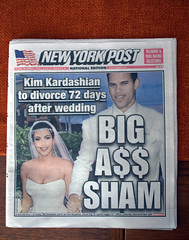
Cover Story:  New York Post, 11.01.11
Photo by Joe Wolf via flickr.com

The most recent marital meltdown making headlines involves the rapid “I don’t” of entrepreneur Kim Kardashian and pro basketball player Kris Humphries. While their split’s every detail is dissected everywhere from tabloids to 24 hour news networks, the Des Moines Resister took a different angle on the issue: they talked to some sociologists.

Susan Stewart, associate professor of sociology at Iowa State University, and Tony Paik, associate professor the University of Iowa’s Department of Sociology, helped explain some of the broader societal issues affecting early divorce and how we perceive flame-out marriages. Stewart maintains that although people generally don’t talk about their own divorces, it’s fair game to critique others’. This appears to especially be true for the nearly 1 in 4  U.S. marriages that end within the first 5 years.

“We are fascinated when people crash and burn,” Stewart said. “It’s a way to work through [our own issues]: ‘They are way worse off than I am.’ ”

Stewart believes age is often a determining factor in early divorce, but short engagement periods and contrasting religious or family backgrounds also come into play. And Paik presents data showing that earlier intercourse, surprisingly, may also be a determinant of short-lived marriages: according to Paik’s analysis, of those who remain abstinent until age 18, only 15 percent will divorce within the first 5 years of marriage. Those who have sex before 18 are shown to divorce at at rate of 31 percent.

Paik hasn’t determined why this might be, but he speculates that sex at a young age may lead to other possible divorce determinants, including premarital pregnancy, permissiveness toward non-marital sex, and premarital cohabitation–each of which seems to lose relevance over time, particularly when it comes to the Kardashian-Humphries union, which, so far as the prurient public knows, included none of these factors.