

demographics

  • Chicago Magazine interviewed Eric Klinenberg (Professor of Social Science and Director of the Institute for Public Knowledge at New York University) about his new book, 2020: One City, Seven People, and the Year Everything Changed. The book–a “social autopsy”–focuses on New York City in the wake of the COVID-19 pandemic and examines how institutions broke down during the crisis. “Societies reveal themselves when they’re under threat,” Klinenberg said. “You can see who we are and what we value, whose lives matter and whose don’t.”

  • Jonathan Wynn (Professor of Sociology at UMass Amherst) and Daniel Skinner (Associate Professor of Health Policy at Ohio University) recently wrote a piece for The Conversation on the “paradox of medically overserved communities.” For urban, non-profit hospitals, mission statements usually include providing a benefit to the local community; however, people living around these hospitals tend to have worse health in comparison to the broader city population.

  • Paul Spoonley (Distinguished Professor Emeritus at Massey University) appeared on AM to comment on New Zealand’s aging population and low fertility rates. Spoonley noted that by the 2030s, 1 in 4 people will be over the age of 65 and that care for an older population will place fiscal strain on the government. This story was covered by Newshub.

  • Lindsey D. Cameron (Assistant Professor of Management, Sociology at the University of Pennsylvania), Curtis K. Chan (Professor of Management and Organization at Boston College), and Michel Anteby (Professor of Management and Organizations, Sociology at Boston University) wrote an article for the Harvard Business Review on how gig workers respond to employers labeling them as “heroes.” They interviewed Instacart workers in 2020, after the company launched a “Household Heroes” marketing campaign. While some workers “readily embraced the hero label and viewed their work as resoundingly worthy,” others rejected the label and viewed the label as exploitative and manipulative. Most workers struggled “to reconcile the banality of grocery shopping with the idea that they were doing moral work.” Cameron, Chan, and Anteby warn companies that “moralizing jobs” to increase motivation can backfire.
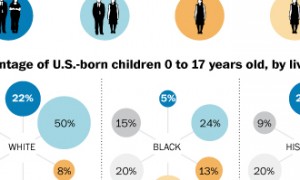

Image excerpt from the Washington Post, created by Christina Rivero. Click for full image.

When thinking about the typical U.S. family, you might imagine a classic sitcom like The Brady Bunch: stay-at-home mom Carol, architect husband Mike, and six lovely children. At the time the show aired, a “blended” family of remarried adults was a bit of a novelty, sure, but it still stuck to the married mother and father, father is the breadwinner trope. And that’s still how many often picture U.S. families.

The Washington Post reports the findings of Ohio State University’s Department of Sociology on the living arrangements of U.S. children from birth to 17 years old. The researchers found that the children’s living arrangements varied distinctly by race. Asian children were most likely to live with a married mother and father, with only the father working, but that set-up only counted for 24% of living arrangements among Asian children. It turns out that dual-income households are the strong majority among both white and Asian children, and that both are more likely to live in dual-income households than either black or Hispanic children. Higher percentages of black and Hispanic children are living with their grandparents. Another notable statistic among black children is their greater likelihood of living with a single, never-married mother (this is true for nearly a quarter of all black kids).

No word yet on all white, three-boy, three-girl families with maids.

The United States has a greater share of its population behind bars than any other nation. Yet this captive audience is almost never captured by large national surveys used to study the U.S. population. This might distort what we think we know about black progress in recent decades, the Wall Street Journal reports, because a large enough swath of the young African American male population is incarcerated and unaccounted for by these surveys.

Among the generally accepted ideas about African-American young-male progress over the last three decades that Becky Pettit, a University of Washington sociologist, questions in her book “Invisible Men“: that the high-school dropout rate has dropped precipitously; that employment rates for young high-school dropouts have stopped falling; and that the voter-turnout rate has gone up.

For example, without adjusting for prisoners, the high-school completion gap between white and black men has fallen by more than 50% since 1980, says Prof. Pettit. After adjusting, she says, the gap has barely closed and has been constant since the late 1980s. “Given the data available, I’m very confident that if we include inmates” in more surveys, “the trends are quite different than we would otherwise have known,” she says.

Voter turnout is another example, especially in light of this year’s presidential election.

…commonly accepted numbers show that the turnout rate among black male high-school dropouts age 20 to 34 surged between 1980 and 2008, to the point where about one in three were voting in presidential races. Prof. Pettit says her research indicates that instead the rate was flat, at around one in five, even after the surge in interest in voting among many young black Americans with Barack Obama in the 2008 race.

“I think that’s kind of stunning,” Prof. Pettit said.

Experts debate the feasibility of including prisoners in such surveys, as well as how to make the best use of available data. Even Pettit admits, “These are really, really tricky things.”


It’s no surprise that the Great Recession has brought economic inequality front and center in the United States. The focus has been mostly problems in the the labor market, but Jason DeParle at the New York Times points out that other demographic changes have also had a sizable impact on growing inequality.

Estimates vary widely, but scholars have said that changes in marriage patterns — as opposed to changes in individual earnings — may account for as much as 40 percent of the growth in certain measures of inequality.

To illustrate how changes in family structure contribute to increasing inequality, DeParle turns to the research of several sociologists. One issue is the fact that those who are well off are more likely to get married.

Long a nation of economic extremes, the United States is also becoming a society of family haves and family have-nots, with marriage and its rewards evermore confined to the fortunate classes.

“It is the privileged Americans who are marrying, and marrying helps them stay privileged,” said Andrew Cherlin, a sociologist at Johns Hopkins University.

A related trend is the educational gap between women who have children in or out of wedlock.

Less than 10 percent of the births to college-educated women occur outside marriage, while for women with high school degrees or less the figure is nearly 60 percent.

This difference contributes to significant  inequalities in long-term outcomes for children.

While many children of single mothers flourish (two of the last three presidents had mothers who were single during part of their childhood), a large body of research shows that they are more likely than similar children with married parents to experience childhood poverty, act up in class, become teenage parents and drop out of school.

Sara McLanahan, a Princeton sociologist, warns that family structure increasingly consigns children to “diverging destinies.”

Married couples are having children later than they used to, divorcing less and investing heavily in parenting time. By contrast, a growing share of single mothers have never married, and many have children with more than one man.

“The people with more education tend to have stable family structures with committed, involved fathers,” Ms. McLanahan said. “The people with less education are more likely to have complex, unstable situations involving men who come and go.”

She said, “I think this process is creating greater gaps in these children’s life chances.”

As sociologists and others have shown, the income gap between those at the top and bottom has changed dramatically over time.

Four decades ago, households with children at the 90th percentile of incomes received five times as much as those at the 10th percentile, according to Bruce Western and Tracey Shollenberger of the Harvard sociology department. Now they have 10 times as much. The gaps have widened even more higher up the income scale.

But again, DeParle notes that marriage, rather than just individual incomes, makes a big difference:

Economic woes speed marital decline, as women see fewer “marriageable men.” The opposite also holds true: marital decline compounds economic woes, since it leaves the needy to struggle alone.

“The people who need to stick together for economic reasons don’t,” said Christopher Jencks, a Harvard sociologist. “And the people who least need to stick together do.”

For more on the Great Recession and inequality, check out our podcast with David Grusky.

Photo by Brian D. Hawkins via flickr.com
Photo by Brian D. Hawkins via flickr.com/briandhawkins.com

For the first time in about a century, new Census data reveal that population growth in big U.S. cities is exceeding that of the suburbs. According to the Associated Press (via Huffington Post):

Primary cities in large metropolitan areas with populations of more than 1 million grew by 1.1 percent last year, compared with 0.9 percent in surrounding suburbs. While the definitions of city and suburb have changed over the decades, it’s the first time that growth of large core cities outpaced that of suburbs since the early 1900s.

In all, city growth in 2011 surpassed or equaled that of suburbs in roughly 33 of the nation’s 51 large metro areas, compared to just five in the last decade.

Young adults forgoing homeownership and embracing the conveniences of urban life appear to be a driving force behind this trend.

Burdened with college debt or toiling in temporary, lower-wage positions, they are spurning homeownership in the suburbs for shorter-term, no-strings-attached apartment living, public transit and proximity to potential jobs in larger cities…They make up roughly 1 in 6 Americans, and some sociologists are calling them “generation rent.”

A related report from NPR further cites tougher mortgage rules since the housing bubble burst as an important factor.

Even with big drops in housing prices and interest rates, getting a mortgage has become a lot harder since the heady days of “no income, no assets” loans that fueled the housing boom of the early 2000s. Most lenders now require a rock-steady source of income and a substantial down payment before they will even look at potential borrowers. And many millennials won’t be able to reach that steep threshold.

The combination of stricter mortgage requirements, college loan debt, and a tough economy leaves sociologist Katherine Newman skeptical of young adults’ prospects for home ownership for the foreseeable future. From Huffington Post:

“Young adults simply can’t amass the down payments needed and don’t have the earnings,” she said. “They will be renting for a very long time.”

Courtesy of _PaulS_ (http://www.flickr.com/photos/kapkap/)

Find out how your income ranks in different parts of the U.S. with this interactive graphic from the New York Times. Needless to say, what earns 1% status in New York is not the same as in Flint, Mich. Data comes from demographic researchers at the Minnesota Population Center at the University of Minnesota.

A breakdown of the jobs of the 1%, featured over on Sociological Images, is part of the same Times package.

mormon ad
Image by Trontnort via flickr

Media attention around the Republican crop of presidential candidates, as well as a new ad campaign with the tagline “I am a Mormon,” have popularized discussion about the Church of Latter-day Saints. In Utah, however, new data shows Mormonism isn’t as prominent as it once was, especially among men. A report written by sociologists Rick Phillips (University of North Florida) and Ryan Cragun (University of Tampa) and released by Trinity College in Hartford, Connecticut found that Utah’s Mormon majority is shrinking. It’s now down to 57 percent, and men account for only 40 percent of those Utah Mormons (down from 47.5 percent two decades ago).

In their paper, the Salt Lake Tribune reports, Phillips and Cragun suggest the reason for this widening gender gap might be that Utah’s men are abandoning their faith at higher rates than women. In the past, Mormon men remained tied to the church rather than lose their social standing in the community, argue Phillips and Cragun, both on the board of the Mormon Social Science Association. “However, declining Mormon majorities [in Utah] may have weakened that link, and Mormon men who lack a strong subjective religious commitment to the church are now free to apostatize without incurring sanctions in other social settings.”

Other scholars in the field, disagree with Phillips and Cragun’s interpretation of the data. David Campbell, a political scientist at the University of Notre Dame, points out to the Salt Lake Tribune this shift isn’t necessarily due to men leaving the church, but could also be a result of more women joining. And Marie Cornwall, sociologist at Brigham Young University and editor of the Journal for the Scientific Study of Religion, has her own criticism of Phillips and Cragun’s conclusions:

They have no way of knowing whether the growing gap reflects migration patterns—professional men and women leave the state to look for jobs and, given the lower rates of professional women, that may mean that men are leaving the state as much as it means that they are leaving the [LDS] Church.

As in so many other cases, the numbers can’t tell the whole story of why the population of Utah’s male Mormons seems to be shrinking.