debt

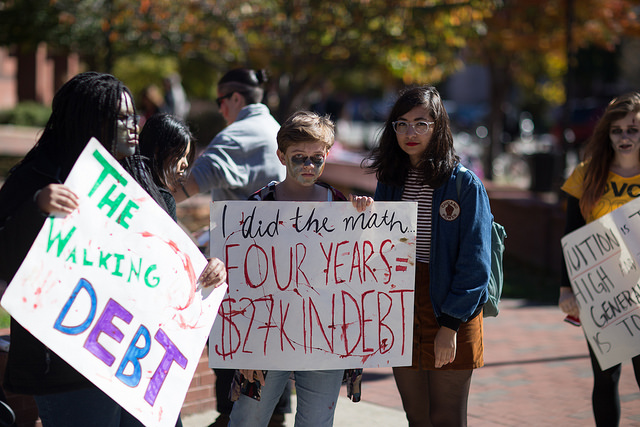
Photo of people protesting student debt. Photo by Tom Woodward, Flickr CC

While considerable media attention has been paid to the student debt crisis in the United States, few stories have detailed how this burden falls disproportionately on Black borrowers. Recently, CNBC interviewed Jason Houle about how student loans contribute to the racial wealth gap.

In their research, Houle and his co-author found that Black Americans accumulate nearly twice as much debt as their white counterparts by graduation. This disparity grows through adulthood as Black borrowers pay their loans at a slower rate than whites (4% per year vs. 10% per year). Fifteen years after college, Black borrowers hold 185% more student debt than whites. Houle contends that “the racial wealth gap is both the biggest and has grown the fastest among those with a college education,” and that student loans are a primary reason for this trend. In fact, student loans explain roughly 25% of the total racial wealth gap by age 30.

Houle offers several explanations for this gap. Black students on average have less financial capacity to pay for college than whites, causing them to pursue more loans. Additionally, Black students are more likely to attend expensive for-profit colleges and use private loans, both of which offer fewer protections to consumers. Houle uses the phrase “predatory inclusion” to describe this phenomenon, remarking that expanded access to higher education for Black Americans has also expanded opportunities for financial institutions to exploit them. These findings have made Houle rethink the metaphor of higher education as an engine of upward mobility: 

“In a world where we have rising college costs and rising student debt, it raises questions about whether or not that engine may be sputtering out.”


Photo by The Great 8, Flickr CC.

Income inequality is a hot topic this election, and the Panama Papers have added fuel to the fire. Indeed, it seems that there’s no end to the data that shows the discrepancy between the 1% and the rest of us. What will it to start seeking solutions to extreme income disparities?

New research by TSP contributor Kevin Leicht of Urbana Champaign (available in an article in The Sociological Quarterly) points us in the right direction. As he explains in an interview with The Atlantic’s Gillian B. White, the way social scientists and others conceptualize inequality is too tied to trying to increase diversity at the top rather than studying the economy as a whole. Furthermore, while we’ve been very interested in inequality by race, we don’t do enough to consider gender inequalities, particularly as they exist within racial groups. The popular narrative is that hard work can jettison anyone to the top, but research like Leicht’s shows how outdated this notion is.

To read more of Leicht’s work, see his TSP papers, “Has Borrowing Replaced Earning?”, “Economic Decline and the American Dream,” and “Old Narratives and New Realities,” or check out our volume on the new sociology of debt, Owned.

Photo by Francisco Gonzalez via Flickr.
Starbucks responds to employees’ lack of affordable education choices. Photo by Francisco Gonzalez via Flickr.

Last month, Starbucks CEO Howard Schultz appeared on the Daily Show to discuss a new partnership with Arizona State University that will allow workers to earn an online degree while still keeping their day jobs. Schultz was happy to announce that the coffee corporation would be the “first U.S. company to provide free college tuition for all [its] employees.”

However, ASU clarified that Starbucks won’t actually provide any money to help its employees afford their education. Rather, workers will have the chance to enroll in ASU’s online programs at a greatly reduced price, but will still have to pay for the remaining costs out of their own pockets, with student loans, or via federal aid.

The “Starbucks Scholarship” won’t be awarded upfront, but the company does plan to reimburse students after they pay for, and complete, their first 21 credits. Applying for financial aid can be time consuming and complex, and sociologist Sara Goldrick-Rab argues that a “wholly online education is of questionable value for low-income students…[E]specially when such students are required to pay for those first 21 credits before they qualify for reimbursement.”

During this time, ASU online will likely make a profit off incoming students who are paying for their education with financial aid—continuing what sociologist Tressie McMillan Cottom describes as a “long and shady history” of companies making money off public funds.

It’s hard to be fully cynical about the Starbucks Scholarship since it will likely open the (virtual) doors for many students to earn a college degree. Nonetheless, the plan hardly addresses the structural problem of an unaffordable education system. In his interview with Jon Stewart, Schultz likened the tuition benefits to employee-provided health care—a comparison journalist David Perry isn’t keen about:

The development of health care as an employee benefit rather than a universal right has been a disaster for America, leading to high costs and poor results. Yes, the employees are much better off with health care than without, much as some workers will benefit from the new tuition policy. But if making college affordable becomes a job perk, rather than a societal goal, we’re collectively worse off.

A sign protesting the imposition of tuition fees at NYC's historic Cooper Union, a 150-year-old free school. Photo by Michael Fleshman via flickr.com.
A sign protesting the imposition of tuition fees at NYC’s historic Cooper Union, a 150-year-old free school. Photo by Michael Fleshman via flickr.com.

UC Berkeley grad students and Scholars Strategy Network members Charlie Eaton and Jacob Habinek are in an ideal spot—geographically, educationally, even generationally—to look at college debt. Young people seeking first degrees, let alone post-secondary education, are increasingly floundering in student debt, and Congress is dragging its heels when it comes to finding ways to mitigate that debt’s effects. But the state of California’s higher education system is also notoriously in the red, and that’s where their research comes in.

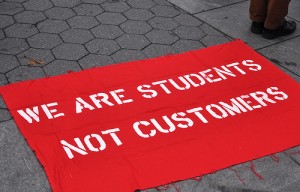
“Public research universities,” like those the authors attend, “have passed along their own debt to students by raising tuition and fees by an average of 56 percent from 2002 to 2010,” writes Don Troop in The Chronicle of Higher Education’s Bottom Line blog. So, yes, the students face rising loan debt, but it’s at least partially due to the borrowing needs of the colleges getting passed along to the “consumer,” a model not usually associated with public institutions. Troop goes on to cite the authors’ work examining data “from 155 public research universities,” “among which debt-service payments had risen 86 percent from 2002 to 2010.”

The idea that inflation raises the cost of goods and providers then raise the cost of the goods for the end consumer isn’t new. When that commodity is education, however, we see students (even those who never graduate) holding what may soon amount to adjustable rate credit card bills: federal and private education loans. To read the full SSN report, click here.

Photo by Kristine Lewis via flickr.com.

For many, the “American Dream” means owning a comfortable home in a nice neighborhood, and that idea brings a certain Mellencamp tune to mind.

The song nods to a deeper point: the history of American housing policy from the New Deal and the G.I. Bill onwards was often defined by who couldn’t get a little pink house. In fact, racial biases among policymakers and bureaucrats made it difficult or impossible for minorities to get support for housing in white neighborhoods (For a great account of this history, see Ira Katznelson’s book When Affirmative Action Was White, or his recent blog post over at The Scholars Strategy Network).

Today’s housing policies may be flipping the script on this story, but not necessarily in a good way.

The Atlantic Cities reports new research from NYU Sociologist Jacob Faber on the 2006 housing bubble that preceded the massive economic crash and kickoff to the U.S. “Great Recession” in 2008. It turns out that during this bubble, in addition to denying home loans to racial minority groups, banks were also targeting minority groups for lower quality loans. The article reports:

Black and Hispanic families making more than $200,000 a year were more likely on average to be given a subprime loan than a white family making less than $30,000 a year… blacks were 2.8 times more likely to be denied for a loan, and Latinos were two times more likely. When they were approved, blacks and Latinos were 2.4 times more likely to receive a subprime loan than white applicants.

Faber adds that the trend doesn’t just deny support to these minority groups, it actually ignores their financial successes.

…this data offers another illustration that middle-class blacks have often not been able to leverage their income status for the same benefits as middle-class whites.

Ain’t that America?

Photo by Brian D. Hawkins via flickr.com
Photo by Brian D. Hawkins via flickr.com/briandhawkins.com

For the first time in about a century, new Census data reveal that population growth in big U.S. cities is exceeding that of the suburbs. According to the Associated Press (via Huffington Post):

Primary cities in large metropolitan areas with populations of more than 1 million grew by 1.1 percent last year, compared with 0.9 percent in surrounding suburbs. While the definitions of city and suburb have changed over the decades, it’s the first time that growth of large core cities outpaced that of suburbs since the early 1900s.

In all, city growth in 2011 surpassed or equaled that of suburbs in roughly 33 of the nation’s 51 large metro areas, compared to just five in the last decade.

Young adults forgoing homeownership and embracing the conveniences of urban life appear to be a driving force behind this trend.

Burdened with college debt or toiling in temporary, lower-wage positions, they are spurning homeownership in the suburbs for shorter-term, no-strings-attached apartment living, public transit and proximity to potential jobs in larger cities…They make up roughly 1 in 6 Americans, and some sociologists are calling them “generation rent.”

A related report from NPR further cites tougher mortgage rules since the housing bubble burst as an important factor.

Even with big drops in housing prices and interest rates, getting a mortgage has become a lot harder since the heady days of “no income, no assets” loans that fueled the housing boom of the early 2000s. Most lenders now require a rock-steady source of income and a substantial down payment before they will even look at potential borrowers. And many millennials won’t be able to reach that steep threshold.

The combination of stricter mortgage requirements, college loan debt, and a tough economy leaves sociologist Katherine Newman skeptical of young adults’ prospects for home ownership for the foreseeable future. From Huffington Post:

“Young adults simply can’t amass the down payments needed and don’t have the earnings,” she said. “They will be renting for a very long time.”