

climate change

Colorado Arts and Science Magazine wrote an article about Leslie Irvine (Professor of Sociology at the University of Colorado at Boulder) and Cameron Whitley’s (Assistant Professor in the Department of Sociology at Western Washington University) research on the loss of companion animals in the Marshall Fire that was overlooked by public officials and the news media. They found that “the wildfire…killed more than 1,000 companion animals who were trapped in homes”, however, two months after the fire only 16% of news stories published mentioned animals. Whitley and Irvine shed light on how these companion animals “…don’t fit into breaking news. But they shape everyday life for years…for people with animals, the disaster often continues for the rest of those animals’ lives—through toxic exposure, long‑term illness and ongoing [unrecognized] grief.”

Leslie Irvine & Cameron Whitley

The Conversation recently published an article by Emily Huddart (Associate Head and Professor of Sociology at University of British Columbia) and Tony Silva (Associate Professor of Sociology at University of British Columbia) on how political orientation impacts opinions on climate policy.  Examining the range of climate opinions on the political right, they found that affective polarization drove the variation: “Negative feelings toward the left and positive feelings toward the right were by far the strongest predictors of climate policy attitudes.” Huddart and Silva explain that “If opposition to climate policy is rooted in social and political identity, then strategies for building support need to reflect that reality…this will mean finding core needs that Canadians have in common and seeking policies that can have climate benefits while meeting those core needs.”


Emily Huddart & Tony Silva

The book Trash! A Garbageman’s Story by Simon Pare-Poupart made it onto a New York Times book list called The Nonfiction Everyone Will Be Talking About in 2026. Pare-Poupant’s book investigates society’s relationship with garbage, drawing from his graduate study in sociology. It is “A Montreal garbageman’s sharp and funny memoir/exposé, in which he attempts to convince people to ‘stop imagining that your garbage magically disappears…’”

Simon Pare-Poupart

An article from Newswise by the American Sociological Association (ASA) announces the expansion of Context, “the quarterly magazine that makes cutting-edge sociology research accessible to general readers,” to an online-only fully digital publication. Editor David Grazian (Professor of Sociology at the University of Pennsylvania) explains that “With the move online, Contexts enters a new chapter—one that broadens our reach and deepens our ability to engage a public hungry for evidence-based perspectives on the most pressing social issues of our time.”
American Sociological Association (ASA)

  • Julia Sonnevend (Associate Professor of Sociology and Communications at the New School for Social Research) was interviewed by Public Seminar about her new book Charm: How Magnetic Personalities Shape Global Politics. Sonnevend discussed how political charm is evaluated by (often fragmented) audiences and how the charm of a political leader affects views of their country: “We simply pay more attention to personalities than to institutions, values, or even facts. If you think about the international context, we are often talking about countries Americans know very little about. And when there is a relatable political character, or a character who we really dislike, it is easier to put the country in a box.”
  • Eric Klinenberg (Professor of Social Science at New York University) wrote an opinion piece in the New York Times arguing that there is an “urgent need to make dangerous heat more recognizable.” Klinenberg discusses how, despite the fact that deaths due to heat waves typically outnumber deaths from hurricanes, tornadoes, and floods combined, Americans are “quick to forget” heat waves. Klinenberg argues that major heat waves should be named (like major storms are named, e.g. “Hurricane Katrina” or “Superstorm Sandy”) to help us “recognize it as an enemy and mobilize support for public projects” to avoid future climate disasters.
  • Pesquisa ran an article on homelessness in Brazil, which has grown about 211% from 2012 to 2022. Research from the Institute of Applied Economic Research (IPEA) indicates that the primary reasons for homelessness are financial hardship, broken family ties, and health issues (particularly related to addiction). Marco Antônio Carvalho Natalino (Sociologist at the Institute of Applied Economic Research) explains that “the reason for homelessness influences its duration,” and homelessness due to family or health issues tends to last longer. Fraya Frehse (Professor of Sociology at the University of São Paulo) commented that the spread of homelessness is a global reality.
  • Ahead of the U.S. presidential debate, Tressie McMillan Cottom (Associate Professor at the University of North Carolina’s School of Information and Library Science) joined four other New York Times columnists in an online discussion on the candidates and their potential pathways to winning the election. McMillan Cottom noted that “Trump is a known entity. He does not have to “win” the debate…he has to win the media cycle. His biggest risk is being ineffectual at commanding attention.” For Harris, the “best path to winning is through historic turnout and enthusiasm.” McMillan Cottom emphasized the importance of selling a compelling story to scared, angry voters: “The big story of Trump’s win in 2016 was that voters were angry and experts missed it. … The story in this election is that voters are still angry and we may still be missing it. I spent time talking to female voters in nail salons, hair salons and waxing salons. … The women I talked to in those female spaces are angry and afraid. As one low-information voter told me, she wants someone to look like a fighter.”
  • David Karen (Professor of Sociology at Bryn Mawr) is featured in the recently released film Love 2020. The film is about the 2020 US Open–the first major international event held during the COVID-19 pandemic. Karen commented that it “was a delight to talk with Jacqueline Joseph, the director of the film, about so many things that I’m passionate about: tennis, New York City, the role of sports in our lives, and movements for social justice.” This story was covered by Bryn Mawr News

And Some Bonus Clippings:

  • Arlie Russell Hochschild’s new book, Stolen Pride: Loss, Shame, and the Rise of the Right, was covered by WBUR and the Boston Globe.
  • Sherry Turkle’s interview for Body Electric discussing the effects of AI chatbots on relationships was re-publicized on NPR last week.
  • Dana R. Fisher (Director of the Center for Environment, Community & Equity at American University) recently published a new book: Saving Ourselves: From Climate Shocks to Climate Action. Fisher argues that we need an “AnthroShift” (a “broad-based and yet deeply ingrained change of perception and behavior”) to address climate change: “Without a sustained shock that has tangible consequences in terms of social costs to people and property, the subsequent change will be ephemeral.” The book was reviewed by Yale Climate Connections.
  • Argentinian sociologist Agustín Teglia is using chess workshops as a tool to foster socialization among young people who are vulnerable to violence and marginality. “It’s a good way to generate a mediator, a common code to form a group. There can be children of different ages and levels, and each one has a role to receive and integrate classmates or teach them rules,” Teglia describes. This story was covered by Scroll.in.
  • Tressie McMillan Cottom (Associate Professor at the University of North Carolina) wrote an opinion piece for the New York Times on how O.J. Simpson will be remembered “as a spectacle.” Cottom discusses how Simpson received “a kind of carte blanche usually reserved for powerful white men, because his public mythology erased his private abuses” and how, during his infamous murder trial, Simpson’s legal team presented him as a symbol of “Black martyrdom” following the acquittal of L.A. police officers for the beating of Rodney King. “He wanted to be above the rules not because of what he was but because of who he was,” Cottom writes. “It’s the height of karmic irony, then, that what ultimately made Simpson special was the way his Blackness — that socially constructed distance from the white acceptance he so clearly craved — will forever define his legacy.”
  • Apryl Williams (Assistant Professor of Communication and Media at the University of Michigan) recently published a new book: Not My Type: Automating Sexual Racism in Online Dating. The book combines technical analysis, interviews, and a historical analysis of racism and romance to discuss how the algorithms of dating sites that sort users to predict attraction are racially informed. “By matching users with others who look like them, dating platforms both reflect and reinforce racial stereotypes and biases common in American culture, which attribute attractiveness and desirability to certain groups and rank others as less attractive.” This story was covered by The Harvard Gazette.
  • Alex Kotlowitz recently reviewed The Unclaimed: Abandonment and Hope in the City of Angels for The Atlantic. The book, by Pamela Prickett (Associate Professor of Sociology at the University of Amsterdam) and Stefan Timmermans (Professor of Sociology at UCLA), utilizes interviews to profile four individuals whose bodies were unclaimed upon their death to show how “some human deaths are valued less than others.” Matt Desmond praised the book as “[a] rare and compassionate look into the lives of Americans who go unclaimed when they die and those who dedicate their lives to burying them with dignity.” Kotlowitz’s review highlights how the book left him feeling surprisingly hopeful: “What is so remarkable about the lives of these people is how, despite their personal quirks and injuries, others took them in, embraced them, made them feel a part of a community.”
  • The Cut interviewed Gretchen Sisson (Sociologist at Advancing New Standards in Reproductive Health (ANSIRH) at the University of California San Francisco) about her new book Relinquished: The Politics of Adoption and the Privilege of American Motherhood, which highlights experiences of birthmothers in the adoption industry. Sisson describes how many birthmothers want to become parents, but participate in adoption for financial reasons: “We have to understand adoption largely as a product of inequity and poverty, and that is a fundamental understanding that we just don’t have in this country,” Sisson says.
  • Eric Klinenberg (Professor of Social Science and Director of the Institute for Public Knowledge at NYU) appeared on Plain English with Derek Thompson to discuss the “hanging out crisis” (the decline in face-to-face interactions), the importance of social infrastructure, and why “aloneness isn’t always loneliness.”
  • Robert Bullard (Distinguished Professor and Director of the Robert D. Bullard Center for Climate and Environmental Justice at Texas Southern University) appeared on Living on Earth to discuss how an elevated highway has caused destructive flooding in Shiloh, Alabama. “This is one of the worst cases of environmental racism that I have seen in the 40 years that I’ve worked on this. … If you look at the damage that has been caused over the last six years, you can see the drainage systems are pointed like cannons into the community. It’s almost as if the state is saying “We want you out of here. And if you don’t leave, we’re gonna drown you. We’re gonna drive you out.” Bullard discussed how pollution, vulnerabilities to climate change, and vulnerabilities to harmful infrastructure are racially segregated. This story was picked up by Inside Climate News.
  • Sociologist Margee Kerr (Faculty Lecturer at the University of Pittsburgh) was quoted in an Axios article on why people either love or hate horror movies. Kerr discusses how personal experience can affect how people respond to a jump scare. If you have positive memories of Halloween fun, you may have many “environmental context cues that tell you that in this situation, [the fear response] feels good,” Kerr explains. However, people who have experienced life-threatening situations may avoid fear in any situation. 
  • In rural Norway, a haunted grocery store (reportedly plagued by flying potatoes, electrical mishaps, and ghostly figures) captured the attention of sociologist Lars Birger Davan (PhD Candidate at Oslo Metropolitan University). Questioning how the unexplainable experiences of the staff and customers affected their relationship to society, Davan found that they were cautious in divulging details of experiences so as to not appear “crazy.” However, conversations with others who also had unexplainable experiences provided reassurance. Other sociologists weighed in on the effects of brushes with the paranormal. Marc Eaton (Associate Professor at Ripon College) noted that saying you’ve seen a ghost often comes with an assumption of irrationality or mental illness, making people hesitant to share paranormal experiences. Dennis Waskul (Professor of Sociology at Minnesota State University Mankato) stated that while paranormal experiences can be terrifying, they can also add intrigue into “a world that’s overly mechanized and a world that’s dominated by very predictable outcomes… a world of monotony where every day is just like the next damn day. And suddenly now, you’ve got a ghost in your house. Well, that is really friggin’ interesting.” This story was covered by Atlas Obscura.
  • The National Academies of Science, Engineering, and Medicine (NASEM) released a new report including recommendations to help the United States achieve significant carbon emission reductions. A key recommendation is that the energy transition should help people and communities most affected by climate change–particularly poor communities and communities of color–and address historical harms. Multiple sociologists were authors on the report. Patricia Romero-Lankao (Professor of Sociology at the University of Toronto and one of the report authors) noted that the focus on equity is important because energy transitions are “social, and political, and institutional” and require community support. This story was reported by NPR.
  • Alexei Levinson (Head of the Socio-Cultural Department at the Levada Center) was interviewed by The Bell on public opinion in Russia regarding Putin and the war in Ukraine. Levinson noted that the war is generally popular, as many Russians see it as an indirect conflict with the West. While Putin remains popular in Russia (in part due to his informal use of jokes), Levinson speculates that losing the war would end Putin’s career.
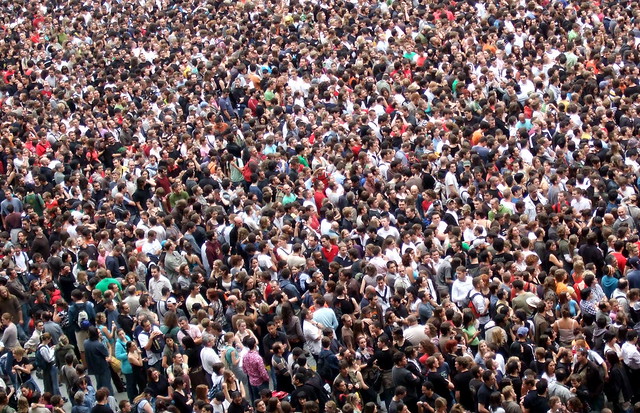
Photo of a large crowd of people, with no space in between.
Photo by James Cridland, Flickr CC

For most of human history, the world population has been much smaller than it currently is — the population has grown substantially only in the last two centuries, as technological and medicinal advances increased life expectancy. Social scientists now say that this growth will end within this century, according to a recent article in The Atlantic. By 2100, when the world population will be approximately 11 billion, growth rates and death rates will be relatively equal; while the population will continue to grow in some parts of the world, other regions will bear aging, smaller populations. Thus, though the numbers seem to equalize, human demographics could look quite different than they do now. Based on these population considerations, the 2100 world could witness many social, political, and cultural shifts, both on a local as well as a global level.

To begin, shifting populations could shape family structures and cultural production.

  • Traditional family structures may change in places where most people currently have large, extended families. Sociologist Parfait Eloundou-Enyegue explains that some of these places will experience smaller fertility rates, leading to smaller families. This could change traditional family structures in some countries as large, extended families give way to smaller, nuclear families. The family reunion may be less lively, but it’s not all bad; as families get smaller, parents can invest more time and resources into their children, whether it’s being able to afford better schools or giving the kids their own room.
  • Art, music, theater, and other forms of culture are often clustered around larger, urban environments with youthful populations. As demographics change and certain parts of the world become relatively younger than others, we could see a shift in dominant produces or culture and entertainment. For example, marketing and producing sports has already changed as certain parts of the world have grown while others have shrunk. For several parts of the world that have been often overlooked in global culture and entertainment, this could be their big break; break a leg!

At the same time, the population plateau of 2100 could spark tensions and challenges, particularly for economics, political interests, and social policy. 

  • The world population will be collectively older than it is now, and a much larger proportion of people will be of retirement age. This could cause political and policy shifts in many countries, particularly those with social spending programs that support the retired and elderly. Often, these are paid for by the employed persons in the labor force, a group that will be comparatively younger and smaller in the future; this will likely cause shifts in how social services operate and receive funding. Furthermore, since such programs are often key political issues, changing populations could spark shifts in the political arena based on different interests and agendas across age groups. 
  • By 2100, the global environment and climate could look much different than it does now, and the population is estimated to plateau just below 11 billion people. Climate change affects different parts of the world in a variety of ways. Across the world, some populations will shrink and age in comparison to others. Thus, different countries’ social and political responses to environmental issues will likely reflect considerations of their different population needs. 

Of course, these population predictions are just predictions, but they are informed by complex tools and methods in demography; such analyses are built on hard data regarding the world population and trends in fertility and birth. Thus, even if there are some fluctuations in the numbers, the general trend towards an aging population in some regions and a younger population in others will remain. Overall, this could lead to many social, cultural, and political changes.

The world may stop growing, but the population plateau could still cause many shifts and shake-ups; change really is the only constant.

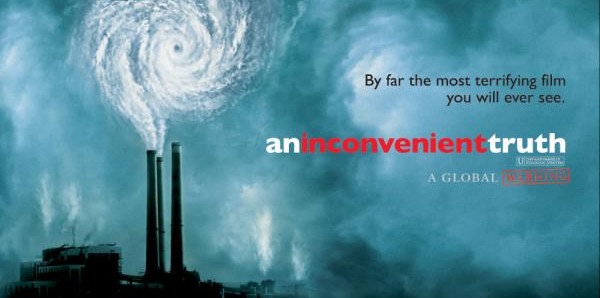
The poster for "global warning" film "An Inconvenient Truth."
The poster for “global warning” film “An Inconvenient Truth.”

Beliefs about climate change are not so much about social demographics, but about what else you believe in–your values, worldviews, and political affiliations. The Washington Post recently featured a new analysis reviewing all existing literature on climate change beliefs. They found that people who vote for more liberal political parties are more likely to believe in climate change. In addition, those who are more concerned with the environment–measured by something called the New Ecological Paradigm (NEP)–were also more likely to believe in global warming. Finally, the trustworthiness of scientists was also a strong predictor in individuals’ beliefs in climate change.

Beliefs, though, do not always translate into action. The researchers found that even those who believe in climate change sometimes do not support policies to remedy it. This occurs more as the policies asked about get more specific. According to sociologist Aaron McCright, this disconnect may simply reflect how people feels about those policies regardless of how they help the environment. He says, “even people who are pretty environmental don’t like taxes still.”

So how do these findings help fight climate change? Sociologist Riley Dunlap suggests that since it may not be possible to change people’s minds, activists should focus their resources on mobilizing voter support for politicians who recognize the importance of climate change. Additionally, McCright suggests that conservative leaders who believe in climate change should be more outspoken about their positions. Psychology professor Matthew Hornsey add that the key, to his mind, is making messages about climate change fit with the worldviews of people who generally do not support climate change. Painting environmentalism as patriotic, for instance, may spur support for mitigation policies.

15121150847_8c49b89d8d_o
Climate Change has reached scientific consensus, so why and how do people still deny it? Photo via Takver, Flickr CC.

Even with nearly a hundred percent consensus within the scientific community, the notion that humans are not causing climate change is still widespread amongst the public. A new study in Nature Climate Change by sociologist Justin Farrell of Yale University aimed to find out how climate doubt is manufactured, and was covered in The Washington Post.

Farrell, the sole author of the study, is quoted at length about his findings. Unsurprisingly, his motivation for research was grounded in a genuine curiosity as to how there is such an extraordinary gap between scientific and public consensus:

“I’ve personally been interested in understanding how a social movement can spread such uncertainty and doubt in the general public on an issue that has achieved near scientific consensus.”

What he found is that the organizations that promote these contrarian views are connected in a network. Those organizations that are central to the network, received funding from larger corporate interests, in this case either ExxonMobil or the Koch Brothers. Farrell isn’t anti-corporate funding, but he is pro-transparency.

“Of course, the solution is not to forbid corporate funding of this or that issue, but to start by providing better access to who is funding who, so that folks are not kept in the dark, making it hard to know who to trust, if anybody.”

“I hope people read these findings in the light of the bigger picture, and not just ExxonMobil or Koch, but more broadly these two entities are simply a very strong indicator of the larger types of financial interests that are behind the movement,” he said.

In addition to Farrell, the article quotes Robert Brulle, professor of sociology and environmental science at Drexel University, who served as a reviewer for the study. Brulle had interesting advice for how climate change activists can shift the narrative and persuade public opinion:

“When you look at comparative strategies, the climate science community or the climate advocacy community does not have as much of a media-centered focus as does the conservative movement,” Brulle said. “I think that that’s what this paper starts to push on. You have to move more toward a media-centered influence—the influencers’ strategy—rather than trying to convert individual by individual.”

Read the full article by Chelsea Harvey here, and learn more about sociological studies of how echo chambers work to limit the amount of climate change science that enters political debates with this article in the Fall 2015 issue of Contexts, the public outreach journal of the American Sociological Society.

Photo by Howard Ignatius via Flickr.
Sociologists find that beliefs about global warming predict people’s temperature perceptions. Photo by Howard Ignatius via Flickr.

Winter is in full swing up here in Minneapolis, and with it comes the traditional chorus that “it isn’t that bad” just yet. However, new research shows complaining about the weather—the archetype of casual chatting—may be more than just small talk. The Washington Post reports on new research from Aaron McCrightRiley Dunlap, and Chenyang Xiao which finds a significant relationship between political affiliation and perceptions about the weather. From the article:

The paper…examined people’s perceptions of the winter of 2012, which was anomalously warm. Comparing Gallup polling results from early March 2012 (just after the winter ended) with actual temperature data…“The researchers found that ‘Democrats [were] more likely than Republicans to perceive local winter temperatures as warmer than usual”…beliefs about global warming also predicted temperature perceptions.

It may have been one of the warmest years on record, but this work shows that partisanship affected who actually felt warmer than usual. We’ve known about socialization for a long time— many researchers study how social groups teach people to act in certain ways—but this study is especially interesting because it shows how deeply political socialization can effect individuals. Later in the article Dunlap argues that “people have begun to filter their fundamental perceptions of what is going on…through a partisan frame.” Contrary to expectations, this also means firsthand experiences with extreme weather as the planet warms may not be enough to inspire widespread change for environmental protection. Looks like we’ll need more than small talk.

Photo by Nicolas Raymond via flickr.com

Is economic development compatible with environmental sustainability? Are “green jobs” the way of the future? Those questions are at the center of sociologist Andrew Jorgenson‘s research on the economic activity and carbon emissions of 106 countries.

Analyzing data from 1970 to 2009, Jorgenson calculated a ratio of carbon emissions to life expectancy at birth, and then compared it with each country’s gross domestic product. The results are not encouraging. Jorgenson found that in all regions of the world except for Africa, development is linked with an increase in carbon emissions. Africa may be the exception that proves the rule. Jorgenson noted that, since 1995, African nations have experienced much more carbon-intensive development in exchange for increasing life expectancies of their populations.

Achieving the three-legged stool of economic growth, reduced harm to the environment, and improved human health will not be easy, and Jorgenson is skeptical that technological advancements alone are likely to accomplish the task. “We need to start seriously thinking differently about solutions to these sustainability challenges and recognizing that hoping for technology and engineering solutions … is probably not the way to go,” Jorgenson said.

Picture 2